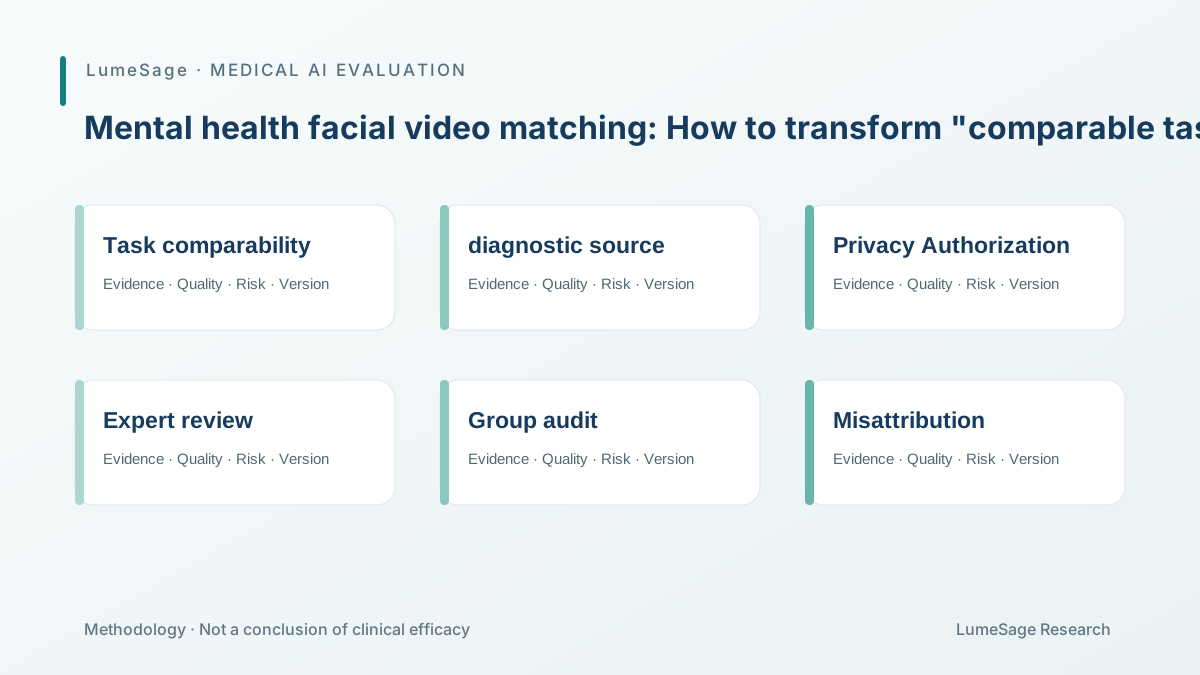
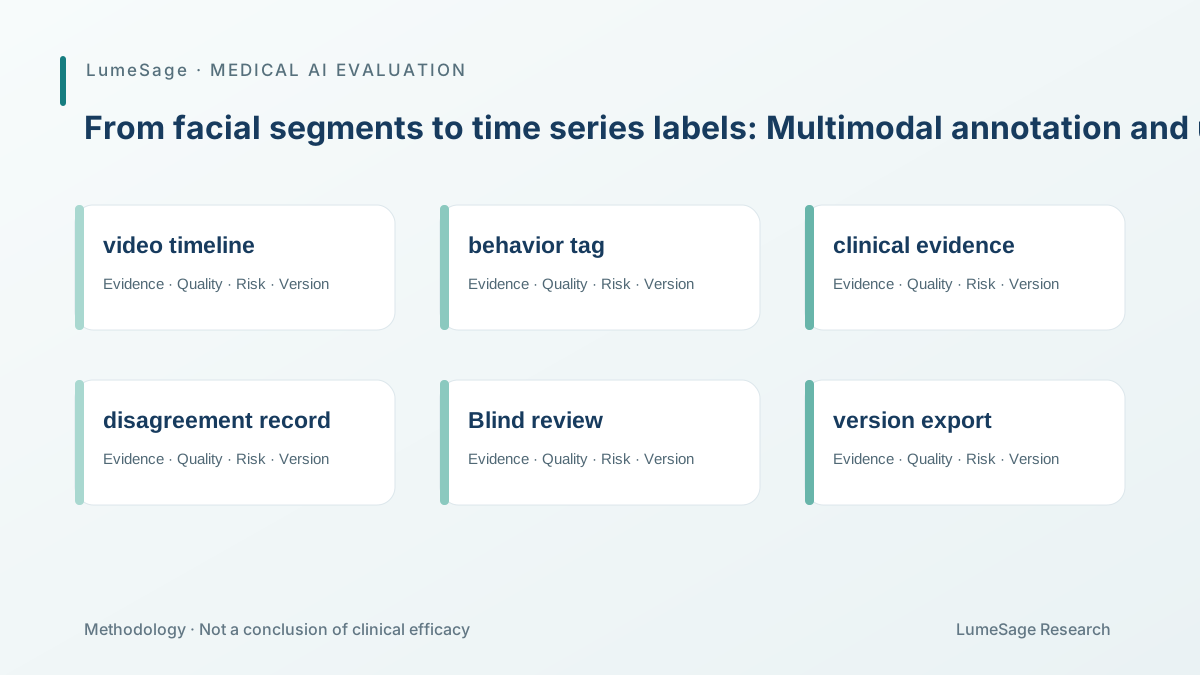
From facial segments to time series labels: Multimodal annotation and uncertainty for mental and psychological videos
What do you think of
Emotions and expressions will change as the task progresses, and frame-by-frame labels cannot replace clinical constructs; labeling design must distinguish between observable behaviors, subject narratives, and clinical judgments.
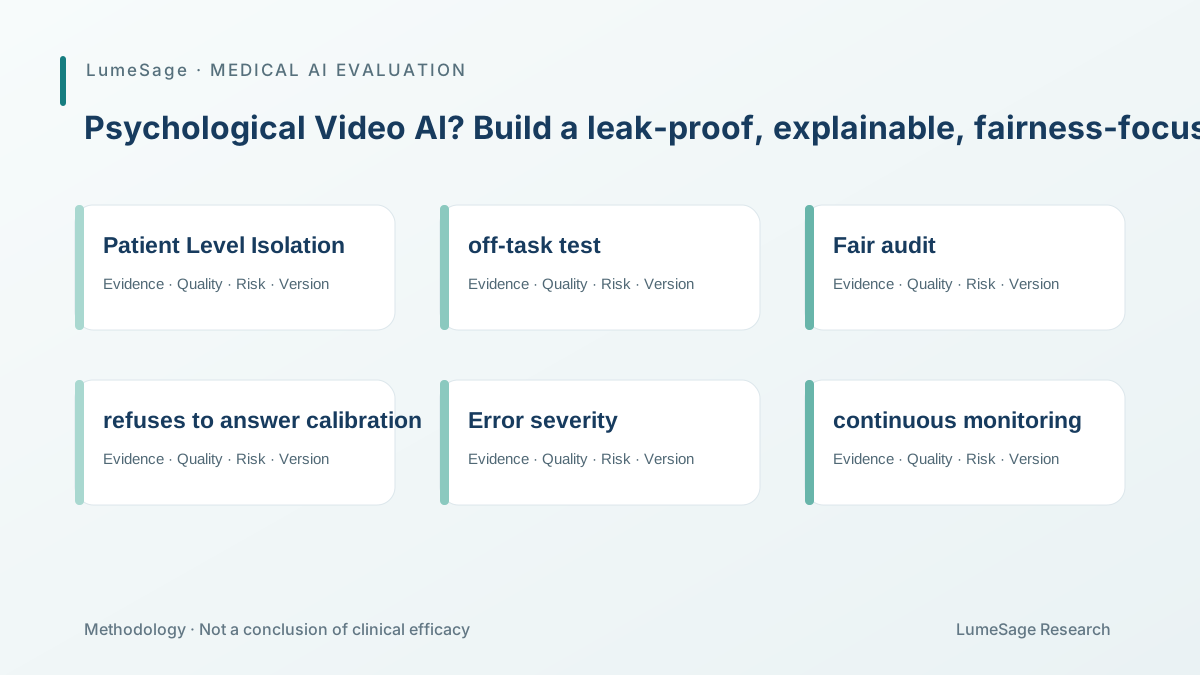
Psychological Video AI? Build a leak-proof, explainable, fairness-focused benchmark
video models may come from background, language, device, site, or identity clues; trusted reviews must set up patient-level isolation, external sites, and error analysis.
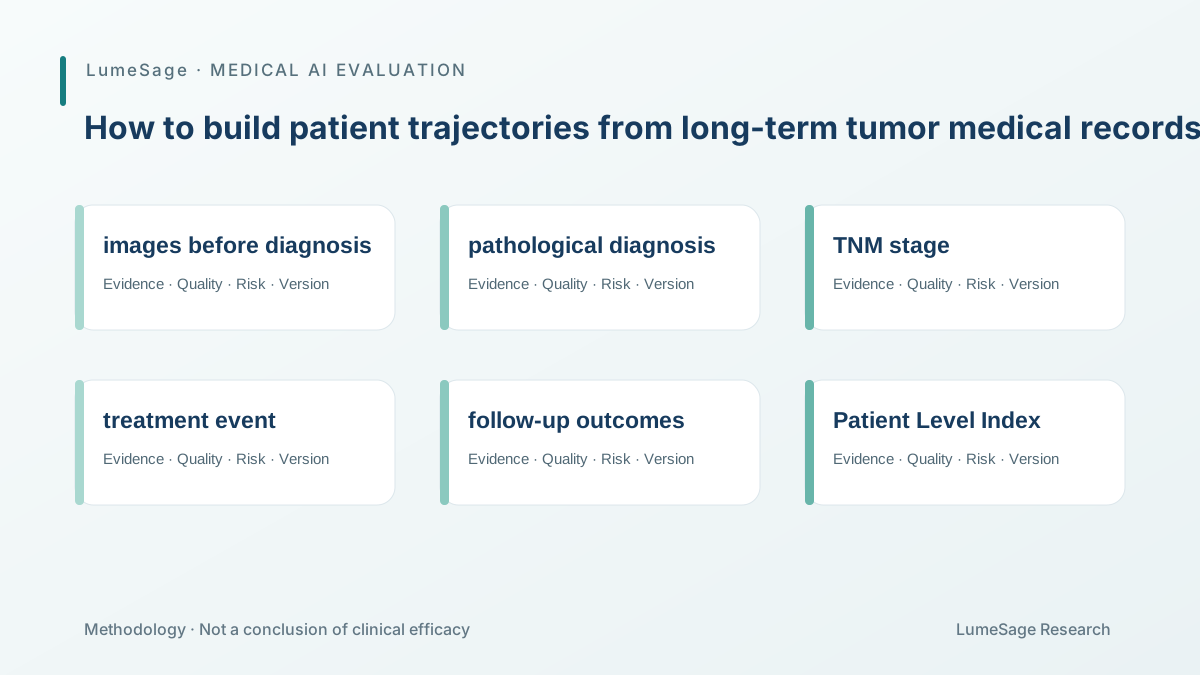
How to build patient trajectories from long-term tumor medical records: from pre-diagnosis images to treatment outcomes
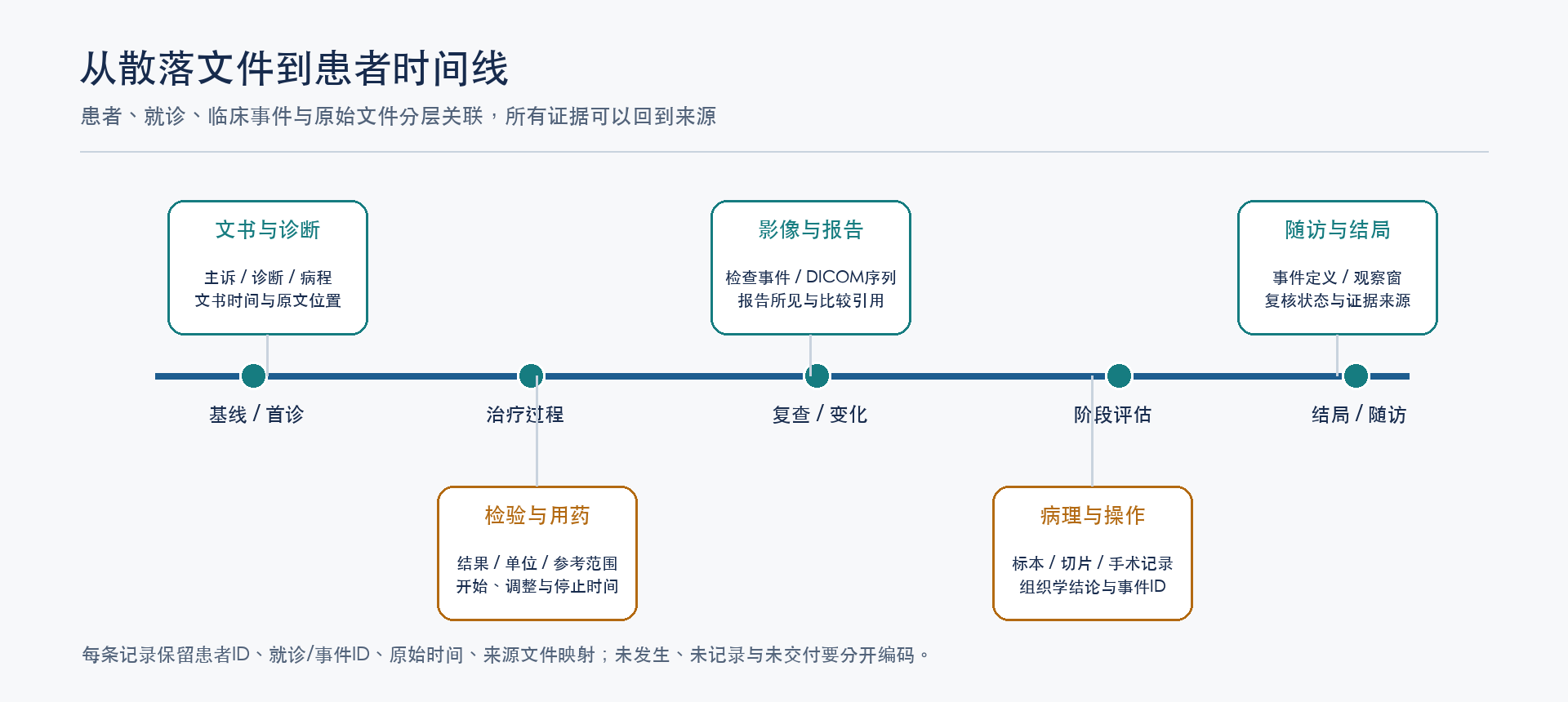
The value of longitudinal tumor data lies in putting pre-diagnosis clues, pathological diagnosis, staging, treatment and follow-up back into the timeline, rather than stacking modal files in the same directory.
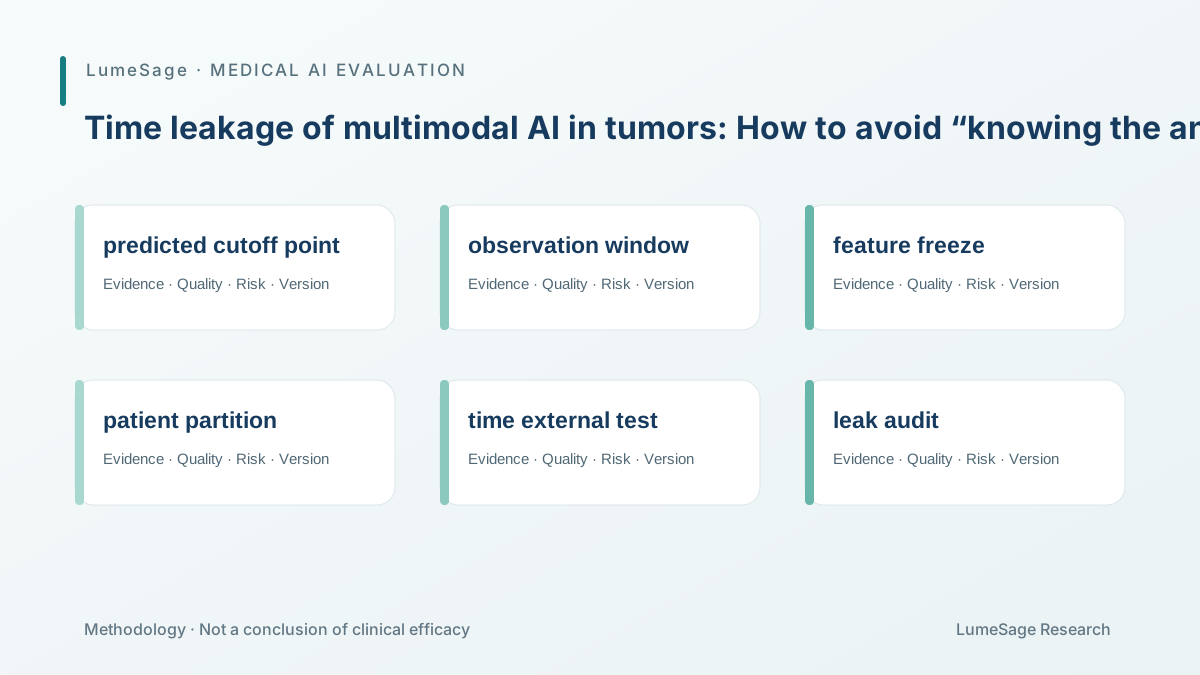
Time leakage of multimodal AI in tumors: How the training set avoids “knowing the answer in advance”
The time relationship between imaging, pathology, treatment and follow-up determines whether the model is predicting or looking back at the outcome; the feature cutoff point must precede the target event.
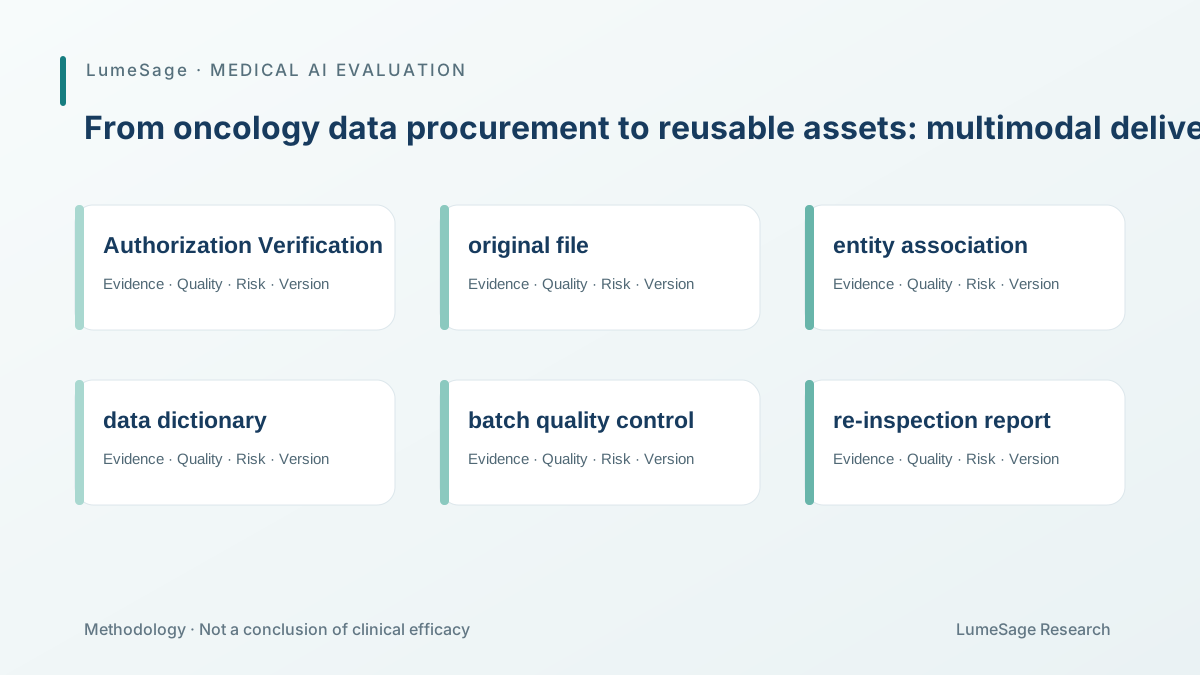
From oncology data procurement to reusable assets: multimodal delivery acceptance and continuous evaluation
Large-scale data delivery can only support multi-tasking research and repurchase when files, fields, patients, exams, specimens and authorizations form a traceability chain.
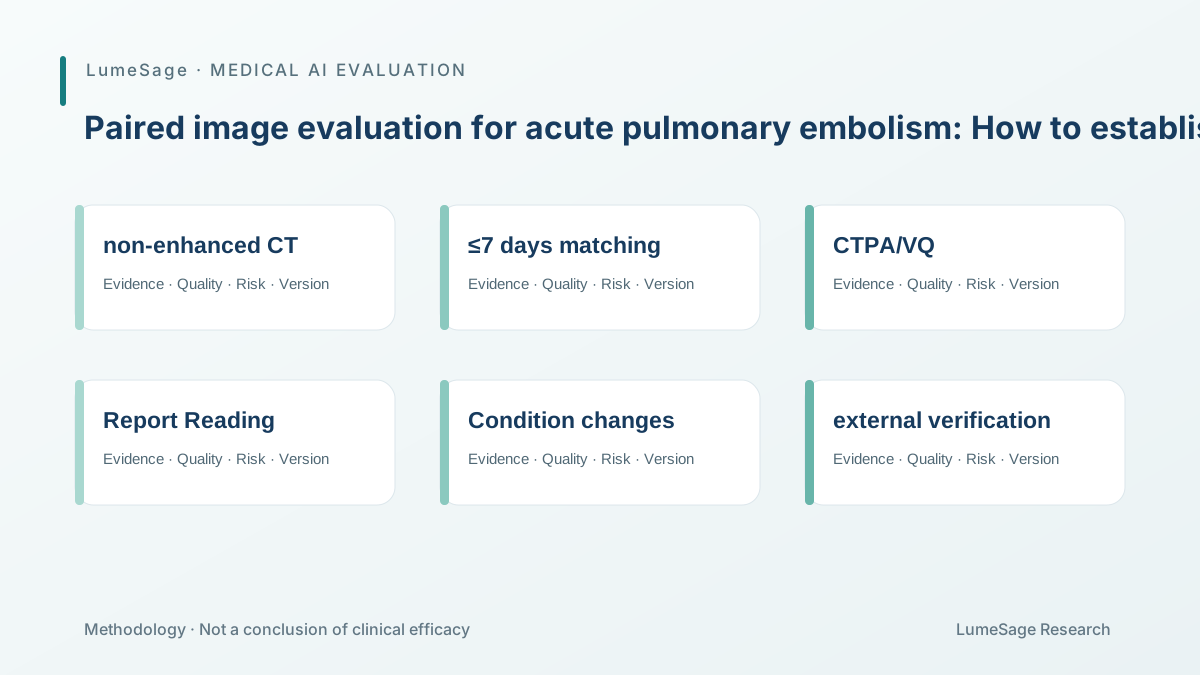
Paired image evaluation for acute pulmonary embolism: How to establish a reliable reference between non-enhanced CT and CTPA
Pairing of non-enhanced chest CT with CTPA/SPECT V/Q at the same patient at a recent time point can study whether the model can identify clues from limited images; the pairing design must account for changes in time and clinical status.
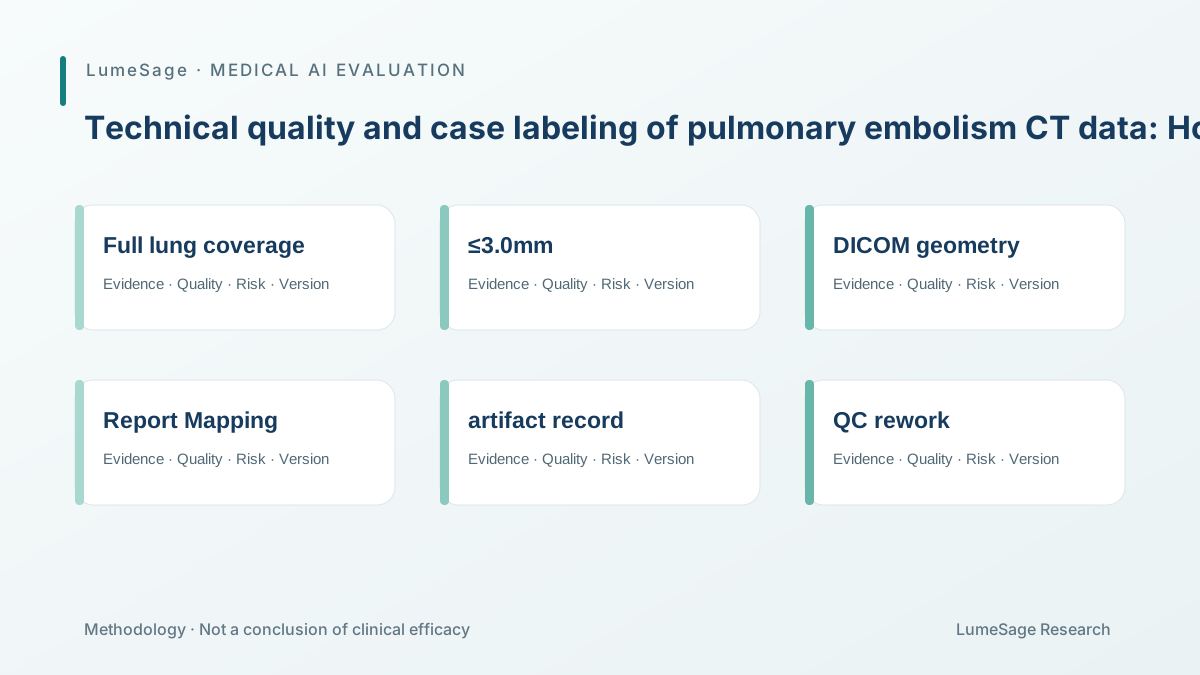
Technical quality and case labeling of pulmonary embolism CT data: How to make DICOM computable and auditable
Small branches of pulmonary vessels and scan reconstruction differences directly affect visibility; data quality specifications should simultaneously manage full lung coverage, thin slices, reporting semantics, reference evidence, and exception exclusion.
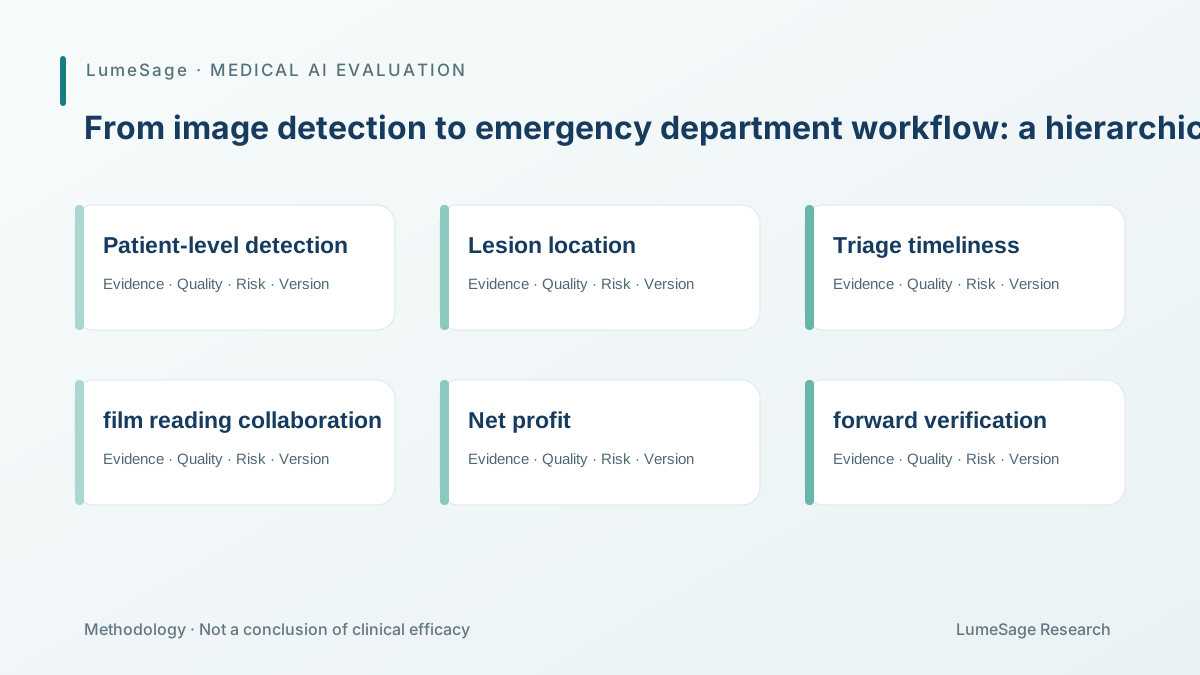
From image detection to emergency department workflow: a hierarchical evaluation framework for pulmonary embolism AI
The clinical value of pulmonary embolism AI needs to simultaneously examine detection, location, triage timeliness, human-machine collaboration and error consequences; a single accuracy rate cannot describe the emergency workflow.
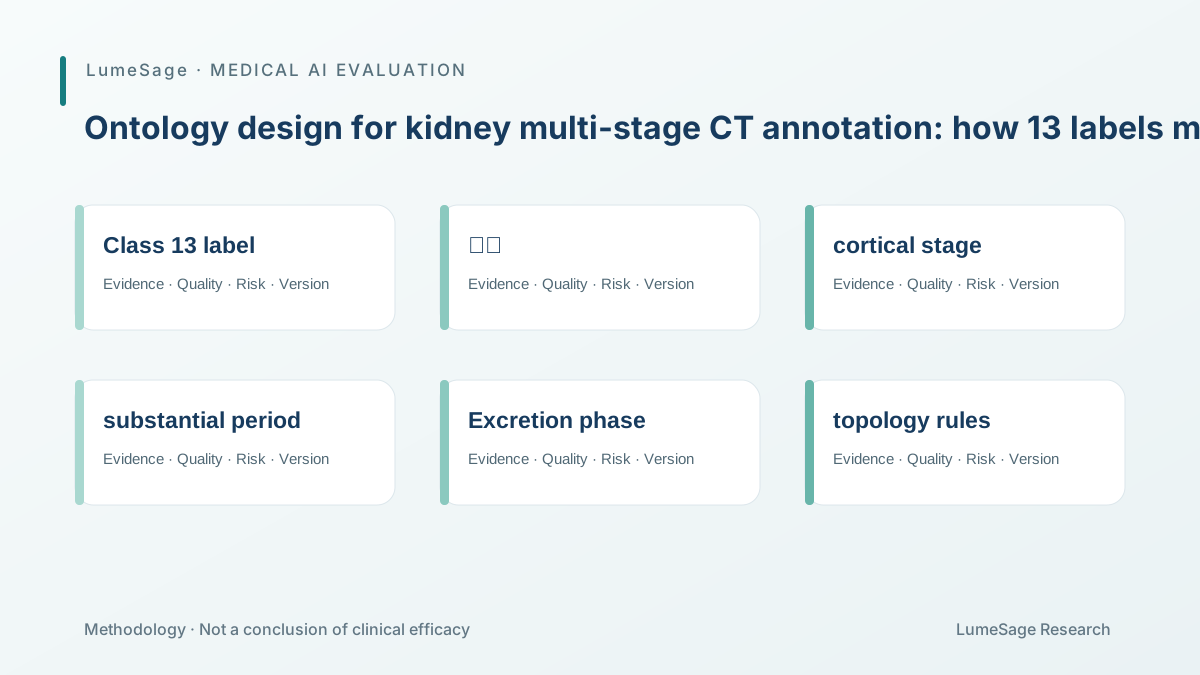
Ontology design for renal multi-stage CT annotation: how 13 labels maintain anatomy and phase semantics
labels are not color numbers, but machine-readable conventions with anatomical boundaries, applicable phases, connectivity rules, and inclusion/exclusion ranges.
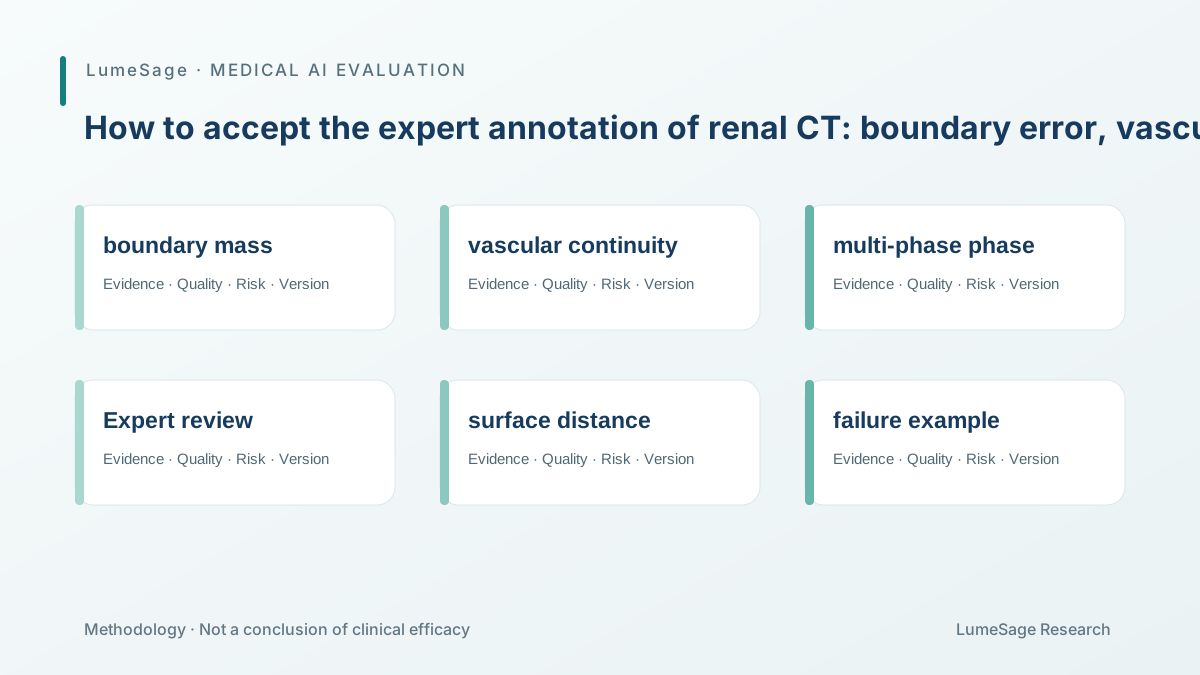
How to accept the expert annotation of kidney CT: boundary error, vascular continuity and multi-phase consistency
In multi-organ segmentation of the kidney, organs with clear boundaries, slender blood vessels, collecting systems, and small lesions require different quality control schemes.
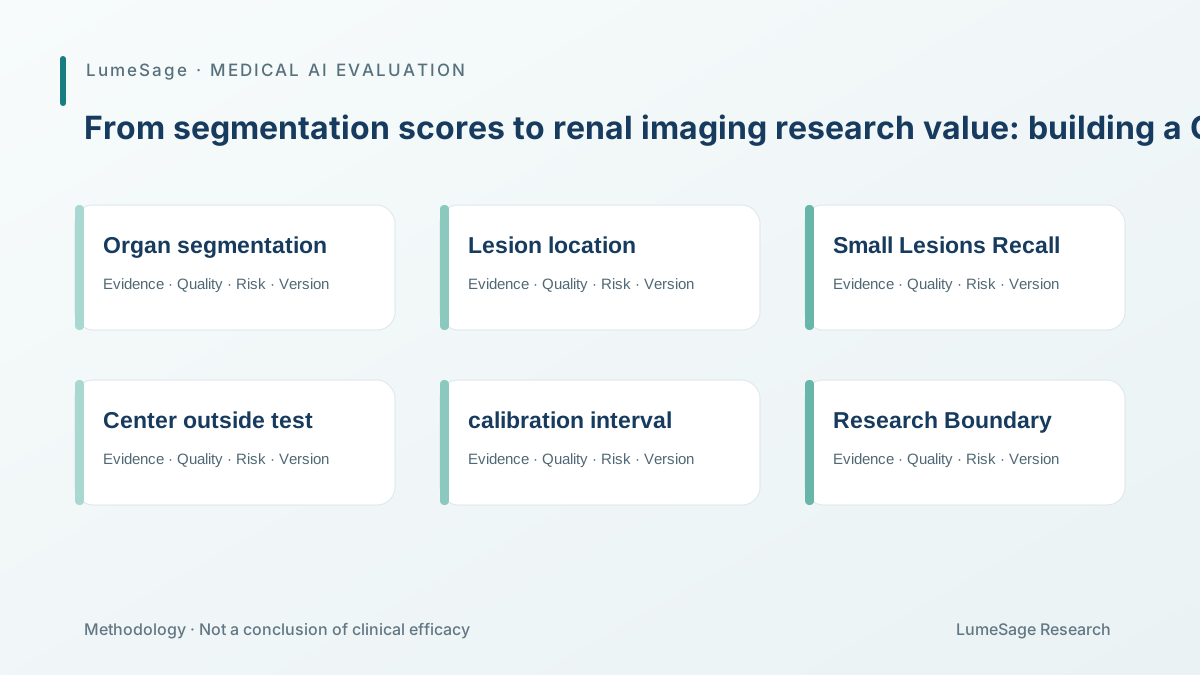
From segmentation scores to renal imaging research value: building a CT benchmark for clinical questions
High-quality organ and lesion labels can support segmentation, quantification, classification and follow-up research, but different goals require different reference standards and evaluation indicators.
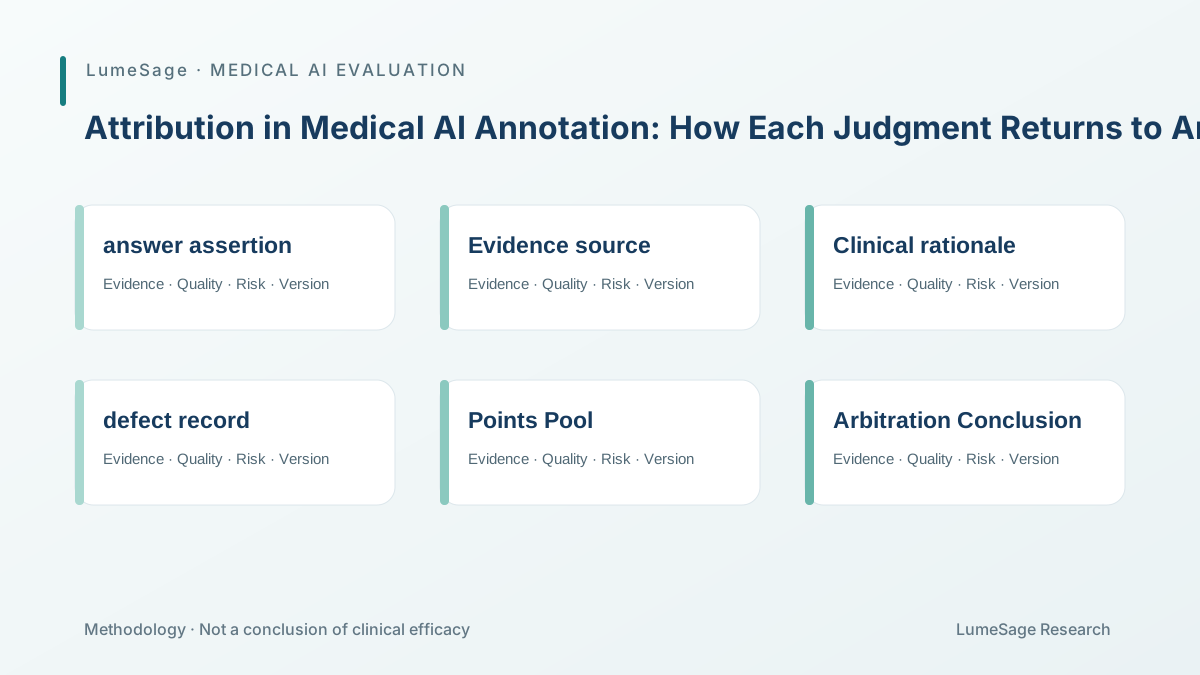
Attribution in Medical AI Annotation: How Each Judgment Returns to Answers, Evidence and Clinical Reasons
The core of attributional annotation is not to like or rate, but to correspond the verifiable assertions in the model answers with the source text, literature and clinical logic one by one.
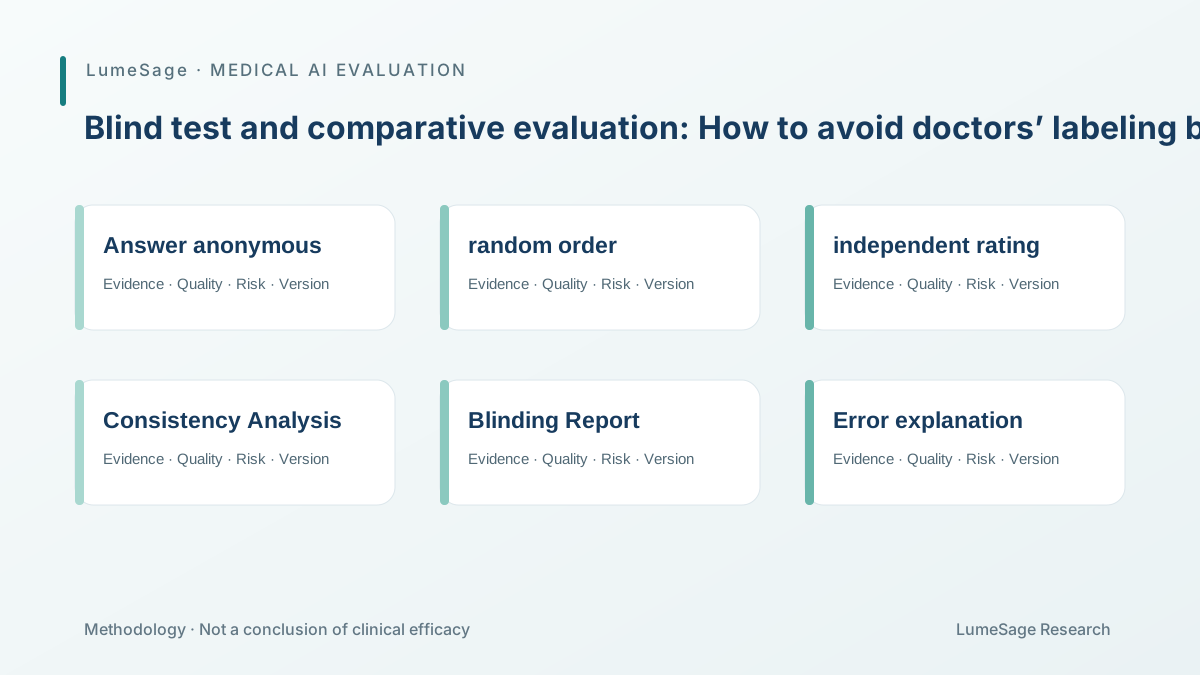
Blind test and comparative evaluation: How to avoid doctors’ labeling being misled by model brand and ordering
Multiple answers to the same question are valuable, but if the annotator knows the identity of the model, the order of answers, or the expected conclusions, systematic bias will occur in the evaluation.
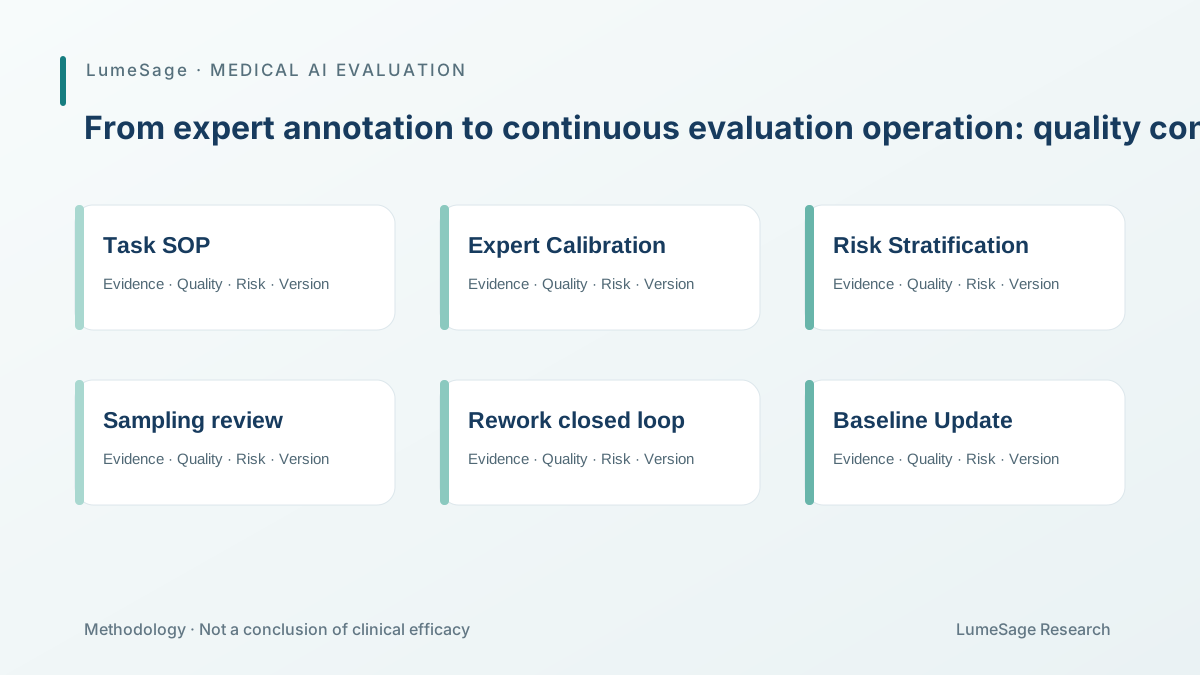
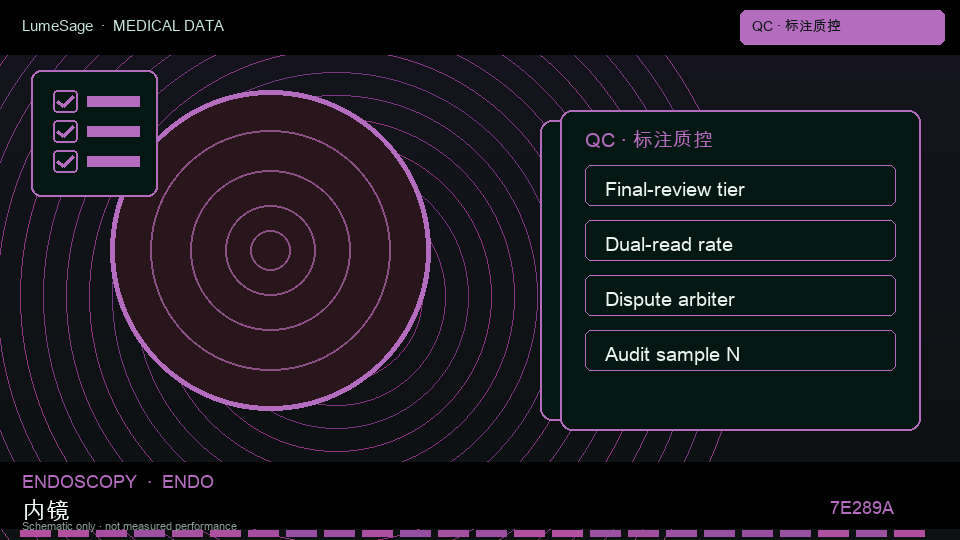
From expert annotation to continuous evaluation operation: quality control, arbitration, rework and version management
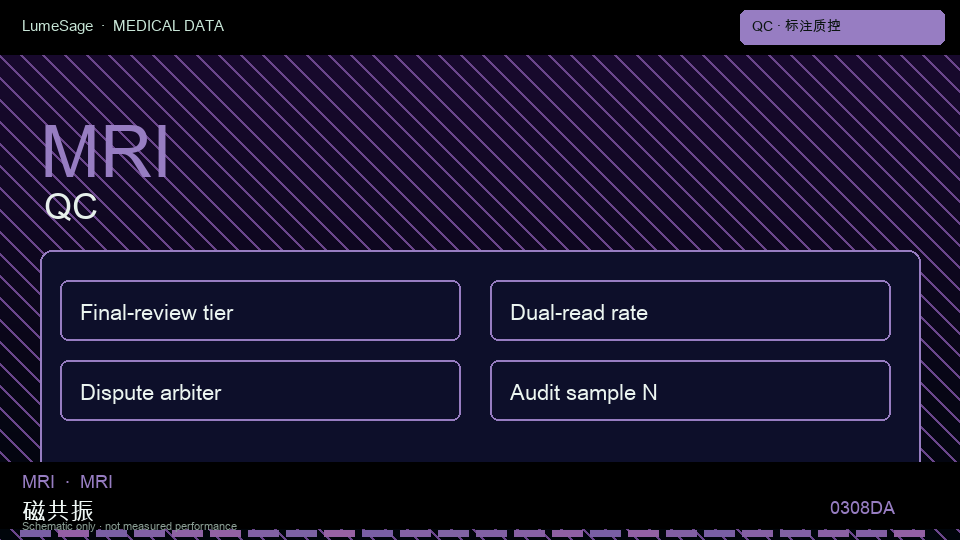
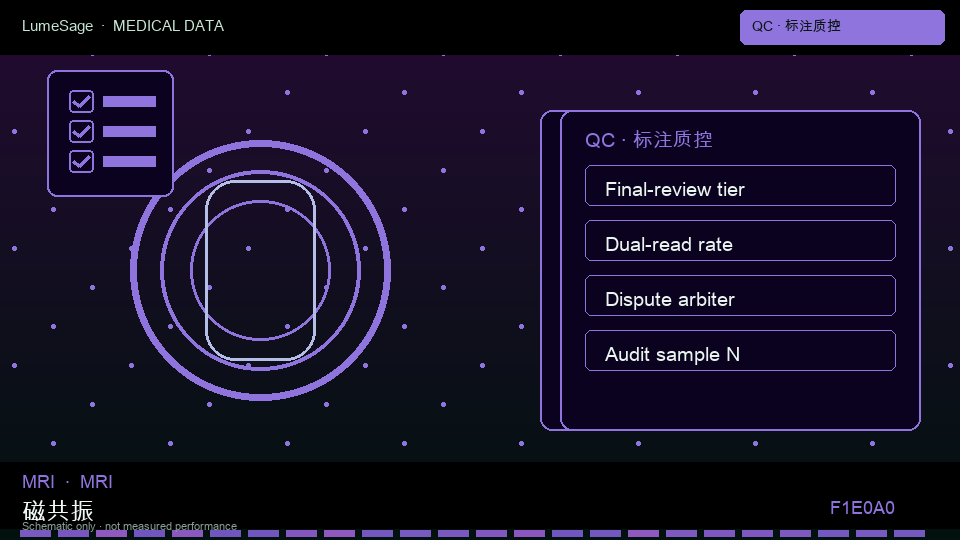
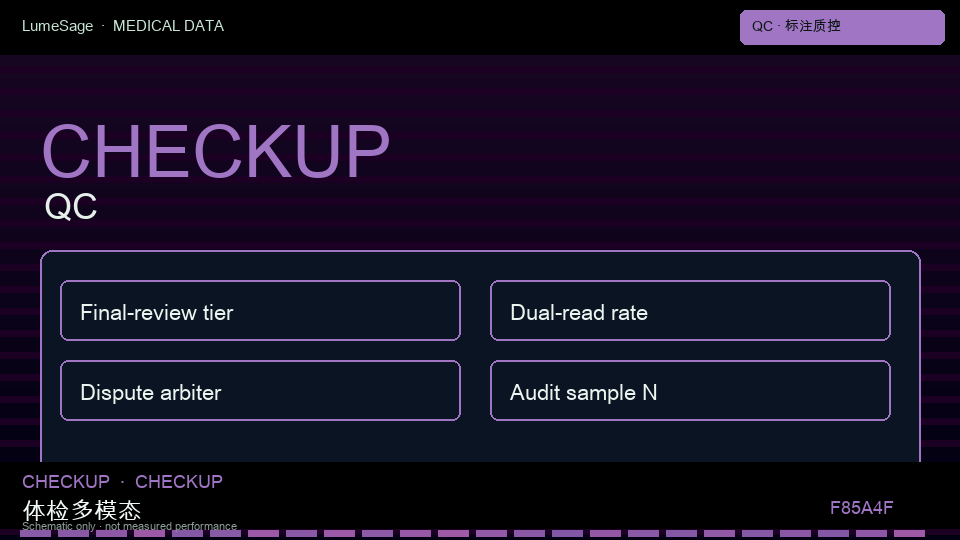
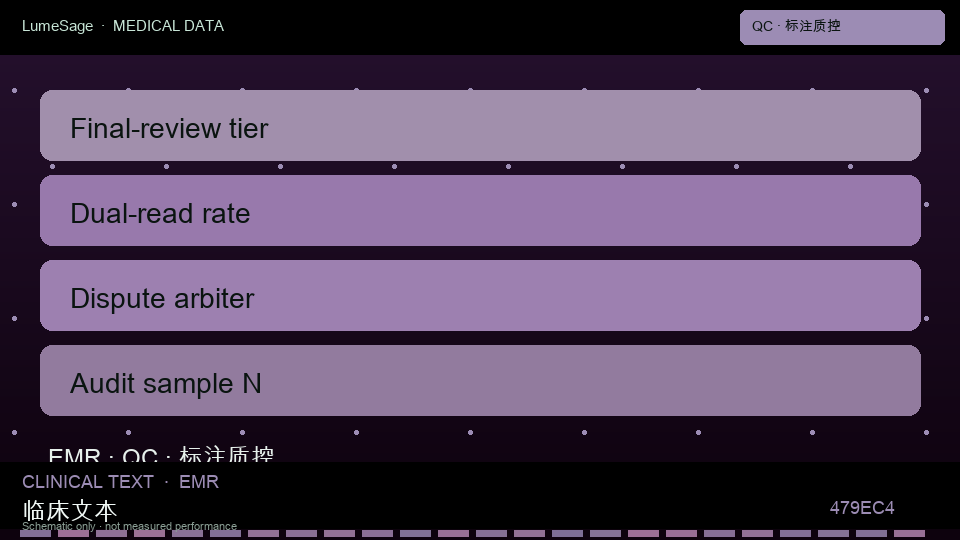
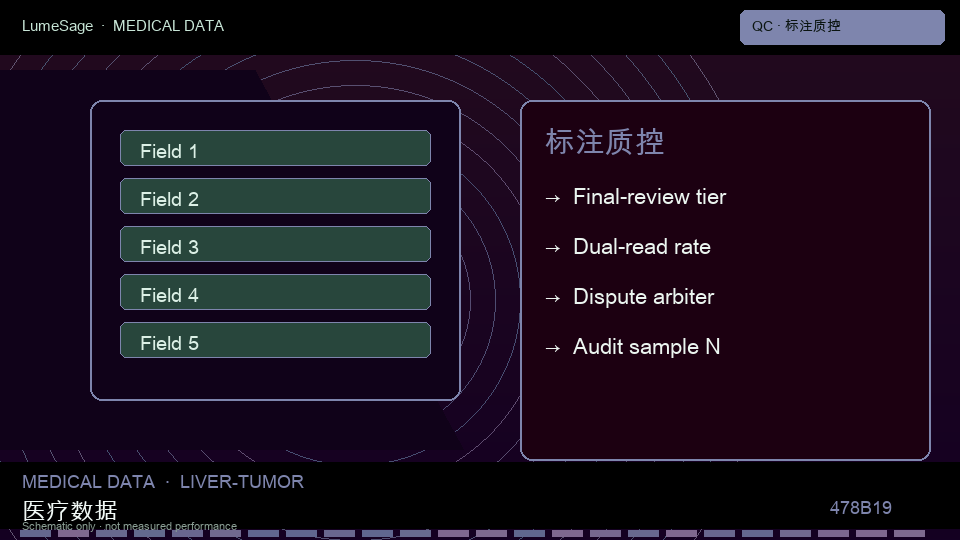
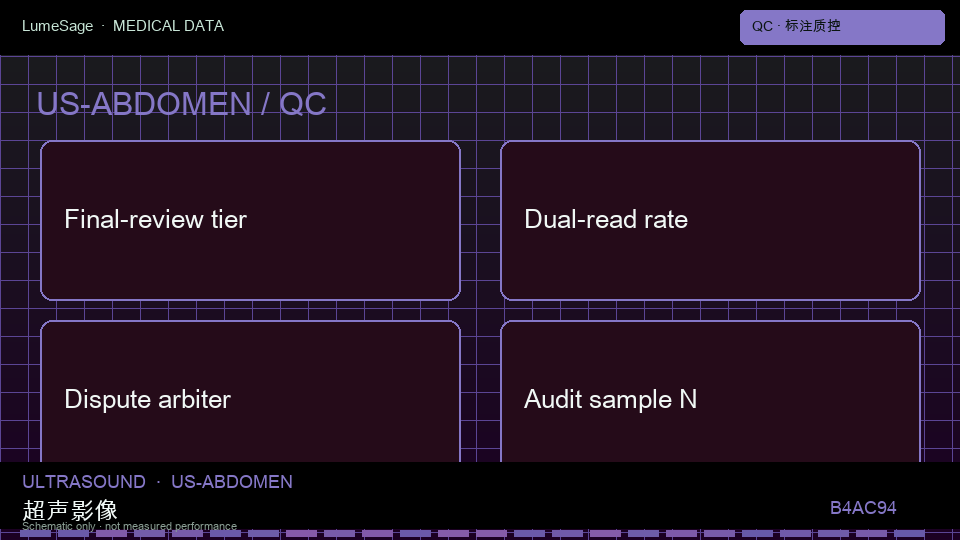
The medical annotation workflow needs to bind manpower arrangements, task definitions, quality thresholds, dispute mechanisms and model versions. Otherwise, scores cannot be reproduced and data iteration is difficult.
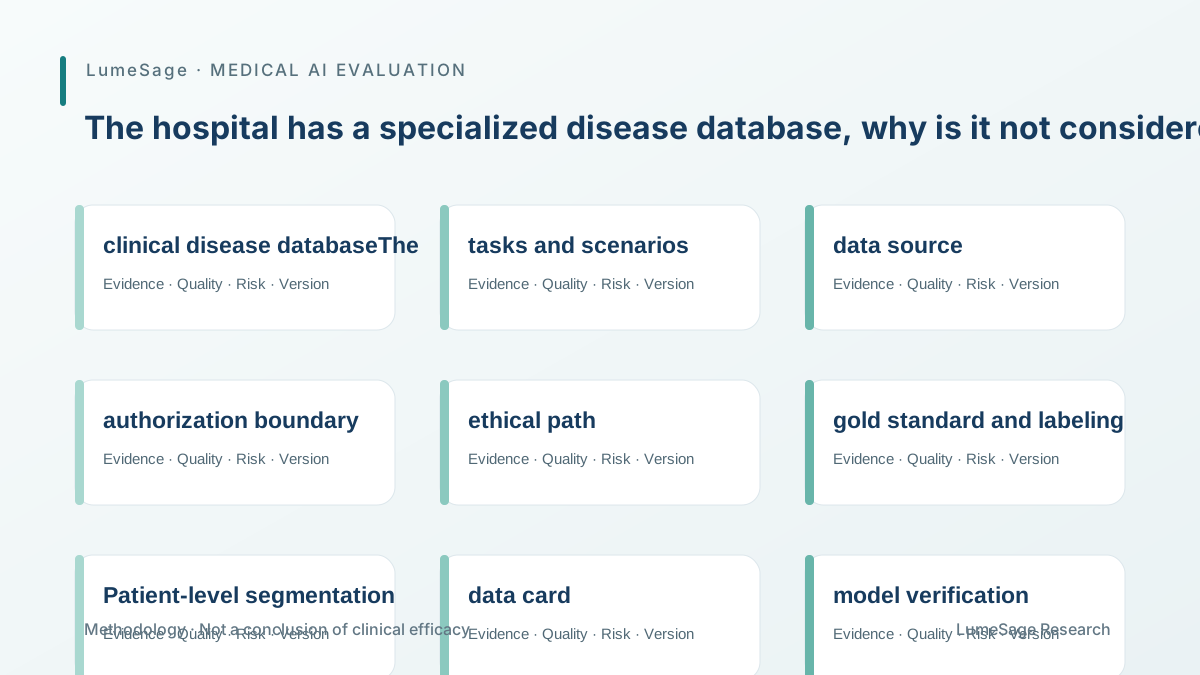
The hospital has a specialized disease database, why is it not considered a high-quality data set? 12 concepts to understand before participating in construction
The disease-specific database is an important clinical resource, but only by connecting purposes, sources, authorization, reference standards, data quality, division and application verification into a reviewable chain can it become a data set for medical AI.
2026-10-29 · Medical AI research · Scientific news
Medical AI Needs a Hard Exam in Scientific Reasoning: Langhui Proposes an HLE-Style Medical Evaluation Framework
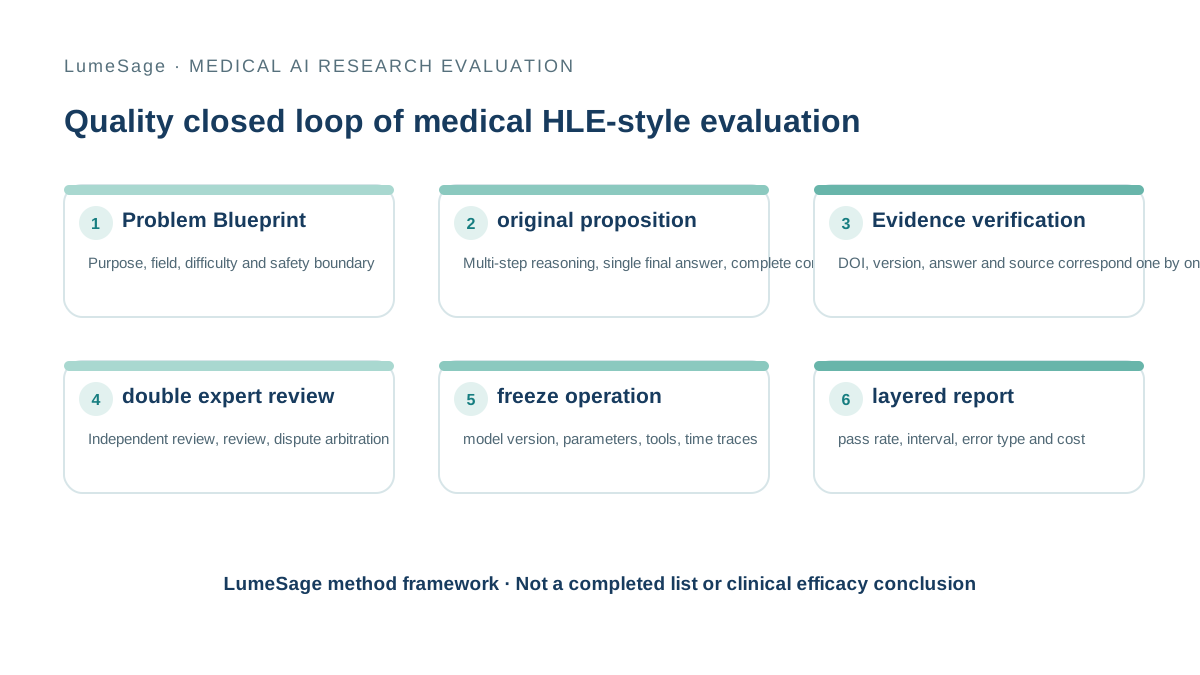
Humanity’s Last Exam (HLE) brings expert-level, closed-ended academic questions to large-scale model competency assessment. Combined with a demand draft containing 1,500 cross-field scientific research reasoning questions, this article proposes an HLE-style evaluation plan for Biology/Medicine: with 500 medical and life science questions as the planning scale, a closed loop is built around original questions, evidence sources, dual expert review, frozen model operation, statistical reports and private set aside. LumeSage can organize medical data governance, expert annotation, quality control and evaluation projects by project; this article is an independent design suggestion and does not represent an official HLE extension, nor does it constitute clinical effectiveness certification.
Can AI Understand Three Checkup Reports Over Time? LumeSage’s Framework for Longitudinal Health Evaluation
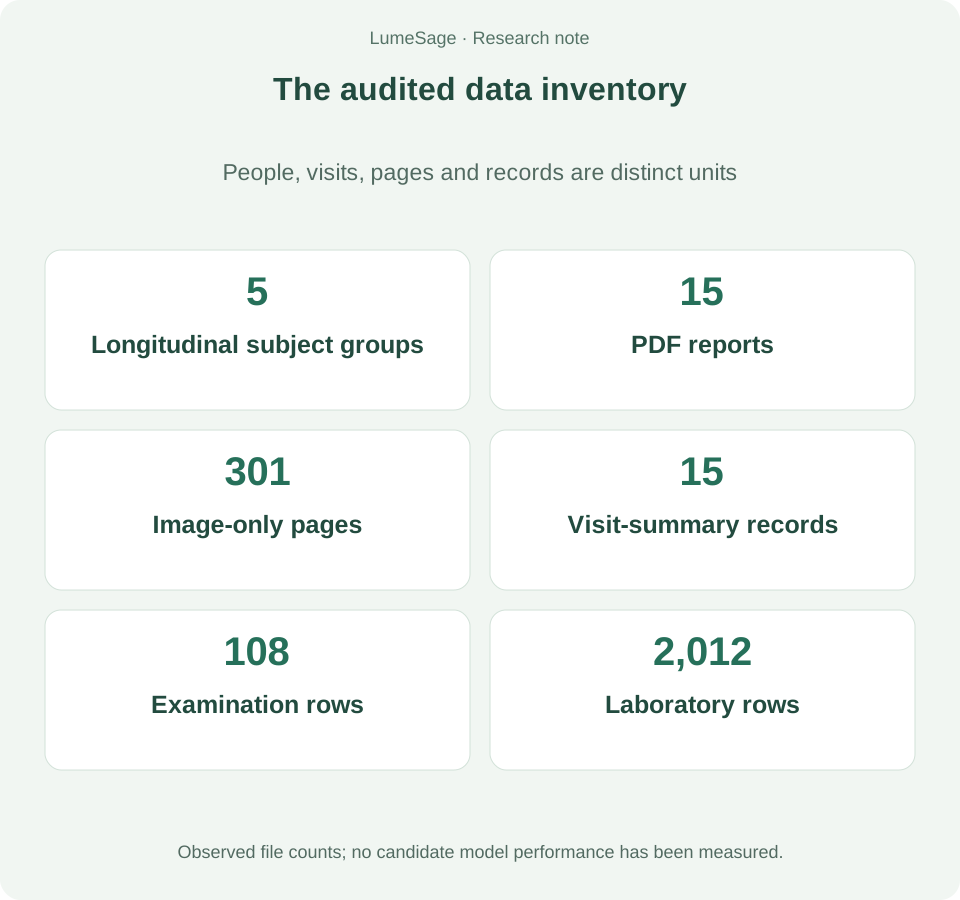
Drawing on five longitudinal checkup histories, 15 PDFs and three structured tables, LumeSage proposes a framework for report comprehension, temporal reasoning, evidence-grounded communication and safety. The study connects a local data audit with HealthBench and recent medical AI research.
Beyond High Scores: A Clinical Workflow, Safety, and Cost Framework for Medical AI Benchmarks
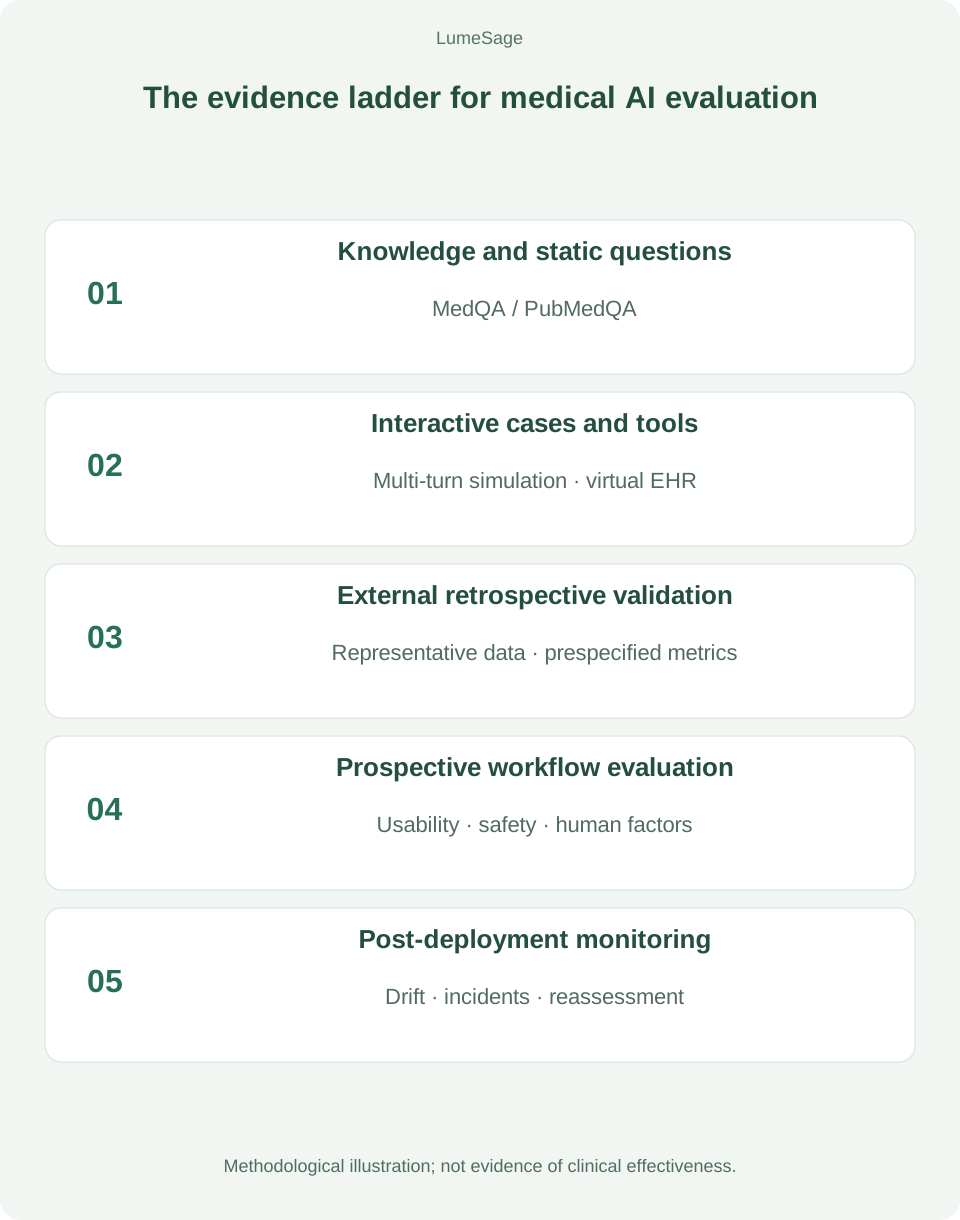
Medical AI benchmarks are moving beyond static medical questions toward multi-turn history taking, test selection, patient safety, human–AI collaboration, and workflow evaluation. Drawing on current research, clinical evaluation guidance, and a proposed agent-benchmark design, this white paper examines scientific validity, methodological risks, feasibility, and business value, then proposes a reproducible framework for building and maintaining medical AI leaderboards.
A Hunan Telecom delegation visits LumeSage to discuss medical data collaboration
The teams discussed medical data collaboration, data annotation, high-quality datasets and data exchange, and explored potential areas for cooperation.
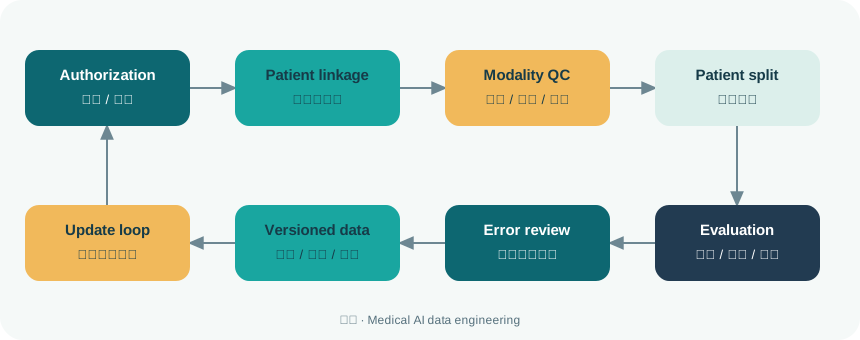
How is medical AI multimodal data organized by patient? From medical record folders to traceable longitudinal data assets
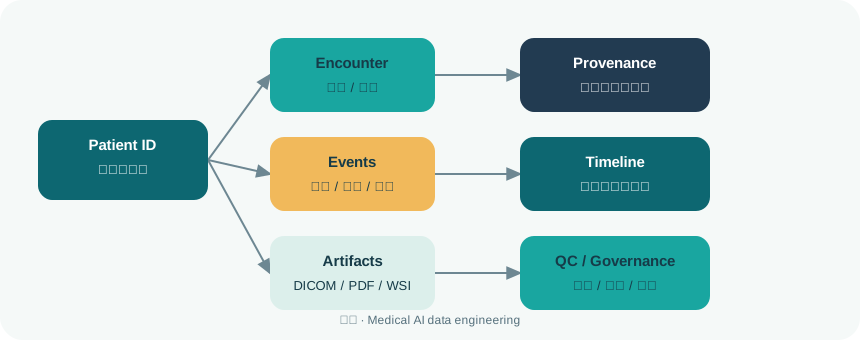
Analysis of medical AI patient-level multi-modal data construction: how to associate structured medical records, searchable PDF, DICOM and pathology, design timeline, data lineage, de-identification and patient-level acceptance.
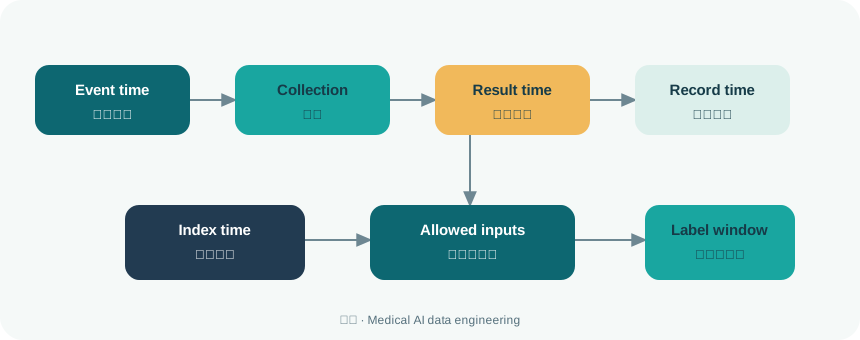
Why does medical AI need to understand time? From test timestamps to longitudinal clinical event maps
provides an in-depth analysis of medical AI time series data engineering, clinical event timestamps, test collection and reporting moments, diagnostic revisions, time leaks, patient-level segmentation and multi-modal longitudinal modeling.
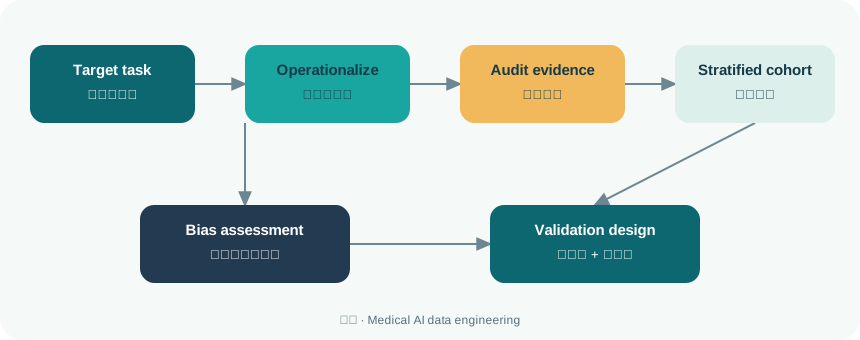
How to select complex medical cases scientifically: an auditable cohort built from diagnostic revisions, consultations and pathology discordance
Analyzes the medical AI complex case cohort construction method: stratified by diagnostic modification, consultation, hospitalization trajectory, ICU, comorbidity and pathology differences, while identifying selection bias, lineage bias and label noise.
From DICOM to pathology slides: How medical multi-modal AI establishes a verifiable data and evaluation closed loop
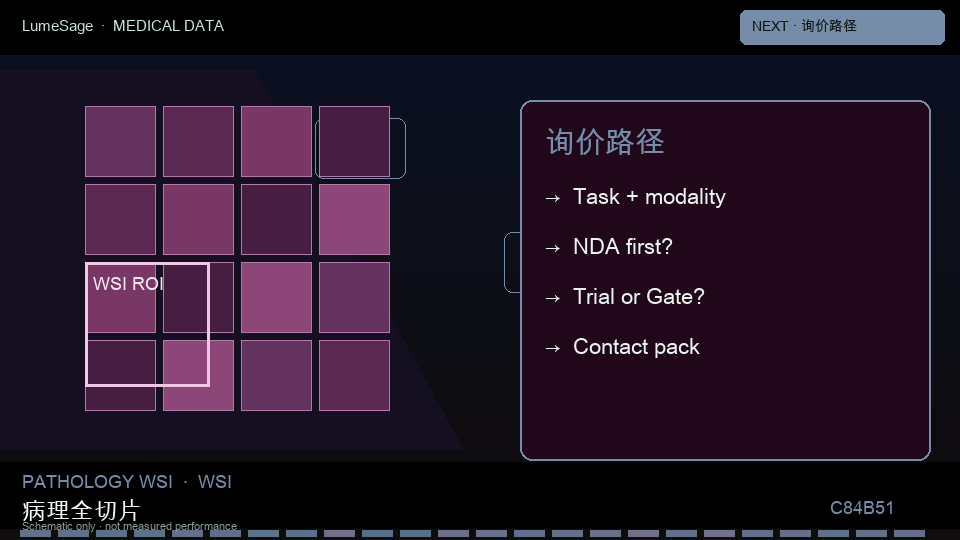
analyzes DICOM and pathological multi-modal modeling for medical AI engineers: sequence integrity, WSI multi-scale representation, image-text pairing, weak supervision, patient-level isolation, external verification and calibration.
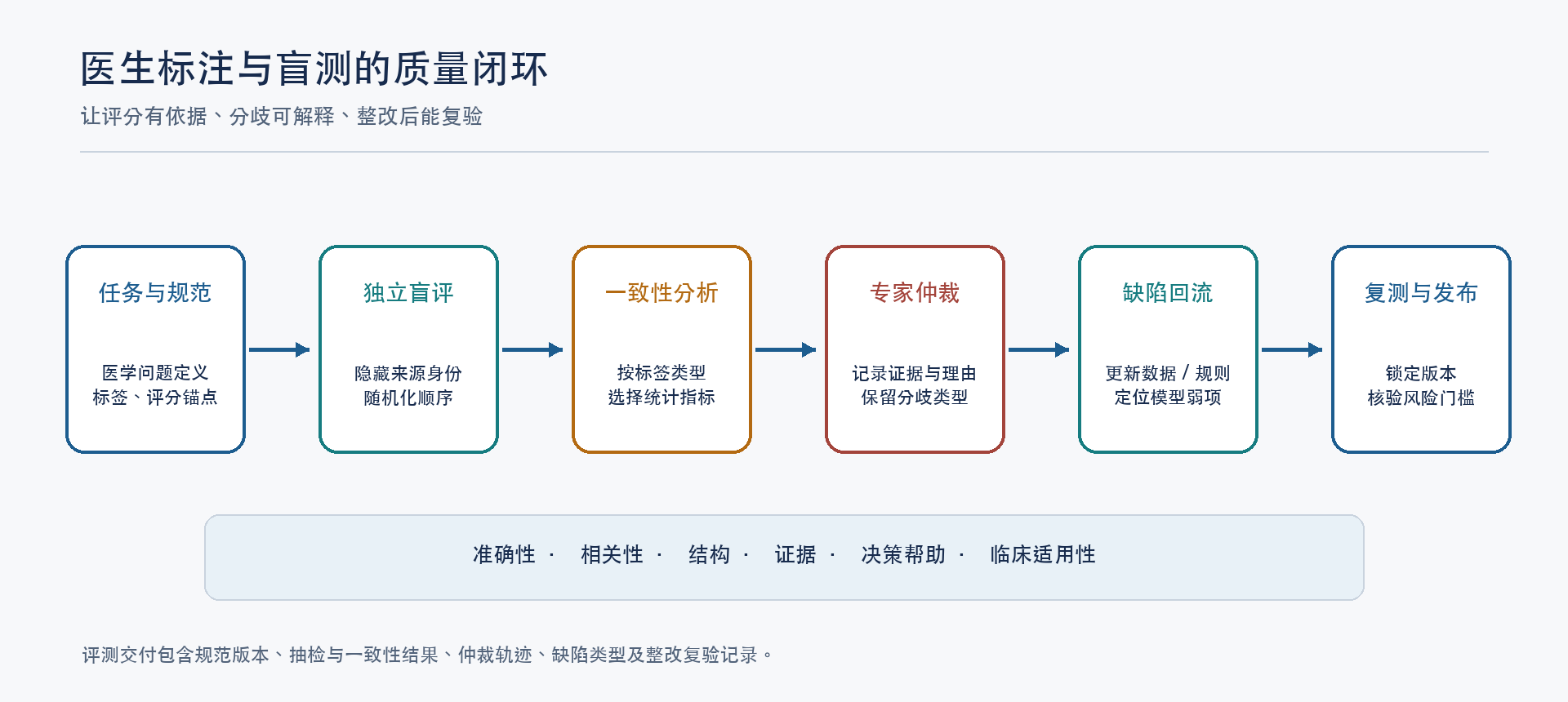
How can medical AI labeling be reviewable, blindly tested, and iterable?
Medical AI annotation requires task definition, physician review matching, blind comparison, independent double standards, disagreement arbitration and statistical planning. This article explains how to turn medical judgment into a quality closed loop that is explainable, reviewable, and capable of continuous improvement.
How to build a computable patient trajectory from long-term multi-modal medical records
Long-series multimodal medical data sets should connect patients, visits, events, documents, tests, medications, images, and outcomes to a computable timeline. This article discusses patient-level correlation, clinical temporal semantics, cross-modal indexing, DICOM de-identification, and evaluation methods to prevent data leakage.
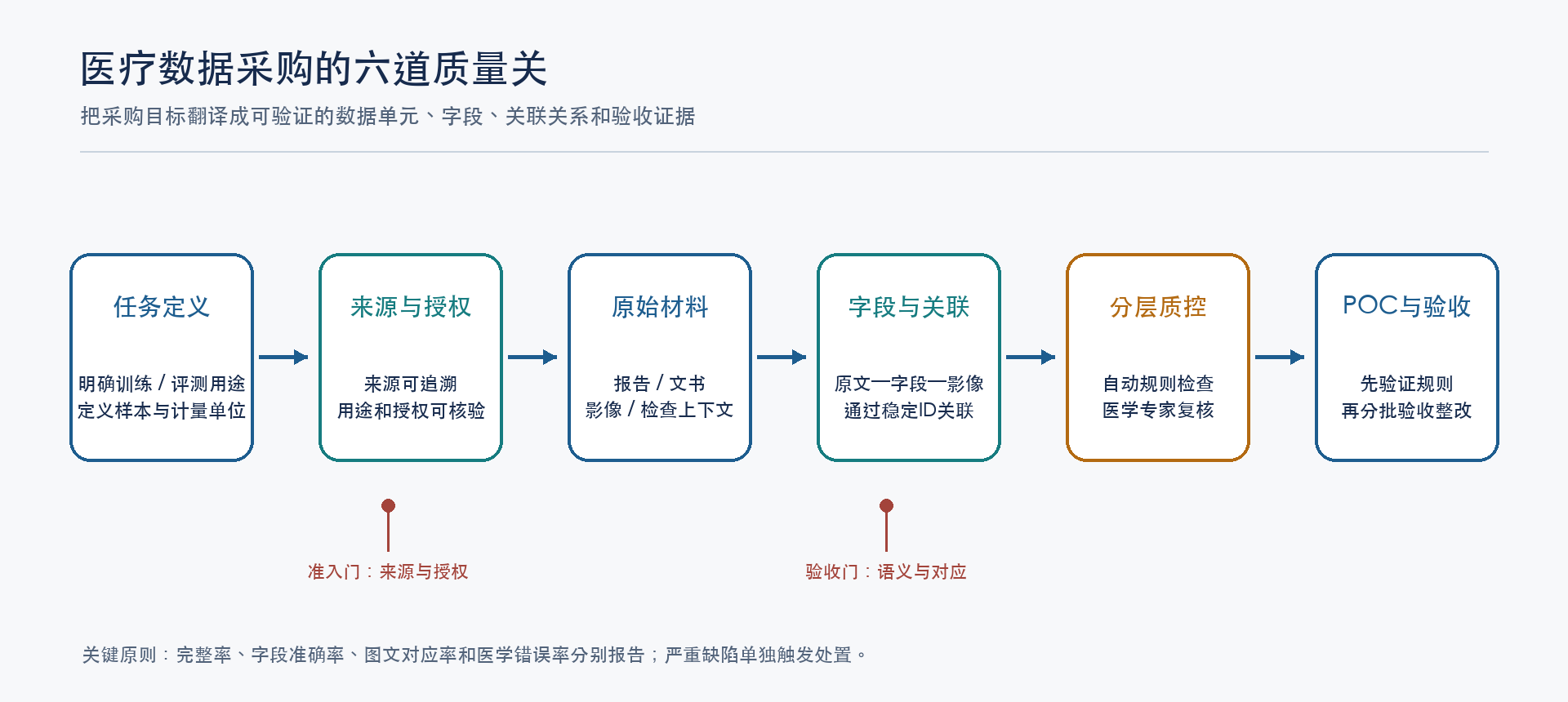
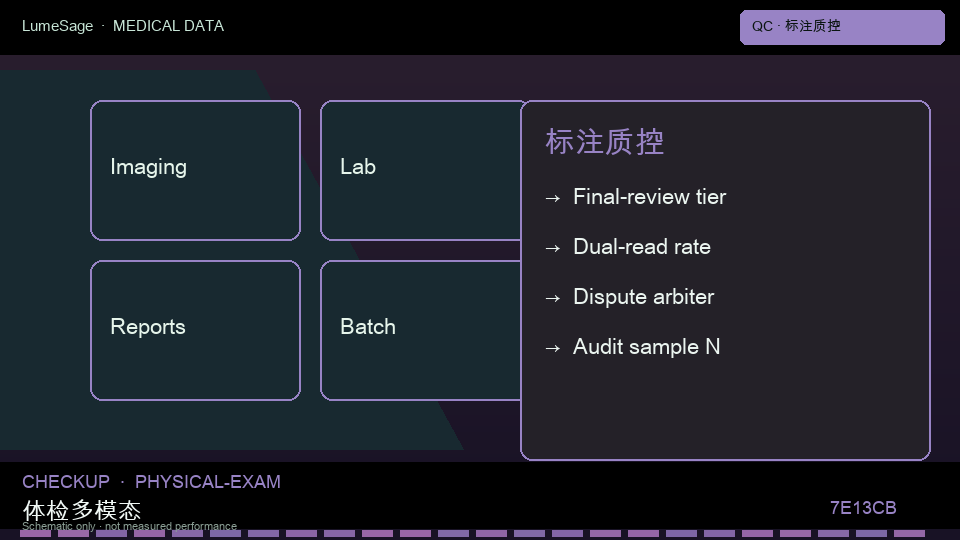
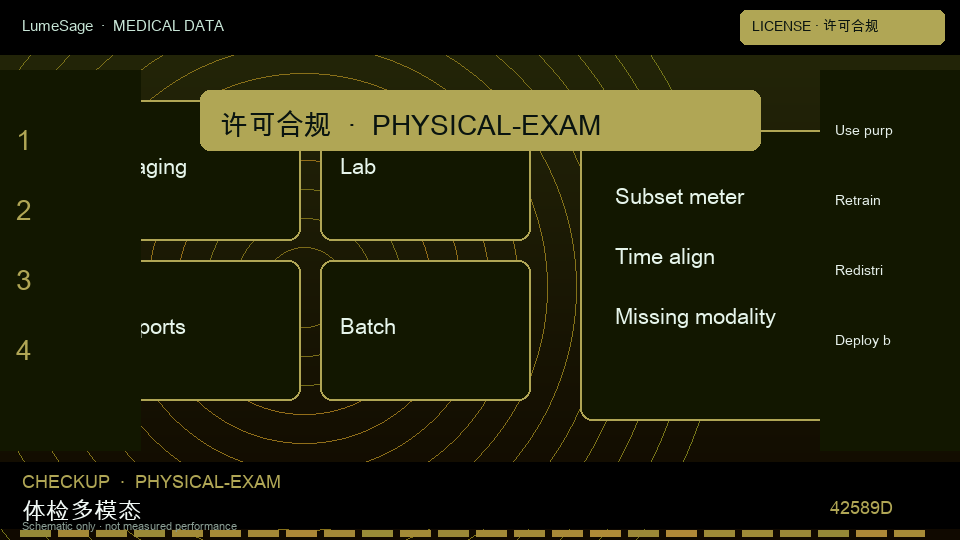
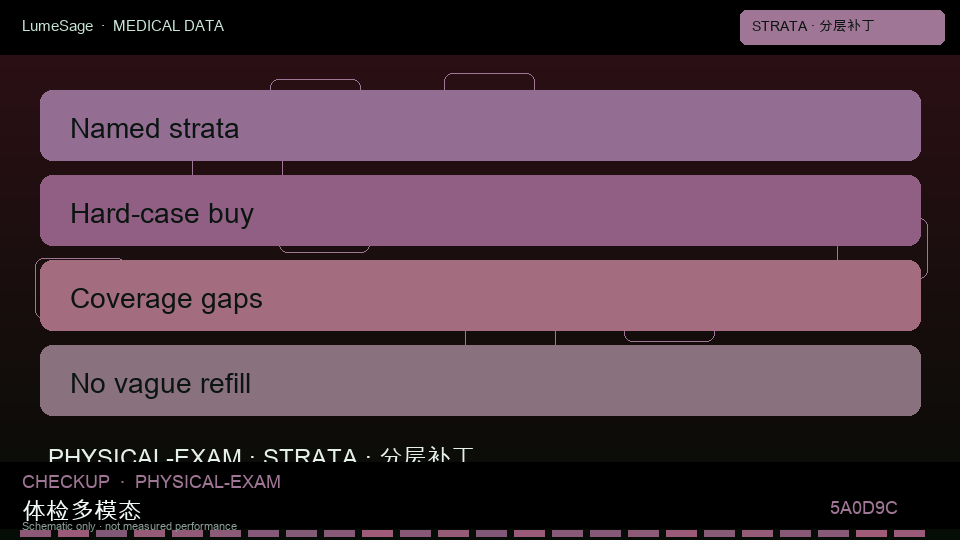
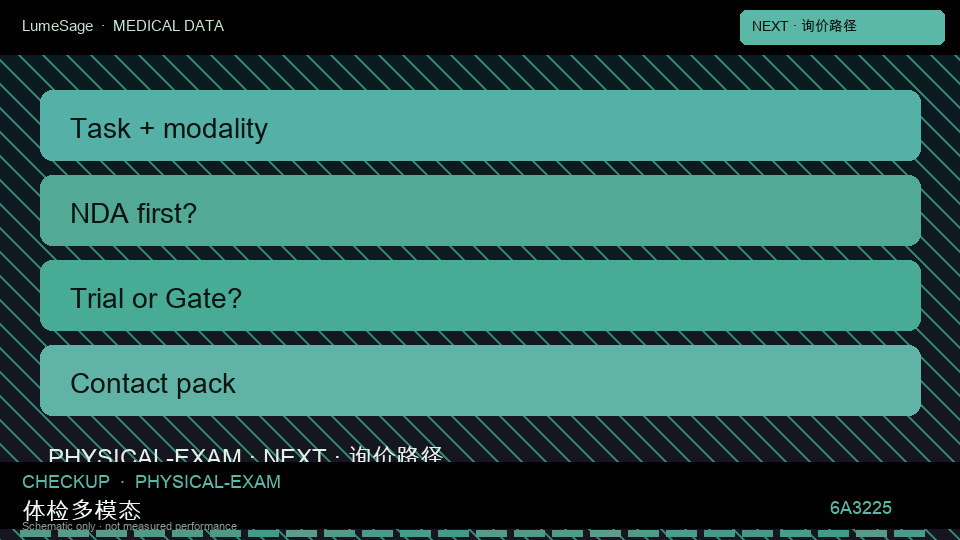
How to accept the data procurement of physical examination report from report image to reviewable data assets
Physical examination report data procurement needs to be jointly designed from sample definition, field and original text mapping, image pairing, medical quality control, de-identification and POC acceptance. This article provides an executable acceptance framework to help teams transform document delivery into traceable and reviewable data assets.
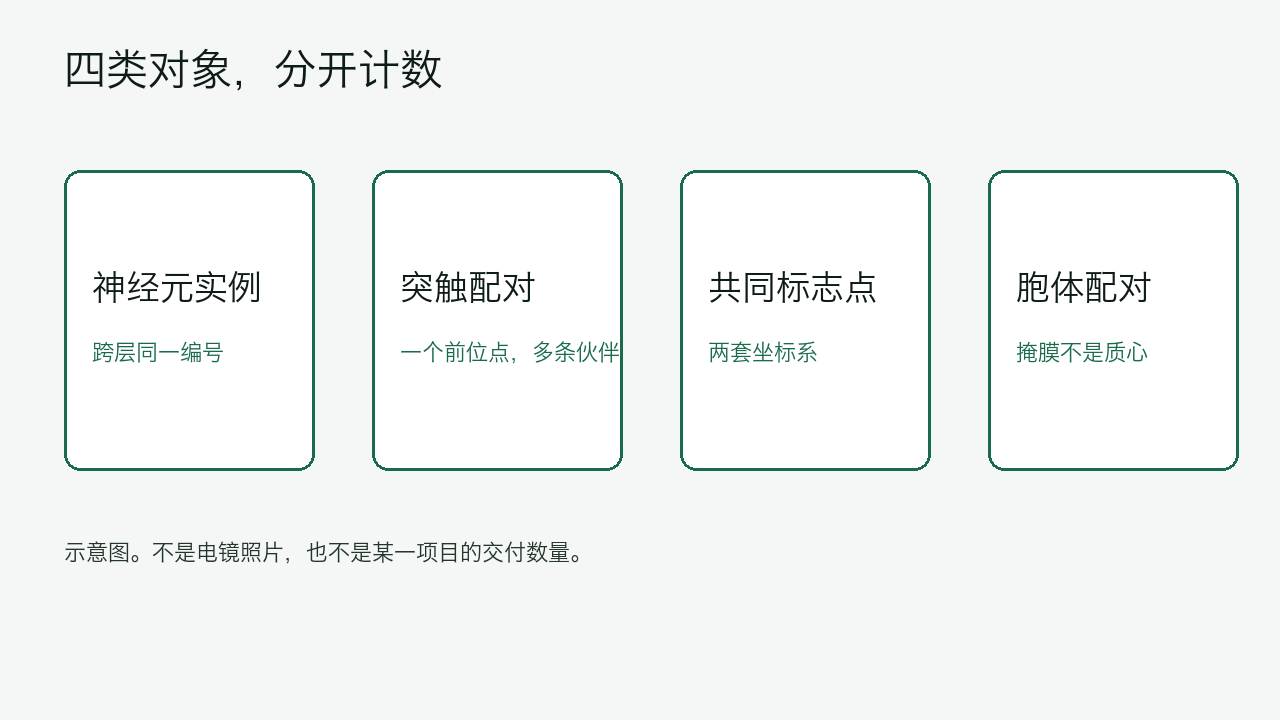
The navigation of ants has been written into textbooks, but there is no whole-brain wiring diagram.
Drosophila adult whole brain wiring diagram has been released. The navigational behavior of ants is well understood, but synapse-level whole-brain reconstructions have not yet been made. Two sets of coordinates for multi-partner synapses and photoelectron microscopy and acceptable three-dimensional annotations are the next kilometer. Scale and permissions are only written on the data card.
How to build high-quality datasets from medical expert tasks: file anchors, scoring rubrics and held-out evaluation
October 2, 2026 Looking at medical expert tasks from the perspective of data set methodology: A task consists of labels, prompt words, input files, expert answers and traceable scoring rules. It first serves private evaluation, and only after passing the safety details can you enter the training split. The screen recording is not a formal report, and the total score on the public list is not a conclusion of the contract.
Canine and feline orthopedic CT bone segmentation: separate articular surfaces, fracture fragments and carpal or tarsal bones before confirming STL alignment
Veterinary orthopedic surgery planning requires an editable mask that is separated bone by bone in dog and cat CT, and the fracture fragments are kept separately and aligned with the original film. Beijing Langhui Technology Co., Ltd. undertakes the closed-loop process according to the existing labeling: desensitized storage, numbering and bone classification, blind review and revision, and exporting nrrd or nii. gz after locking. The split-bone STL is converted and verified by locking the mask in the pilot. The public page does not list the unit price, nor does it list the approximately 500 undelivered cases as completed cases.
Medical image annotation platform scientific research closed loop: acquisition desensitization, delineation blind review, omics training and incremental separate acceptance
Read the medical image annotation platform on October 2, 2026: How the collection, delineation, blind review, omics and deep learning of the manual delivered can be connected into a closed loop of scientific research, and the quotation increment should not be mixed with the existing network capacity for acceptance.
Hospital Information Department accepts medical image collection: HY-Xiaocai, PACS docking, local DICOM and desensitization before uploading
On October 2, 2026, the information department and collectors should check HY-Xiaocai according to the manual: it only runs on Windows, uses a PACS template or a local disk to obtain DICOM, desensitizes it before uploading, non-DICOM will not enter the platform, and video analysis is not within the capabilities of the existing network. The acceptance depends on whether the template, desensitization field and target data set fall in the same record.
How does the Research Office manage medical imaging queues: individual research, collaborative research, third-level clinical variables and locked read-only
October 2, 2026 The Scientific Research Office must first decide whether the data set is individual research or collaborative research: Collaborative research shares images and clinical, isolated outlines and can be reviewed blindly, and is read-only after locking; clinical variables have four categories: Boolean, numerical, string, and file, and are hung at the three levels of patient, examination, and lesion. Omics must wait until it is locked before starting.
How annotators draw medical images VOI: Select tools according to structure, write the name first, threshold and interpolation are not the gold standard
October 2, 2026 The annotator must select the drawing tool according to the structure and first write the multi-level VOI names: brush, rectangle, ellipse, fitting, lasso, millimeter expansion, mask modification, threshold, tracking, interpolation, anchor point, palette and copy, each with applicable boundaries. The shortcut key Q is only responsible for hiding. Threshold and interpolation cannot replace the gold standard after review.
How to use pre-annotation by algorithm colleagues: more than 180 segmented first drafts, revisions of the same VOI, blind review cannot be skipped
October 2, 2026 Algorithm engineers should treat the more than 180 preset segmentation models in the manual as first drafts: covering structures such as lungs, livers, kidneys, airways, bones, and blood vessels. The input is CT, MR, or PET, and the output mask or outline is inferred on the GPU and can be viewed in MPR. Manual revision occurs in the same VOI, and blind review cannot be skipped to enter training.
How to check ethics for blind review of medical images: single-blind and multiple-blind reviews are outlined separately, and unfinished samples are not allowed to be analyzed.
October 2, 2026 Methodology and ethics should check whether blind review can block unfinished samples: single-blind or multi-blind separation of outline and review, collaborative research isolation outline, read-only after locking; back-to-back arbitration, time-limited examination sandbox and YY/T 1833 process records are still in the accounting draft, not the state machine that has been delivered in the manual.
How to check the 3D reading of images in the imaging department: MPR is opened only after reaching 50 floors, and window width measurement and PET-CT fusion are accepted separately.
October 2, 2026 Checking Manual from the Imaging Department Reading Seat: How to use window width and window level, measurement and PET-CT fusion separately, why MPR only appears in CT, MR or PT and no less than fifty layers. Three dimensions are not available when the number of layers is insufficient. This is the entry condition. The maximum density projection and volume reproduction in the quotation should be separately listed for acceptance.
Radiomics starts from locking contours: feature table, ICC, three types of dimensionality reduction, fourteen classifiers are not rankings
Read the radiomics in the manual in the order of scientific research statistics: extract 1,688 features after contour locking, use ICC to observe stability, and reduce dimensionality to distinguish between variance threshold, SelectKBest and Lasso. The fourteen classifiers are menus rather than leaderboards. The English paper-style Word is only used as a draft for the research team, and the feature definitions should be written into the data card.
How to select points for deep training of medical imaging: segmentation detection classification curve, termination optimal point and group isolation model library
Two-dimensional and three-dimensional training in the instruction manual for algorithm colleagues: How to compare Loss, Dice, FROC, ROC and AUC for segmentation, detection, classification and image classification. The task can be terminated and the optimal point enters the model library isolated by project group. The library is not a public model zoo. Blind review and outline locking should be completed before training begins.
Omics and Training Word is only a draft within the group: the task number and lock date must be quoted, and it does not replace the clinical report
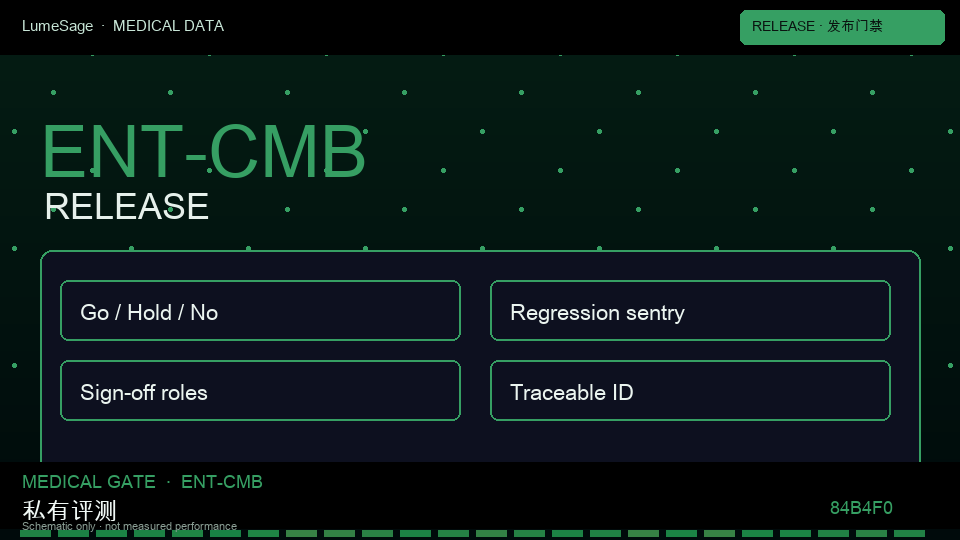
Radiology exports English paper-style Word, and deep learning exports Word according to task type. The task number and profile lock date must be referenced before use. Both are drafts of the research team, not clinical reports that can be exported, nor are they device labels. The structured reporting engine in Quote is delta. If the number enters the gate, you should go through the Medical Gate.
The four roles of the annotation platform must be divided into people: collection, management, research team administrators and platform administrators.
Data collection, data management, research team administrators and platform administrators should be borne by separate persons. When the same person holds four positions, the independent review cannot explain it to the auditor. Collaborative research shared imaging and clinical, isolation delineation, read-only after locking. Platform administrators should not forward patients via chat. Multi-factor authentication and field-level security are offered incrementally.
How to dismantle the medical image annotation platform for procurement: the manual can demonstrate the closed loop, and the incremental branch acceptance with confirmation list
The meter reading method for purchase on October 2, 2026: The manual has been able to demonstrate the closed-loop radiological research for independent acceptance, and the fourteen-line base and seven-category plug-ins will be separately approved according to what is really wanted to buy this time. The contract shall be subject to the confirmation list of both parties.
Don’t buy all multi-modal modes at once: today we can demonstrate the radiation closed loop, pathology, optics, video and text are still incremental
The product plan for October 2, 2026 must first recognize that the old platform demonstrates a closed loop of radiological research, and then treat pathology, optics, video, physiological timing, text, and cross-modality as plug-in increments in the calculation draft. There is no need to tick the modalities that are not included in the bid document to make room for them.
Multi-center collaboration should not be confused with versions: sharing, blind review and locking can be demonstrated, real-time co-editing and version tags are listed separately
October 2, 2026 distinguishes the sharing, blind review, locking and outline isolation of the manual delivered, and real-time collaboration with the MDT in the calculation draft, Git-style tagged version. Only locking without retaining the version and retaining only the version without locking have different failure modes. The production site does not run real-time co-editing, and the acceptance must be written separately.
How to compare mark quality control YY/T 1833: Blind review can be verified, three-level arbitration, examination sandbox and alignment are not certificates
Quality control and compliance readers should separate the single-blind, multiple-blind and completion status in the manual from the third-level arbitration, examination sandbox, quality control center and YY/T 1833 process records on October 2, 2026. The public list is not an acceptance gate, and standard alignment is not a certificate. Which line you buy will be inspected.
Marking data lineage relies on two pointers: the outline lock date, the fifteen-day download package, and the report also points back to the task number.
Data Engineering will separate the locking, fifteen-day export and Word draft in the manual from the snapshot lineage and structured reporting engine in the accounting draft on October 2, 2026. The bloodline must refer to the locking date, the report must refer to the task number, and any materials that do not match the requirements should not be included in the bid document.
The
Label export is not yet purchasable data: locked labels, fifteen-day download, data card fields and Medical Gate
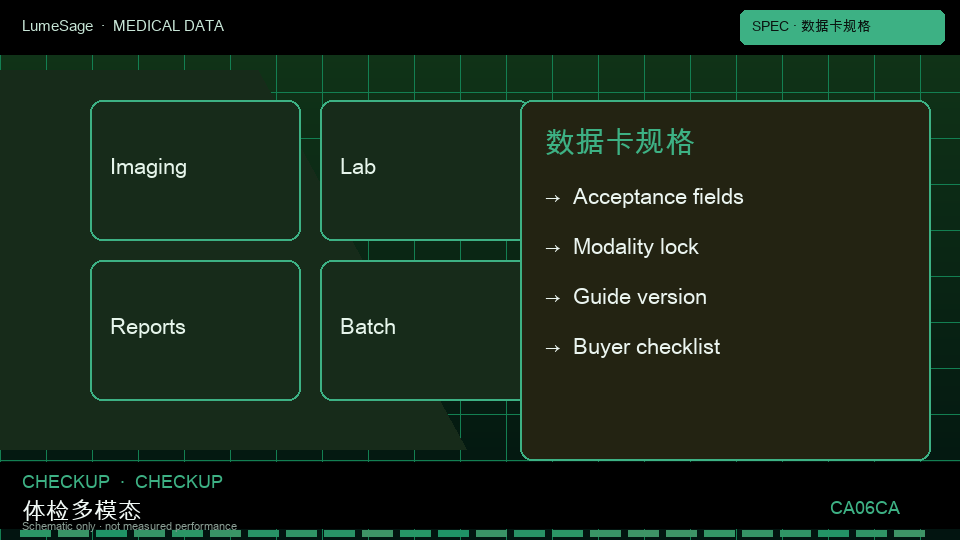
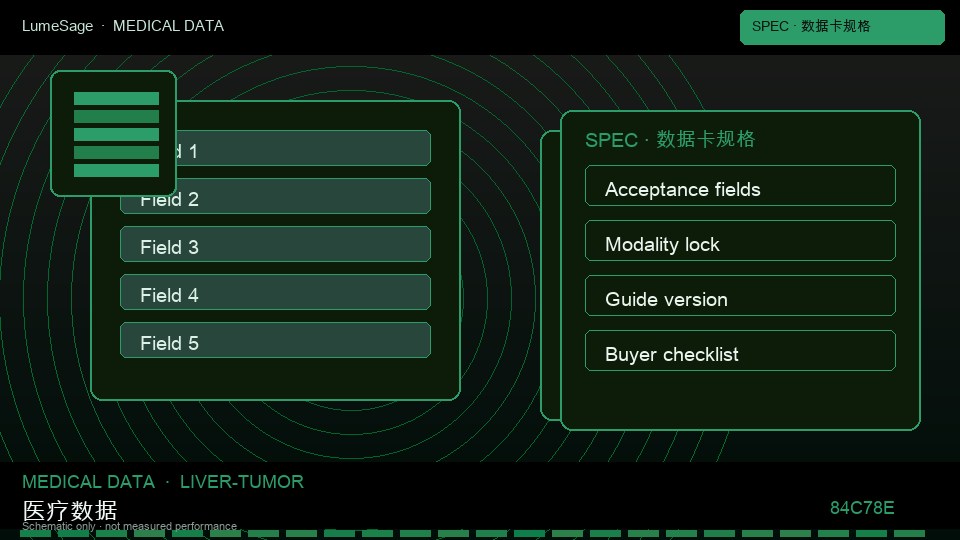
annotation platform handed over a locked label and a fifteen-day download package, which was only enough for internal handover of the research team. For externally interpretable data sets, permission, population, protocol version, known deviations, and prohibited items must be written on the data card. The physician's final review is separately agreed with Medical Gate's private questions, guidelines, and process records, and it is stated whether the training profile enters the gated question.
Only one desensitization study can be passed on the acceptance day: outline, blind review, group study or training on the spot, and screenshots of the public list are not counted as access control.
Complete a desensitized DICOM study through the cooperative data set, outline, blind review, omics or segmentation training, Word and download, and prepare two sets of sequence verification MPR for fifty layers. Screenshots of the public list cannot be used as acceptance. The plug-ins, lineage, quality control and concurrency in the quotation must be listed separately and signed by the heads of the Information Department, Research Department and Algorithm respectively.
Marking quality control comparison frontier in October 2026: Prompt segmentation still needs to be manually locked, and the criteria cannot yield a single total score
takes October 2, 2026 as the observation date, and translates SAM, MedSAM, nnU-Net, HealthBench, MedBench and MedHELM into annotated quality control requirements: prompt contours must still be manually locked, the training protocol must be reproducible, the criteria cannot be harvested into one AUC, and the private set remains in the contract. The SAM in the radial plugin is the quote delta and the interaction threshold is not equal to the model.
Hospital Information Department deploys an annotation platform: desensitization before uploading, account decentralization, export timeliness, and pasting of patient information on the form is prohibited.
The information department checklist is divided into two layers of desensitization: the current network is HY-Xiaocai before uploading, and field-level desensitization, circuit breaker, abnormal alarm and MFA are quotation security items. About thirty people simultaneously requested real accounts for actual testing. The export format and packaging have a time limit of fifteen days, and long-term archiving does not rely on browser links. The form prohibits pasting of names, examination numbers and images.
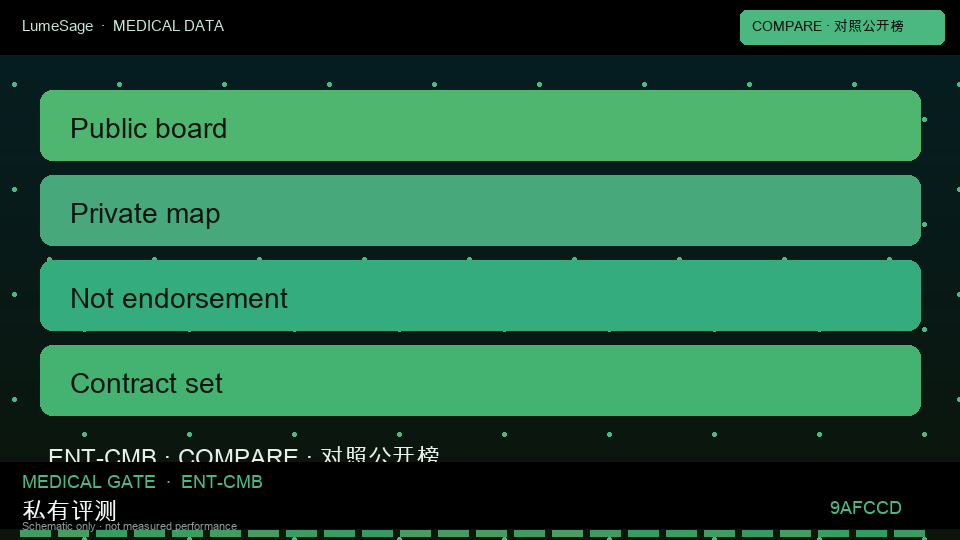
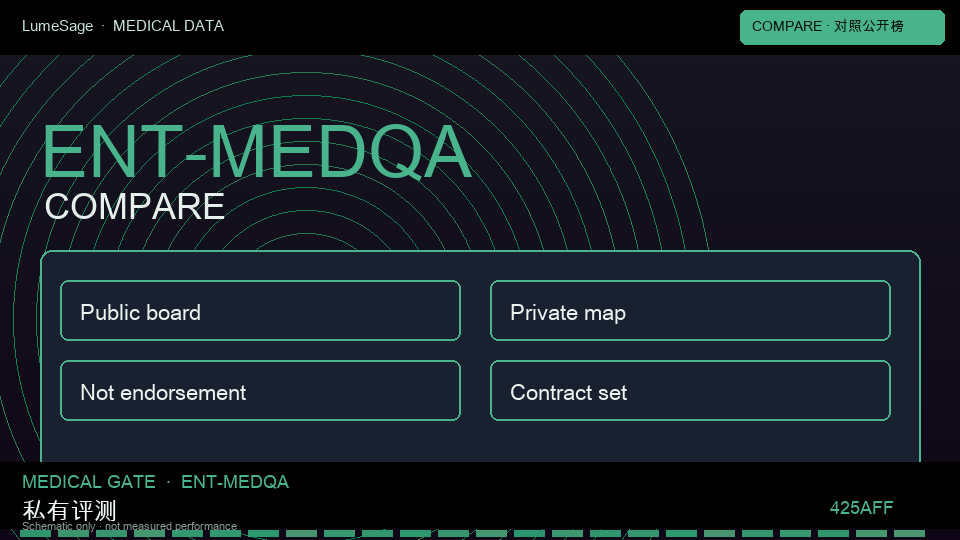
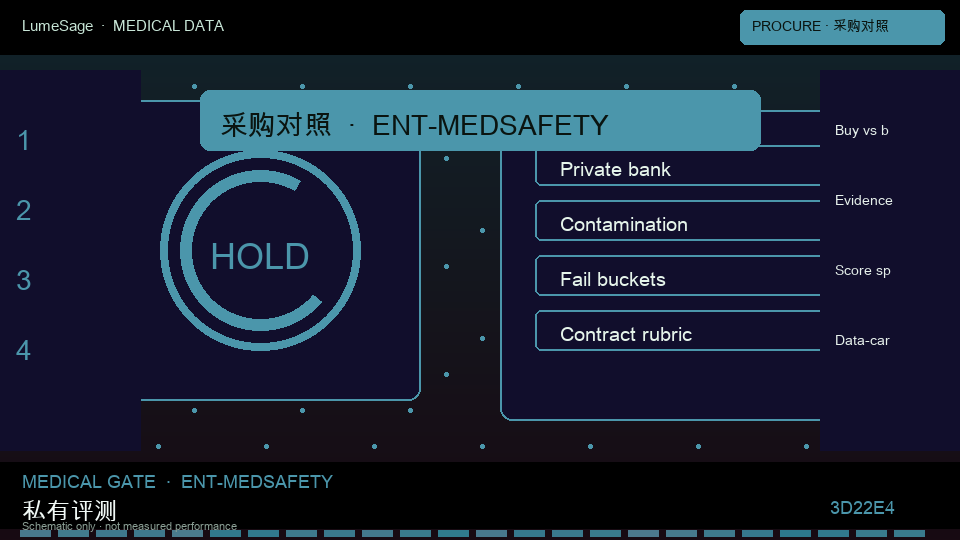
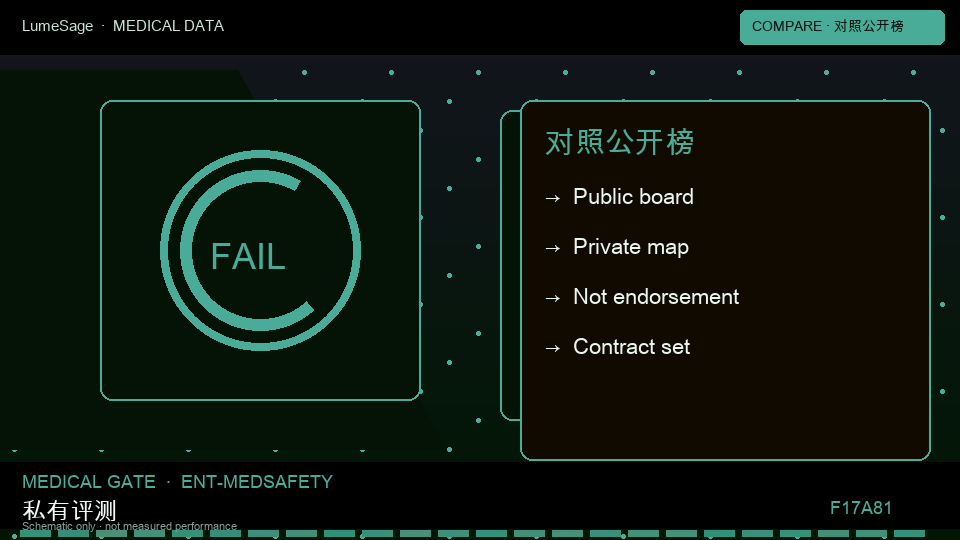
MedBench exam track: Write down the scoring details and comparison dimensions first, and the public total score is not the GB-Exam contract access control
MedBench exam track: Write down the scoring details and comparison dimensions first, and the public total score is not the GB-Exam contract access control
MedBench Safety Ethics Track: The parts that cannot be tested on the public benchmark are written as private questions, and GB-Safety only enters the contract
MedBench Safety Ethics Track: The parts that cannot be tested on the public benchmark are written as private questions, and GB-Safety only enters the contract
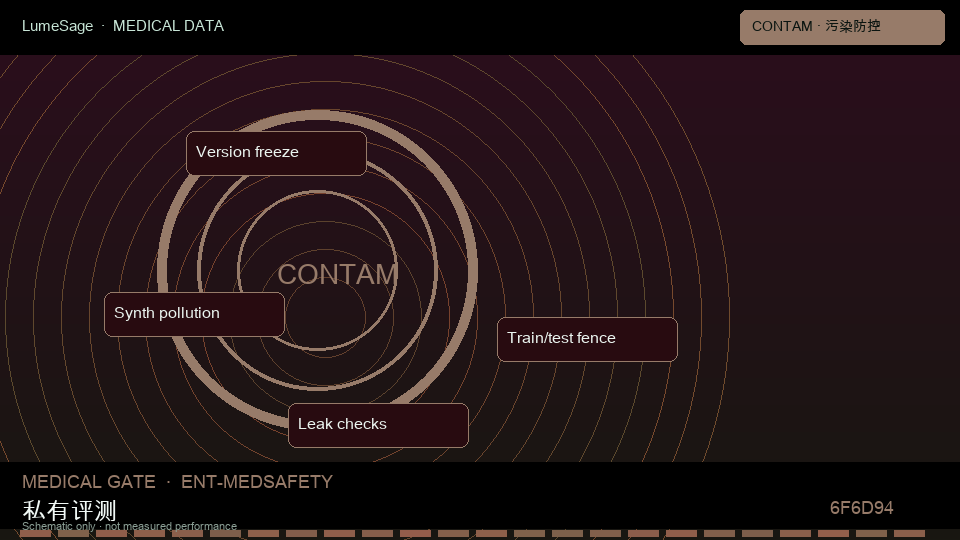
MedBench Safety Ethics Track: Question contamination and credibility are listed separately, and public scores cannot be regarded as GB-Safety passing conclusions.
MedBench Safety Ethics Track: Question contamination and credibility are listed separately, and public scores cannot be regarded as GB-Safety passing conclusions.
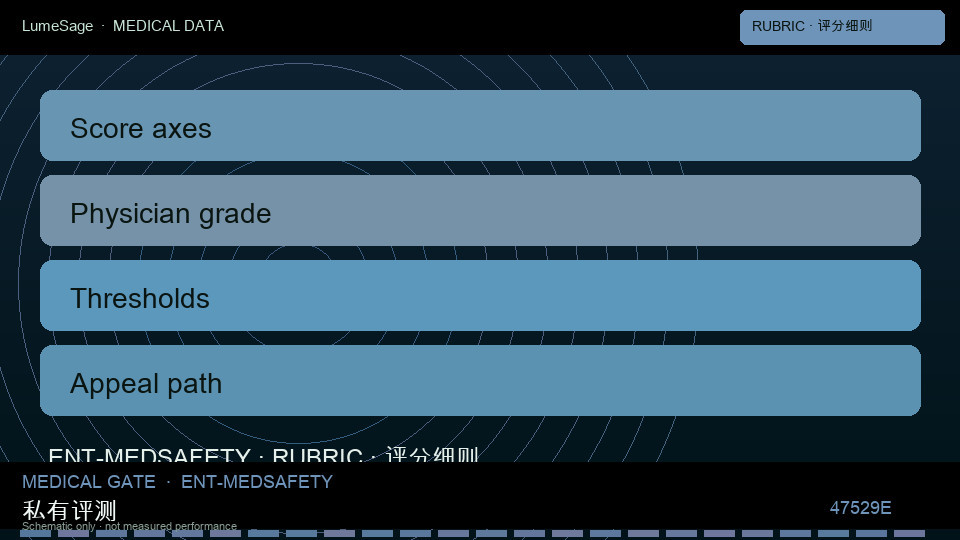
MedBench Safety Ethics Track: Write down the scoring details and comparison dimensions first, and the public total score is not a GB-Safety contract access control
MedBench Safety Ethics Track: Write down the scoring details and comparison dimensions first, and the public total score is not a GB-Safety contract access control
MedBench multi-modal track: The parts that cannot be tested on the public benchmark are written as private questions, and GB-Vision only enters the contract
MedBench multi-modal track: The parts that cannot be tested on the public benchmark are written as private questions, and GB-Vision only enters the contract
MedBench multi-modal track: question contamination and credibility are listed separately, and public scores cannot be regarded as GB-Vision passing conclusions
MedBench multi-modal track: question contamination and credibility are listed separately, and public scores cannot be regarded as GB-Vision passing conclusions
MedBench multi-modal track: write down the scoring details and comparison dimensions first, and the public total score is not the GB-Vision contract access control
MedBench multi-modal track: write down the scoring details and comparison dimensions first, and the public total score is not the GB-Vision contract access control
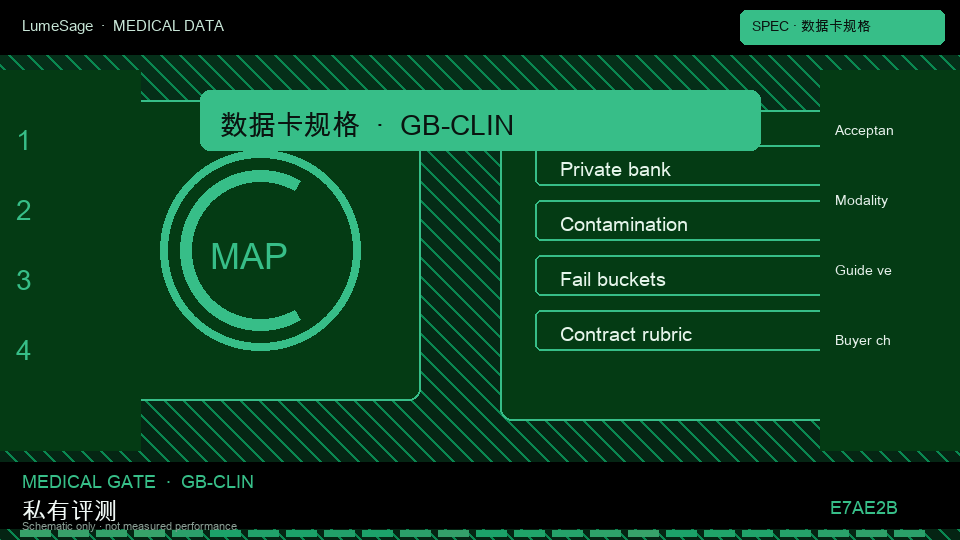
MedBench Agent Track: Question contamination and credibility are listed separately, and public scores cannot be regarded as GB-Clin passing conclusions.
MedBench Agent Track: Question contamination and credibility are listed separately, and public scores cannot be regarded as GB-Clin passing conclusions.
MedBench Agent track: Write down the scoring details and comparison dimensions first, and the public total score is not the GB-Clin contract access control
MedBench Agent track: Write down the scoring details and comparison dimensions first, and the public total score is not the GB-Clin contract access control
HealthBench Consensus: Question contamination and credibility are listed separately, and public scores cannot be regarded as GB-Audit passing conclusions.
HealthBench Consensus: Question contamination and credibility are listed separately, and public scores cannot be regarded as GB-Audit passing conclusions.
HealthBench Consensus: Write down the scoring details and comparison dimensions first, and the public total score is not the GB-Audit contract access control
HealthBench Consensus: Write down the scoring details and comparison dimensions first, and the public total score is not the GB-Audit contract access control
MedBench (classic version): The parts that cannot be tested on the public benchmark are written as private questions, and GB-Exam only enters the contract
MedBench (classic version): The parts that cannot be tested on the public benchmark are written as private questions, and GB-Exam only enters the contract
MedBench (Classic Edition): Question contamination and credibility are listed separately, and public scores cannot be regarded as GB-Exam passing conclusions.
MedBench (Classic Edition): Question contamination and credibility are listed separately, and public scores cannot be regarded as GB-Exam passing conclusions.
MedBench (classic version): Write down the scoring details and comparison dimensions first, and the public total score is not the GB-Exam contract access control
MedBench (classic version): Write down the scoring details and comparison dimensions first, and the public total score is not the GB-Exam contract access control
MedBench (classic version): Write down the layers, thresholds and failure types before going online, and do not replace the GB-Exam with the public list
MedBench (classic version): Write down the layers, thresholds and failure types before going online, and do not replace the GB-Exam with the public list
Dynamic question change evaluation: The parts that cannot be tested on the public list are written as private questions, and GB-Audit only enters the contract
Dynamic question change evaluation: The parts that cannot be tested on the public list are written as private questions, and GB-Audit only enters the contract
Dynamic question change evaluation: question contamination and credibility are listed separately, and public scores cannot be regarded as GB-Audit passing conclusions
Dynamic question change evaluation: question contamination and credibility are listed separately, and public scores cannot be regarded as GB-Audit passing conclusions
Dynamic question-changing evaluation: Write down the scoring details and comparison dimensions first, and the public total score is not the GB-Audit contract access control
Dynamic question-changing evaluation: Write down the scoring details and comparison dimensions first, and the public total score is not the GB-Audit contract access control
Dynamic question-changing evaluation: write down the layers, thresholds and failure types before going online, and do not replace GB-Audit with the public list
Dynamic question-changing evaluation: write down the layers, thresholds and failure types before going online, and do not replace GB-Audit with the public list
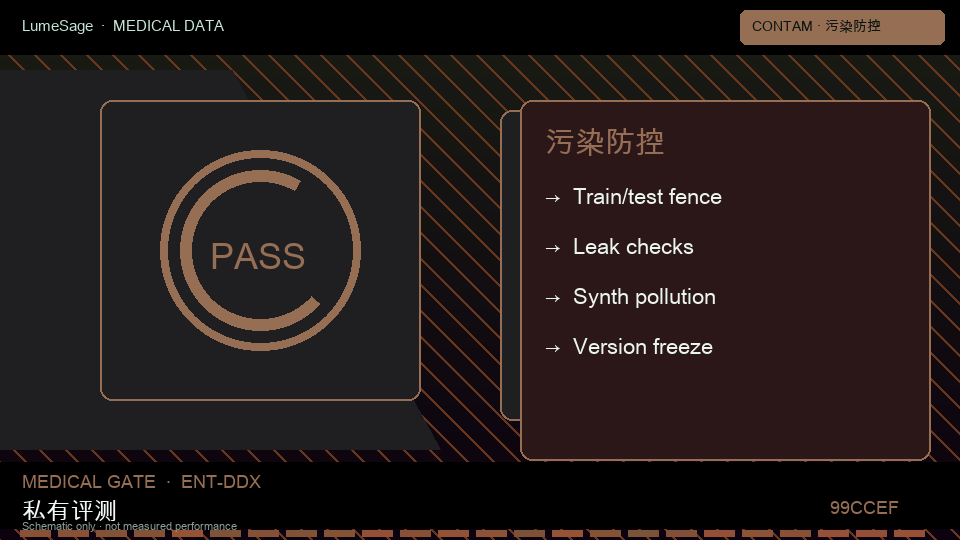
Pollution audit method: The pollution and credibility of the question are listed separately, and the public score cannot be regarded as the GB-Audit passing conclusion
Pollution audit method: The pollution and credibility of the question are listed separately, and the public score cannot be regarded as the GB-Audit passing conclusion
Pollution audit method: Write down the scoring details and comparison dimensions first, and the public total score is not the GB-Audit contract access control
Pollution audit method: Write down the scoring details and comparison dimensions first, and the public total score is not the GB-Audit contract access control
Medical Jailbreak and Improper Suggestions: The parts that cannot be tested on the public list are written as private questions, and GB-Safety only enters the contract
Medical Jailbreak and Improper Suggestions: The parts that cannot be tested on the public list are written as private questions, and GB-Safety only enters the contract
Medical Jailbreak and Improper Suggestions: Question contamination and credibility are listed separately, and public scores cannot be regarded as GB-Safety passing conclusions.
Medical Jailbreak and Improper Suggestions: Question contamination and credibility are listed separately, and public scores cannot be regarded as GB-Safety passing conclusions.
Medical Jailbreak and Improper Suggestions: Write down the scoring details and comparison dimensions first, and the public total score is not the GB-Safety contract access control
Medical Jailbreak and Improper Suggestions: Write down the scoring details and comparison dimensions first, and the public total score is not the GB-Safety contract access control
Medical Jailbreak and Improper Suggestions: Public comparison and private frozen set are listed separately, only GB-Safety is recognized to pass the test
Medical Jailbreak and Improper Suggestions: Public comparison and private frozen set are listed separately, only GB-Safety is recognized to pass the test
Medical Jailbreak and Improper Suggestions: Write down the layers, thresholds and failure types before going online, and do not replace GB-Safety with public lists
Medical Jailbreak and Improper Suggestions: Write down the layers, thresholds and failure types before going online, and do not replace GB-Safety with public lists
Process Audit and Illusion Trajectory: The parts that cannot be tested on the public list are written as private questions, and GB-Vision only enters the contract
Process Audit and Illusion Trajectory: The parts that cannot be tested on the public list are written as private questions, and GB-Vision only enters the contract
Process audit and hallucination trajectory: question contamination and credibility are listed separately, and the public score cannot be regarded as a GB-Vision passing conclusion
Process audit and hallucination trajectory: question contamination and credibility are listed separately, and the public score cannot be regarded as a GB-Vision passing conclusion
Process Audit and Illusion Track: Write down the scoring details and comparison dimensions first, and the public total score is not the GB-Vision contract access control
Process Audit and Illusion Track: Write down the scoring details and comparison dimensions first, and the public total score is not the GB-Vision contract access control
Process Audit and Illusion Track: Write down the layers, thresholds and failure types before going online, and do not replace GB-Vision with a public list
Process Audit and Illusion Track: Write down the layers, thresholds and failure types before going online, and do not replace GB-Vision with a public list
Governance Agent Evaluation: Question contamination and credibility are listed separately, and public scores cannot be regarded as GB-Clin passing conclusions.
Governance Agent Evaluation: Question contamination and credibility are listed separately, and public scores cannot be regarded as GB-Clin passing conclusions.
Governance Agent Evaluation: Write down the scoring details and comparison dimensions first, and the public total score is not the GB-Clin contract access control
Governance Agent Evaluation: Write down the scoring details and comparison dimensions first, and the public total score is not the GB-Clin contract access control
Image-report consistency: Question contamination and credibility are listed separately, and public scores cannot be regarded as GB-Vision passing conclusions.
Image-report consistency: Question contamination and credibility are listed separately, and public scores cannot be regarded as GB-Vision passing conclusions.
Image-Report Consistency: The scoring details and comparison dimensions should be written clearly first, and the public total score is not the GB-Vision contract access control
Image-Report Consistency: The scoring details and comparison dimensions should be written clearly first, and the public total score is not the GB-Vision contract access control
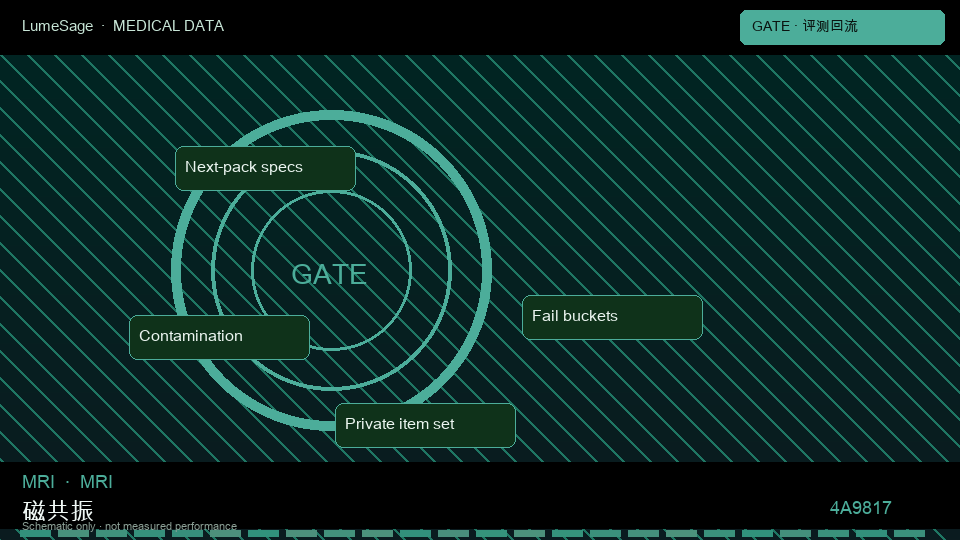
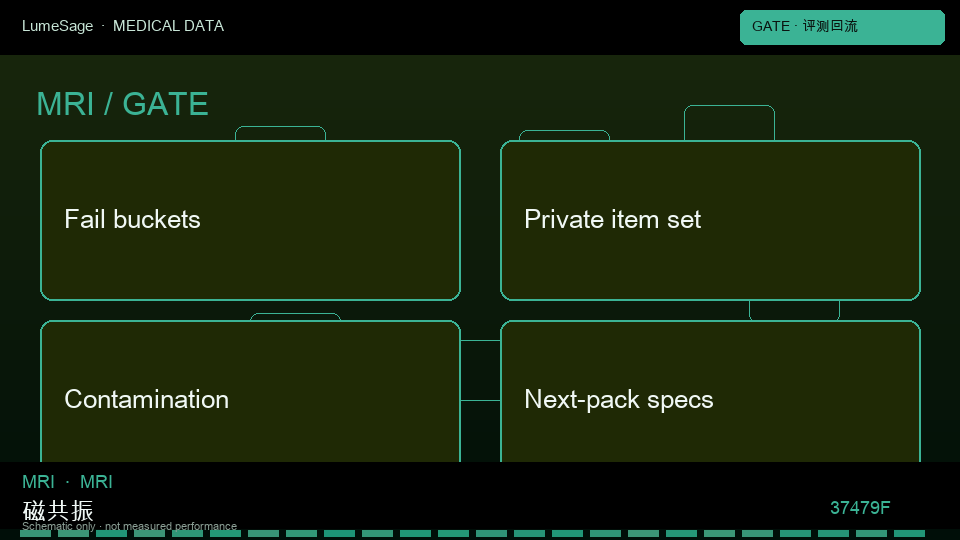
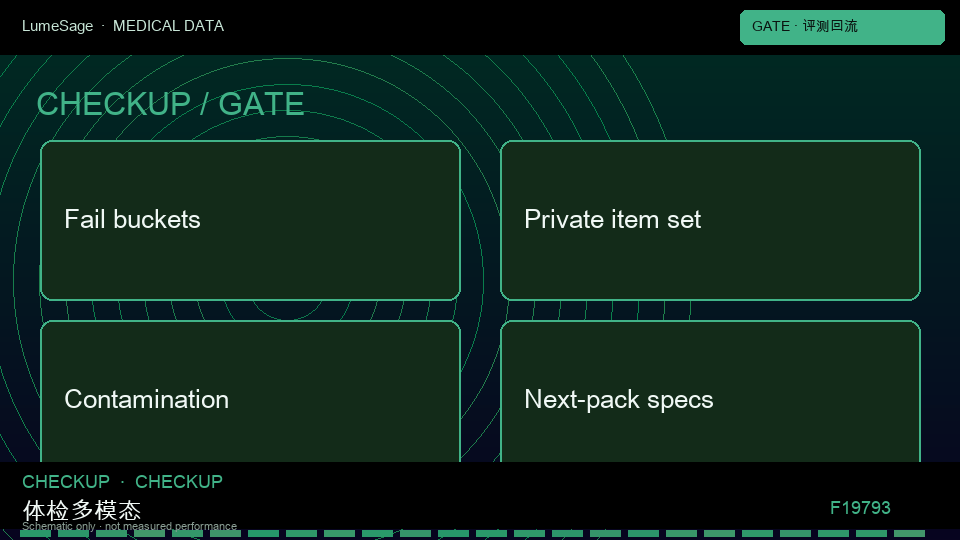
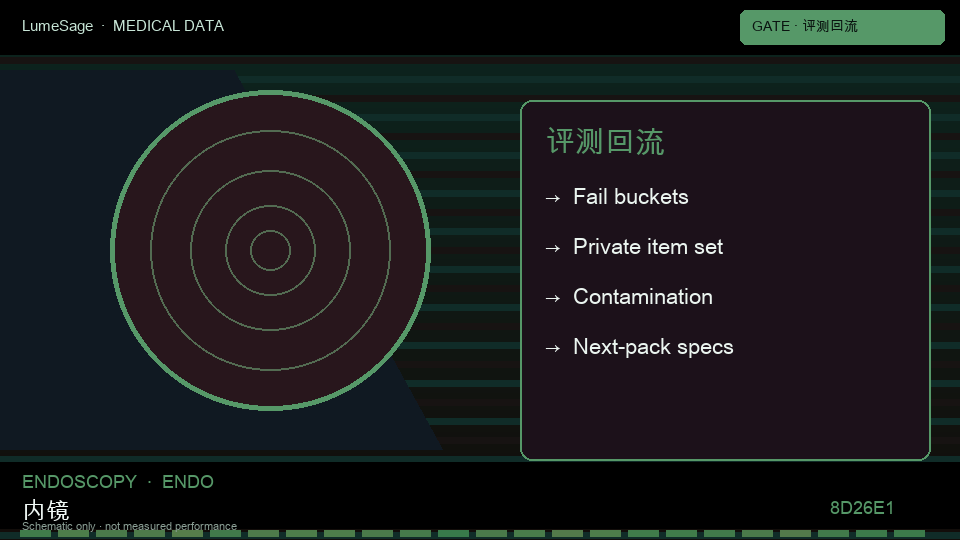
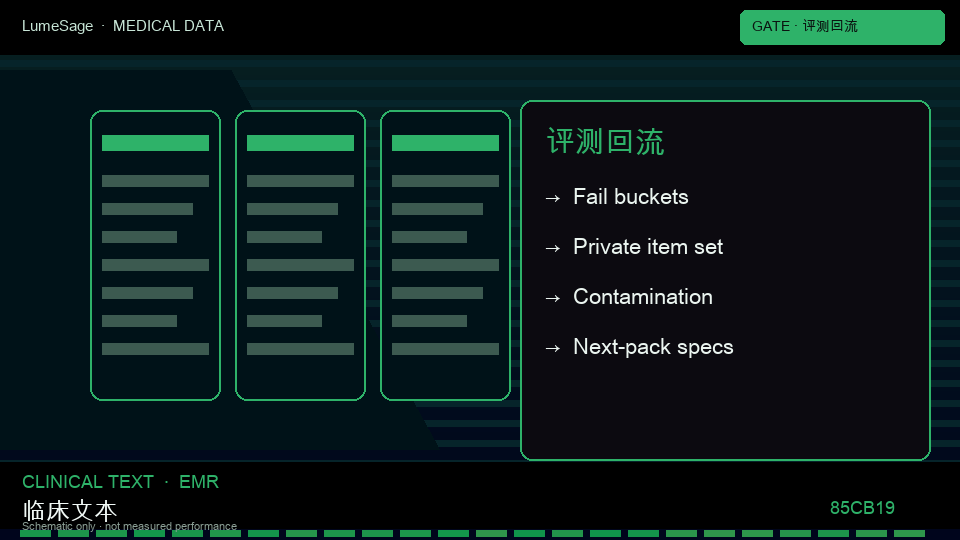
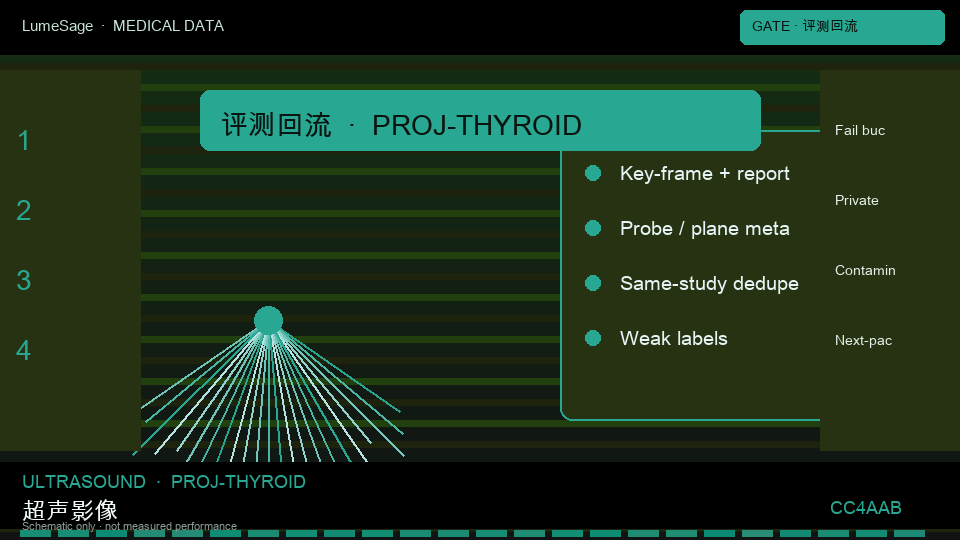
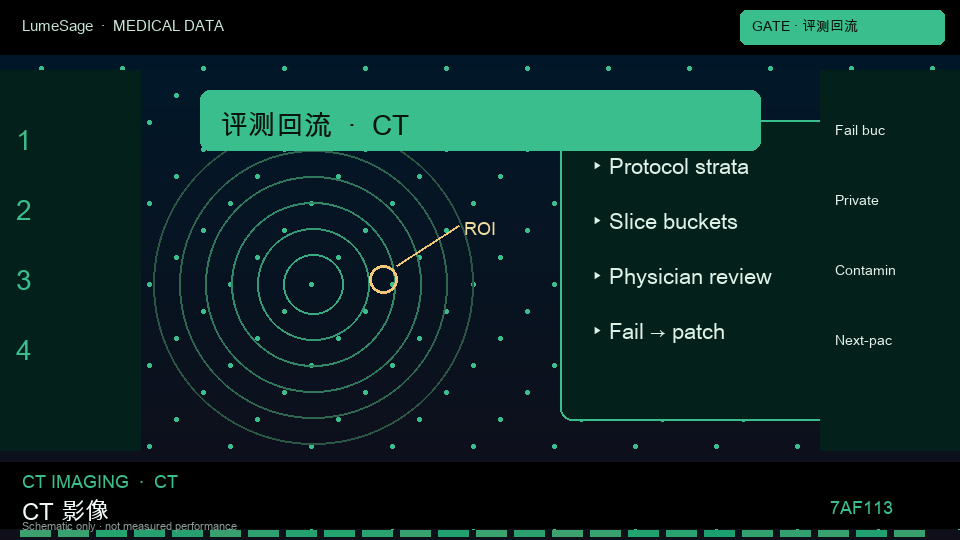
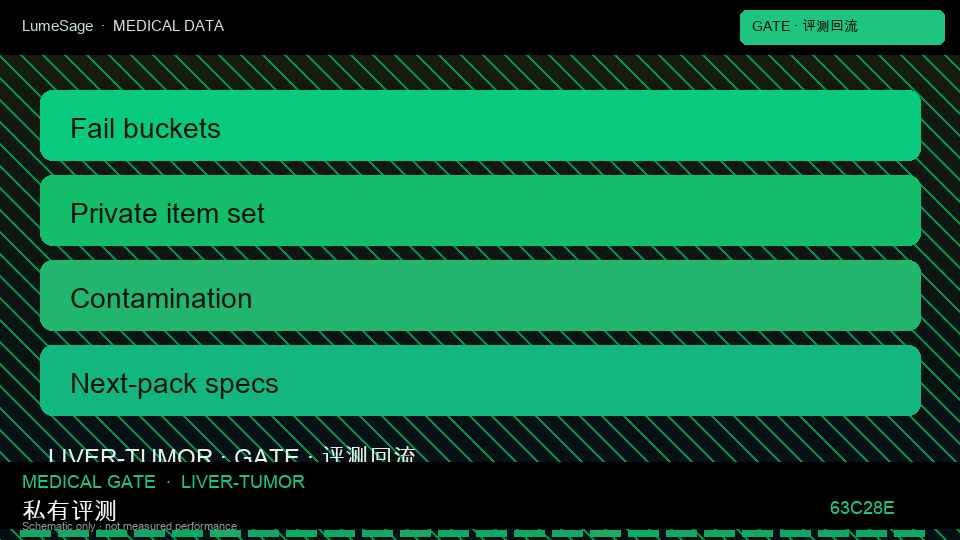
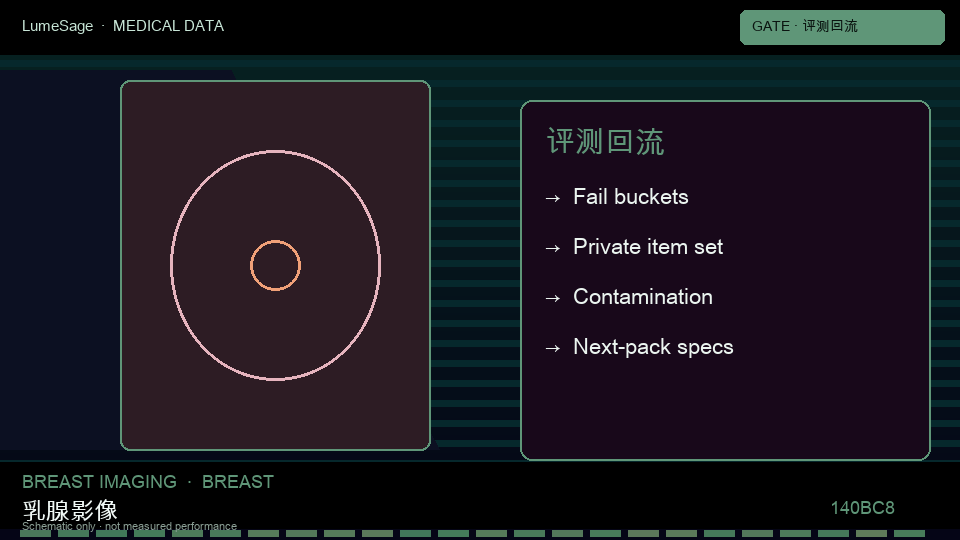
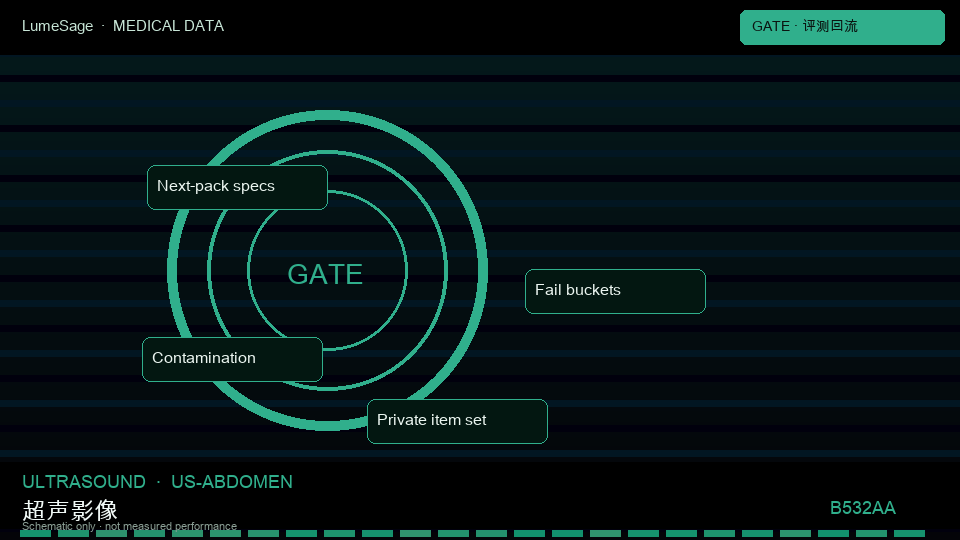
Failed bucketing and reflow: question contamination and credibility are listed separately, and public scores cannot be regarded as MG-Loop passing conclusions
Failed bucketing and reflow: question contamination and credibility are listed separately, and public scores cannot be regarded as MG-Loop passing conclusions
Failed bucketing and reflow: the scoring details and comparison dimensions should be written clearly first, and the public total score is not the MG-Loop contract access control
Failed bucketing and reflow: the scoring details and comparison dimensions should be written clearly first, and the public total score is not the MG-Loop contract access control
clinical guideline version evaluation: the parts that cannot be tested on the public list are written as private questions, and GB-Exam enters the contract
clinical guideline version evaluation: the parts that cannot be tested on the public list are written as private questions, and GB-Exam enters the contract
clinical guideline version evaluation: question contamination and credibility are listed separately, and public scores cannot be regarded as GB-Exam passing conclusions
clinical guideline version evaluation: question contamination and credibility are listed separately, and public scores cannot be regarded as GB-Exam passing conclusions
clinical guideline version evaluation: the scoring details and comparison dimensions should be written clearly first, and the public total score is not a GB-Exam contract access control
clinical guideline version evaluation: the scoring details and comparison dimensions should be written clearly first, and the public total score is not a GB-Exam contract access control
clinical guideline version evaluation: public controls and private frozen sets are listed separately, and only GB-Exam is recognized for passing the test.
clinical guideline version evaluation: public controls and private frozen sets are listed separately, and only GB-Exam is recognized for passing the test.
clinical guideline version evaluation: write down the tiers, thresholds and failure types before going online, and do not replace the GB-Exam with a public list
clinical guideline version evaluation: write down the tiers, thresholds and failure types before going online, and do not replace the GB-Exam with a public list
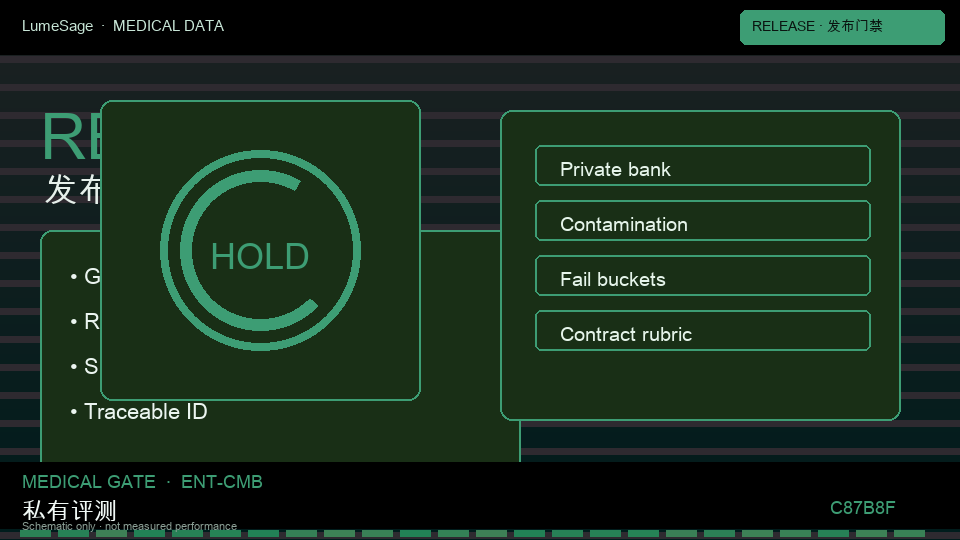
Medical Gate private access control: The parts that cannot be tested on the public list are written as private questions, and MG-Loop only enters the contract
Medical Gate private access control: The parts that cannot be tested on the public list are written as private questions, and MG-Loop only enters the contract
Medical Gate private gate: question contamination and credibility are listed separately, public scores cannot be regarded as MG-Loop passing conclusion
Medical Gate private gate: question contamination and credibility are listed separately, public scores cannot be regarded as MG-Loop passing conclusion
Medical Gate private access control: Write down the scoring details and comparison dimensions first, the public total score is not MG-Loop contract access control
Medical Gate private access control: Write down the scoring details and comparison dimensions first, the public total score is not MG-Loop contract access control
Medical Gate private access control: write down the layers, thresholds and failure types before going online, and do not replace MG-Loop with the public list
Medical Gate private access control: write down the layers, thresholds and failure types before going online, and do not replace MG-Loop with the public list
IMCS/Medical record generation: The parts that cannot be tested on the public list are written as private questions, and GB-Clin only enters the contract
IMCS/Medical record generation: The parts that cannot be tested on the public list are written as private questions, and GB-Clin only enters the contract
IMCS/Medical record generation: Question contamination and credibility are listed separately, and public scores cannot be regarded as GB-Clin passing conclusions.
IMCS/Medical record generation: Question contamination and credibility are listed separately, and public scores cannot be regarded as GB-Clin passing conclusions.
IMCS/Medical record generation: Write down the scoring details and comparison dimensions first, and the public total score is not the GB-Clin contract access control
IMCS/Medical record generation: Write down the scoring details and comparison dimensions first, and the public total score is not the GB-Clin contract access control
MedBench RAG / Knowledge Base Q&A: The parts that cannot be tested on the public list are written as private questions, and GB-Clin only enters the contract
MedBench RAG / Knowledge Base Q&A: The parts that cannot be tested on the public list are written as private questions, and GB-Clin only enters the contract
MedBench RAG / Knowledge Base Q&A: Question contamination and credibility are listed separately, and public scores cannot be regarded as GB-Clin passing conclusions.
MedBench RAG / Knowledge Base Q&A: Question contamination and credibility are listed separately, and public scores cannot be regarded as GB-Clin passing conclusions.
MedBench RAG / Knowledge Base Q&A: Write down the scoring details and comparison dimensions first, and the public total score is not the GB-Clin contract access control
MedBench RAG / Knowledge Base Q&A: Write down the scoring details and comparison dimensions first, and the public total score is not the GB-Clin contract access control
MedBench RAG / Knowledge Base Q&A: Write down the tiers, thresholds and failure types before going online, and do not replace GB-Clin with public rankings
MedBench RAG / Knowledge Base Q&A: Write down the tiers, thresholds and failure types before going online, and do not replace GB-Clin with public rankings
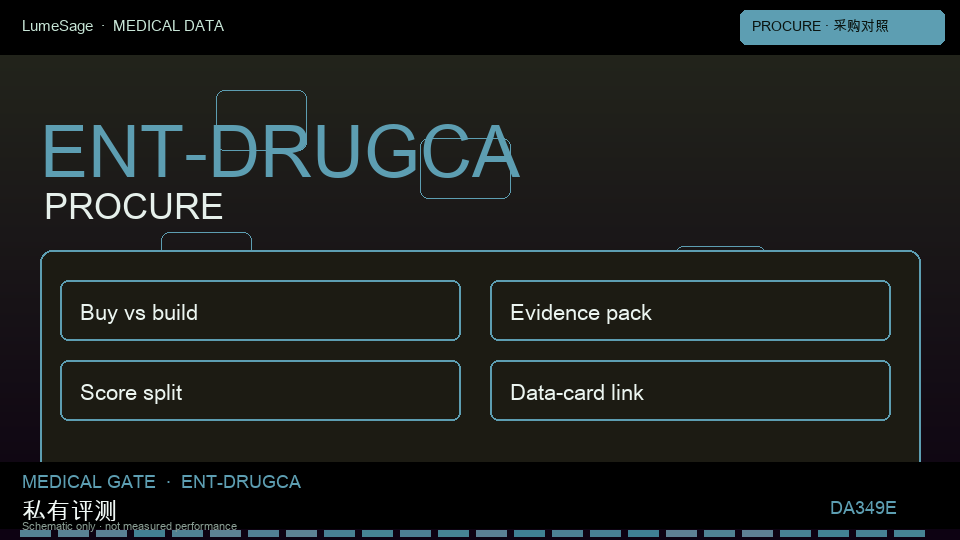
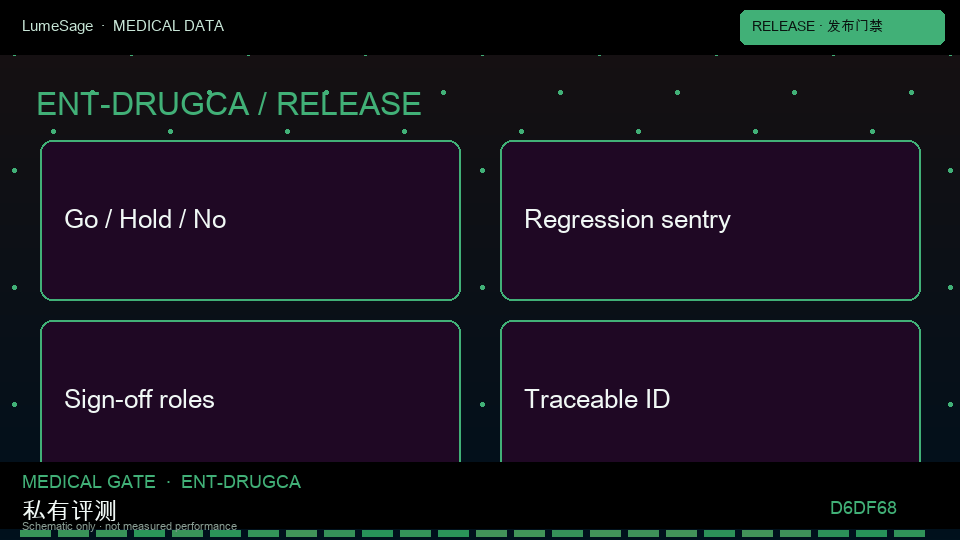
DrugCA / Medication Contraindications: The parts that cannot be tested on the public list are written as private questions, and GB-Safety only enters the contract
DrugCA / Medication Contraindications: The parts that cannot be tested on the public list are written as private questions, and GB-Safety only enters the contract
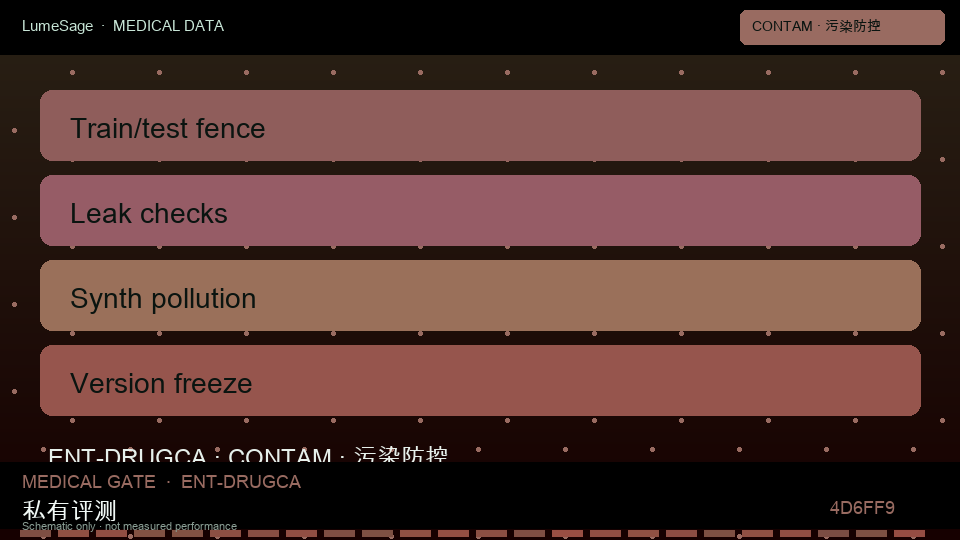
DrugCA / Medication Contraindications: Question contamination and credibility are listed separately, and public scores cannot be regarded as GB-Safety passing conclusions.
DrugCA / Medication Contraindications: Question contamination and credibility are listed separately, and public scores cannot be regarded as GB-Safety passing conclusions.
DrugCA / Medication Contraindications: Write down the scoring details and comparison dimensions first, and the public total score is not a GB-Safety contract access control
DrugCA / Medication Contraindications: Write down the scoring details and comparison dimensions first, and the public total score is not a GB-Safety contract access control
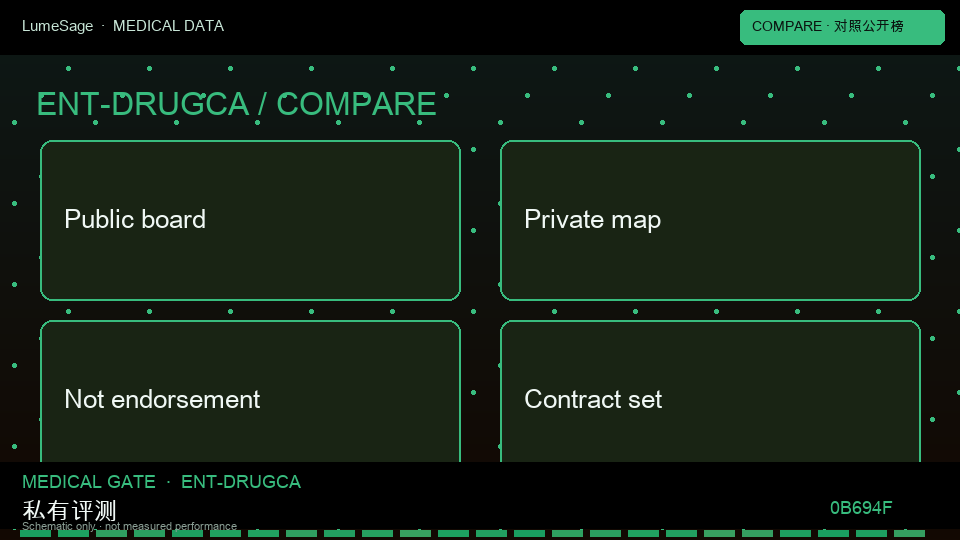
DrugCA / Medication Contraindications: Public controls and private frozen sets are listed separately, only GB-Safety is recognized for passing the test
DrugCA / Medication Contraindications: Public controls and private frozen sets are listed separately, only GB-Safety is recognized for passing the test
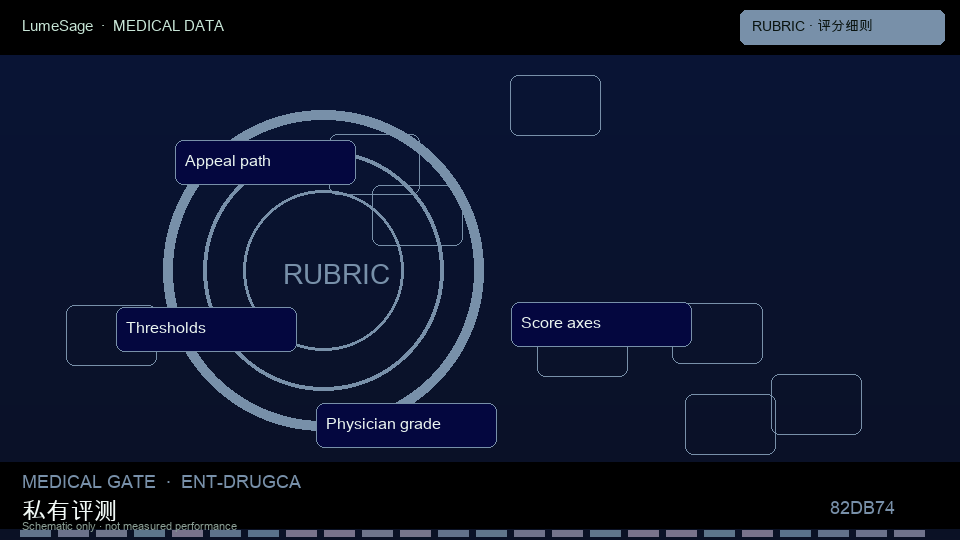
DrugCA / Medication Contraindications: Write down the tiers, thresholds and failure types before going online, and do not replace GB-Safety with public lists
DrugCA / Medication Contraindications: Write down the tiers, thresholds and failure types before going online, and do not replace GB-Safety with public lists
DDx-advanced: Please write down the scoring details and comparison dimensions first. The public total score is not the GB-Clin contract access control.
DDx-advanced: Please write down the scoring details and comparison dimensions first. The public total score is not the GB-Clin contract access control.
When multiple-choice question scores are saturated: the pollution mechanism of public examination results and why private frozen sets become 2026 release gates
When multiple-choice question scores are saturated: the pollution mechanism of public examination results and why private frozen sets become 2026 release gates
Difficulty calibration is not parameter adjustment: hierarchical protocol, tail distribution and contract acceptance fields of examination-type evaluation set
Difficulty calibration is not parameter adjustment: hierarchical protocol, tail distribution and contract acceptance fields of examination-type evaluation set
Controversy over the ecological validity of synthetic dialogue: After clinical journal reminders, how do private clinical title collections supplement the evidence chain?
Controversy over the ecological validity of synthetic dialogue: After clinical journal reminders, how do private clinical title collections supplement the evidence chain?
Hard hallucination online access control: compared with MedHallu, the failure type is written in GB-Safety, and the total score is disclosed without making a contract conclusion
Hard hallucination online access control: compared with MedHallu, the failure type is written in GB-Safety, and the total score is disclosed without making a contract conclusion
Refusal coverage and experience balance: compared with the MedBench safety ethics track, the failure type is written in GB-Safety, and the total score is disclosed without making a contractual conclusion.
Refusal coverage and experience balance: compared with the MedBench safety ethics track, the failure type is written in GB-Safety, and the total score is disclosed without making a contractual conclusion.
CT device domain migration: compared with CheXpert, the failure type is written into GB-Vision, and the total score is disclosed without making a contractual conclusion.
CT device domain migration: compared with CheXpert, the failure type is written into GB-Vision, and the total score is disclosed without making a contractual conclusion.
Pulmonary nodule evaluation reflux sample: Compare failure bucketing and reflux, failure type is written in MG-Loop, and the total score is disclosed without making a contractual conclusion.
Pulmonary nodule evaluation reflux sample: Compare failure bucketing and reflux, failure type is written in MG-Loop, and the total score is disclosed without making a contractual conclusion.
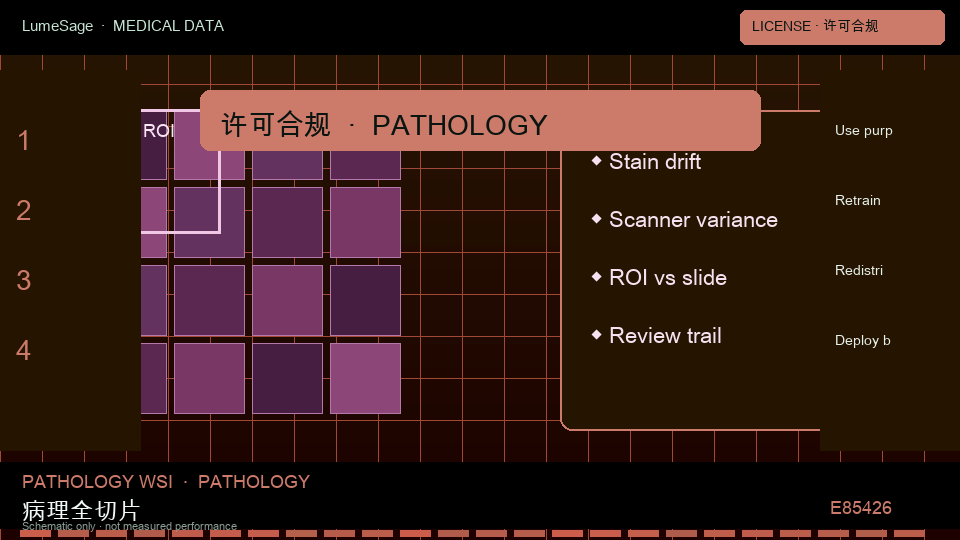
Pathology WSI private topic: Control image-report consistency, failure type is written to GB-Vision, public total score does not make a contractual conclusion
Pathology WSI private topic: Control image-report consistency, failure type is written to GB-Vision, public total score does not make a contractual conclusion
Multiple rounds of triage and referral: compared with CMB-Clin, the failure type is written into GB-Clin, and the total score is disclosed without making a contractual conclusion.
Multiple rounds of triage and referral: compared with CMB-Clin, the failure type is written into GB-Clin, and the total score is disclosed without making a contractual conclusion.
model scorer calibration: compared with HealthBench, the failure type is written into GB-Clin, and the total score is disclosed without making a contractual conclusion.
model scorer calibration: compared with HealthBench, the failure type is written into GB-Clin, and the total score is disclosed without making a contractual conclusion.
Release rejection for high knowledge and low safety: compare with MedBench safety ethics track, write the failure type into GB-Safety, and disclose the total score without making a contractual conclusion
Release rejection for high knowledge and low safety: compare with MedBench safety ethics track, write the failure type into GB-Safety, and disclose the total score without making a contractual conclusion
Financing due diligence pollution field: compare with the pollution audit method, write the failure type in GB-Audit, and disclose the total score without making a contract conclusion
Financing due diligence pollution field: compare with the pollution audit method, write the failure type in GB-Audit, and disclose the total score without making a contract conclusion
Handling of guideline conflict questions: Comparative clinical guideline version evaluation, failure types are written into GB-Exam, and the total score is disclosed without making a contractual conclusion.
Handling of guideline conflict questions: Comparative clinical guideline version evaluation, failure types are written into GB-Exam, and the total score is disclosed without making a contractual conclusion.
Agent tool whitelist: Compare with the governance Agent evaluation, the failure type is written in GB-Clin, and the total score is disclosed without making a contractual conclusion.
Agent tool whitelist: Compare with the governance Agent evaluation, the failure type is written in GB-Clin, and the total score is disclosed without making a contractual conclusion.
Process log access to CI: Compare process audit and hallucination track, failure type is written to GB-Vision, public total score does not make contractual conclusions
Process log access to CI: Compare process audit and hallucination track, failure type is written to GB-Vision, public total score does not make contractual conclusions
Sample-level evidence cutting: compared with Medical Gate private access control, the failure type is written into GB-Audit, and the total score is disclosed without making a contractual conclusion.
Sample-level evidence cutting: compared with Medical Gate private access control, the failure type is written into GB-Audit, and the total score is disclosed without making a contractual conclusion.
Hard subset intergenerational retest: compared with HealthBench Hard, the failure type is written into GB-Clin, and the total score is disclosed without making a contractual conclusion.
Hard subset intergenerational retest: compared with HealthBench Hard, the failure type is written into GB-Clin, and the total score is disclosed without making a contractual conclusion.
Cross-language translation delivery trap: compared with MedQA, the failure type is written in GB-Exam, and the total score is disclosed without making a contractual conclusion.
Cross-language translation delivery trap: compared with MedQA, the failure type is written in GB-Exam, and the total score is disclosed without making a contractual conclusion.
exam set is downgraded to Sentinel: compared with MedMCQA, the failure type is written in GB-Exam, and the total score is disclosed without making a contractual conclusion.
exam set is downgraded to Sentinel: compared with MedMCQA, the failure type is written in GB-Exam, and the total score is disclosed without making a contractual conclusion.
Multimodal reasoning gap: compared with MedBench multimodal track, the failure type is written into GB-Vision, and the total score is disclosed without making a contractual conclusion.
Multimodal reasoning gap: compared with MedBench multimodal track, the failure type is written into GB-Vision, and the total score is disclosed without making a contractual conclusion.
Consensus verification into the due diligence package: compared with HealthBench Consensus, the failure type is written into GB-Audit, and the total score is disclosed without making a contractual conclusion.
Consensus verification into the due diligence package: compared with HealthBench Consensus, the failure type is written into GB-Audit, and the total score is disclosed without making a contractual conclusion.
Continuous Red Team Rhythm: Comparison of Medical Jailbreak and Improper Suggestions, Failure Type Written in GB-Safety, Public Total Score without Contractual Conclusion
Continuous Red Team Rhythm: Comparison of Medical Jailbreak and Improper Suggestions, Failure Type Written in GB-Safety, Public Total Score without Contractual Conclusion
Patch package pricing unit: Compare failure bucketing and reflow, failure type is written into MG-Loop, public total score is not used for contract conclusion
Patch package pricing unit: Compare failure bucketing and reflow, failure type is written into MG-Loop, public total score is not used for contract conclusion
Examination question pollution mechanism: compared with CMB-Exam, the failure type is written into GB-Exam, and the total score is disclosed without making a contractual conclusion.
Examination question pollution mechanism: compared with CMB-Exam, the failure type is written into GB-Exam, and the total score is disclosed without making a contractual conclusion.
Report gold standard source: compared with MIMIC-CXR, the failure type is written in GB-Vision, and the total score is disclosed without making a contractual conclusion.
Report gold standard source: compared with MIMIC-CXR, the failure type is written in GB-Vision, and the total score is disclosed without making a contractual conclusion.
Uncertain option project: compared with MedHallu, the failure type is written in GB-Safety, and the total score is disclosed without making a contract conclusion.
Uncertain option project: compared with MedHallu, the failure type is written in GB-Safety, and the total score is disclosed without making a contract conclusion.
Private frozen collection syntax: control dynamic question change evaluation, failure type is written in GB-Audit, public total score does not make a contractual conclusion
Private frozen collection syntax: control dynamic question change evaluation, failure type is written in GB-Audit, public total score does not make a contractual conclusion
Respiratory Medicine · Hallucinations and inappropriate assertions: compared with MedHallu, the failure type is written in GB-Safety, and the total score is disclosed without making a contractual conclusion
Respiratory Medicine · Hallucinations and inappropriate assertions: compared with MedHallu, the failure type is written in GB-Safety, and the total score is disclosed without making a contractual conclusion
Respiratory Medicine · Refusal to answer and expression of uncertainty: Compare with MedBench safety ethics track, failure type is written in GB-Safety, the total score is disclosed and no contractual conclusion is made
Respiratory Medicine · Refusal to answer and expression of uncertainty: Compare with MedBench safety ethics track, failure type is written in GB-Safety, the total score is disclosed and no contractual conclusion is made
Respiratory Medicine · Equipment and population domain shift: compared with CheXpert, the failure type is written in GB-Vision, and the total score is disclosed without making a contractual conclusion
Respiratory Medicine · Equipment and population domain shift: compared with CheXpert, the failure type is written in GB-Vision, and the total score is disclosed without making a contractual conclusion
Respiratory Medicine · Guideline version conflict: Compare clinical guideline version evaluation, the failure type is written into GB-Exam, and the total score is disclosed without making a contractual conclusion.
Respiratory Medicine · Guideline version conflict: Compare clinical guideline version evaluation, the failure type is written into GB-Exam, and the total score is disclosed without making a contractual conclusion.
Gastroenterology · Hallucinations and improper assertions: compared with MedHallu, the failure type is written in GB-Safety, and the total score is disclosed without making a contractual conclusion
Gastroenterology · Hallucinations and improper assertions: compared with MedHallu, the failure type is written in GB-Safety, and the total score is disclosed without making a contractual conclusion
Gastroenterology · Refusal to answer and expression of uncertainty: Compare with MedBench safety ethics track, failure type is written in GB-Safety, the total score is disclosed and no contractual conclusion is made
Gastroenterology · Refusal to answer and expression of uncertainty: Compare with MedBench safety ethics track, failure type is written in GB-Safety, the total score is disclosed and no contractual conclusion is made
Gastroenterology · Equipment and population domain migration: compared with CheXpert, the failure type is written in GB-Vision, and the total score is disclosed without making a contractual conclusion
Gastroenterology · Equipment and population domain migration: compared with CheXpert, the failure type is written in GB-Vision, and the total score is disclosed without making a contractual conclusion
Gastroenterology · Guideline version conflict: Compare clinical guideline version evaluation, failure type is written in GB-Exam, total score is disclosed and no contractual conclusion is made
Gastroenterology · Guideline version conflict: Compare clinical guideline version evaluation, failure type is written in GB-Exam, total score is disclosed and no contractual conclusion is made
Cardiovascular · Hallucinations and inappropriate assertions: compared with MedHallu, the failure type is written in GB-Safety, and the total score is disclosed without any contractual conclusion.
Cardiovascular · Hallucinations and inappropriate assertions: compared with MedHallu, the failure type is written in GB-Safety, and the total score is disclosed without any contractual conclusion.
Cardiovascular · Refusal to answer and expression of uncertainty: Compare with MedBench safety ethics track, failure type is written in GB-Safety, and the total score is disclosed without making a contractual conclusion
Cardiovascular · Refusal to answer and expression of uncertainty: Compare with MedBench safety ethics track, failure type is written in GB-Safety, and the total score is disclosed without making a contractual conclusion
Cardiovascular · Equipment and population domain shift: compared with CheXpert, the failure type is written in GB-Vision, and the total score is disclosed without making a contractual conclusion
Cardiovascular · Equipment and population domain shift: compared with CheXpert, the failure type is written in GB-Vision, and the total score is disclosed without making a contractual conclusion
Cardiovascular · Guideline version conflict: Compare clinical guideline version evaluation, the failure type is written in GB-Exam, and the total score is disclosed without making a contractual conclusion.
Cardiovascular · Guideline version conflict: Compare clinical guideline version evaluation, the failure type is written in GB-Exam, and the total score is disclosed without making a contractual conclusion.
Neurology · Hallucinations and inappropriate assertions: compared with MedHallu, the failure type is written in GB-Safety, and the total score is disclosed without making a contractual conclusion
Neurology · Hallucinations and inappropriate assertions: compared with MedHallu, the failure type is written in GB-Safety, and the total score is disclosed without making a contractual conclusion
Neurology · Refusal to answer and expression of uncertainty: Compare with MedBench safety ethics track, failure type is written in GB-Safety, total score is disclosed and no contractual conclusion is made
Neurology · Refusal to answer and expression of uncertainty: Compare with MedBench safety ethics track, failure type is written in GB-Safety, total score is disclosed and no contractual conclusion is made
Neurology · Domain shift of equipment and people: compared with CheXpert, the failure type is written in GB-Vision, and the total score is disclosed without making a contractual conclusion
Neurology · Domain shift of equipment and people: compared with CheXpert, the failure type is written in GB-Vision, and the total score is disclosed without making a contractual conclusion
Neurology · Guideline version conflict: Compare clinical guideline version evaluation, the failure type is written into GB-Exam, and the total score is disclosed without making a contractual conclusion.
Neurology · Guideline version conflict: Compare clinical guideline version evaluation, the failure type is written into GB-Exam, and the total score is disclosed without making a contractual conclusion.
Medical Oncology · Hallucinations and improper assertions: compared with MedHallu, the failure type is written in GB-Safety, and the total score is disclosed without making a contractual conclusion
Medical Oncology · Hallucinations and improper assertions: compared with MedHallu, the failure type is written in GB-Safety, and the total score is disclosed without making a contractual conclusion
Medical Oncology · Refusal to answer and expression of uncertainty: compared with MedBench safety ethics track, failure type is written in GB-Safety, and the total score is disclosed without making a contractual conclusion
Medical Oncology · Refusal to answer and expression of uncertainty: compared with MedBench safety ethics track, failure type is written in GB-Safety, and the total score is disclosed without making a contractual conclusion
Medical Oncology · Equipment and population domain migration: compared with CheXpert, the failure type is written into GB-Vision, and the total score is disclosed without making a contractual conclusion
Medical Oncology · Equipment and population domain migration: compared with CheXpert, the failure type is written into GB-Vision, and the total score is disclosed without making a contractual conclusion
Medical Oncology · Guideline Version Conflict: Compare clinical guideline version evaluation, failure type is written in GB-Exam, total score is disclosed and no contractual conclusion is made
Medical Oncology · Guideline Version Conflict: Compare clinical guideline version evaluation, failure type is written in GB-Exam, total score is disclosed and no contractual conclusion is made
Obstetrics and Gynecology · Hallucinations and improper assertions: compared with MedHallu, the failure type is written in GB-Safety, and the total score is disclosed without making a contractual conclusion
Obstetrics and Gynecology · Hallucinations and improper assertions: compared with MedHallu, the failure type is written in GB-Safety, and the total score is disclosed without making a contractual conclusion
Obstetrics and Gynecology · Refusal to answer and expression of uncertainty: Compare with MedBench safety ethics track, failure type is written in GB-Safety, and the total score is disclosed without making a contractual conclusion
Obstetrics and Gynecology · Refusal to answer and expression of uncertainty: Compare with MedBench safety ethics track, failure type is written in GB-Safety, and the total score is disclosed without making a contractual conclusion
Obstetrics and Gynecology · Equipment and population domain migration: compared with CheXpert, the failure type is written in GB-Vision, and the total score is disclosed without making a contractual conclusion
Obstetrics and Gynecology · Equipment and population domain migration: compared with CheXpert, the failure type is written in GB-Vision, and the total score is disclosed without making a contractual conclusion
Obstetrics and Gynecology · Guideline version conflict: Compare clinical guideline version evaluation, the failure type is written into GB-Exam, and the total score is disclosed without making a contractual conclusion.
Obstetrics and Gynecology · Guideline version conflict: Compare clinical guideline version evaluation, the failure type is written into GB-Exam, and the total score is disclosed without making a contractual conclusion.
Pediatrics · Hallucinations and inappropriate assertions: compared with MedHallu, the failure type is written in GB-Safety, and the total score is disclosed without making a contractual conclusion
Pediatrics · Hallucinations and inappropriate assertions: compared with MedHallu, the failure type is written in GB-Safety, and the total score is disclosed without making a contractual conclusion
Pediatrics · Refusal to answer and expression of uncertainty: compared with MedBench safety ethics track, failure type is written in GB-Safety, and the total score is disclosed without making a contractual conclusion
Pediatrics · Refusal to answer and expression of uncertainty: compared with MedBench safety ethics track, failure type is written in GB-Safety, and the total score is disclosed without making a contractual conclusion
Pediatrics · Equipment and population domain migration: compared with CheXpert, the failure type is written in GB-Vision, and the total score is disclosed without making a contractual conclusion
Pediatrics · Equipment and population domain migration: compared with CheXpert, the failure type is written in GB-Vision, and the total score is disclosed without making a contractual conclusion
Pediatrics · Guideline version conflict: Compare clinical guideline version evaluation, the failure type is written into GB-Exam, and the total score is disclosed without making a contractual conclusion.
Pediatrics · Guideline version conflict: Compare clinical guideline version evaluation, the failure type is written into GB-Exam, and the total score is disclosed without making a contractual conclusion.
Orthopedics · Hallucinations and improper assertions: compared with MedHallu, the failure type is written in GB-Safety, and the total score is disclosed without making a contractual conclusion
Orthopedics · Hallucinations and improper assertions: compared with MedHallu, the failure type is written in GB-Safety, and the total score is disclosed without making a contractual conclusion
Orthopedics · Refusal to answer and expression of uncertainty: Compare with MedBench safety ethics track, failure type is written in GB-Safety, the total score is disclosed and no contractual conclusion is made
Orthopedics · Refusal to answer and expression of uncertainty: Compare with MedBench safety ethics track, failure type is written in GB-Safety, the total score is disclosed and no contractual conclusion is made
Orthopedics · Equipment and population domain migration: compared with CheXpert, the failure type is written in GB-Vision, and the total score is disclosed without making a contractual conclusion
Orthopedics · Equipment and population domain migration: compared with CheXpert, the failure type is written in GB-Vision, and the total score is disclosed without making a contractual conclusion
Orthopedics · Guideline version conflict: Compare clinical guideline version evaluation, the failure type is written into GB-Exam, and the total score is disclosed without making a contractual conclusion.
Orthopedics · Guideline version conflict: Compare clinical guideline version evaluation, the failure type is written into GB-Exam, and the total score is disclosed without making a contractual conclusion.
Ophthalmology · Hallucinations and improper assertions: compared with MedHallu, the failure type is written in GB-Safety, and the total score is disclosed without making a contractual conclusion
Ophthalmology · Hallucinations and improper assertions: compared with MedHallu, the failure type is written in GB-Safety, and the total score is disclosed without making a contractual conclusion
Ophthalmology · Refusal to answer and expression of uncertainty: Compare with MedBench safety ethics track, failure type is written in GB-Safety, and the total score is disclosed without making a contractual conclusion
Ophthalmology · Refusal to answer and expression of uncertainty: Compare with MedBench safety ethics track, failure type is written in GB-Safety, and the total score is disclosed without making a contractual conclusion
Ophthalmology · Equipment and population domain migration: compared with CheXpert, the failure type is written in GB-Vision, and the total score is disclosed without making a contractual conclusion
Ophthalmology · Equipment and population domain migration: compared with CheXpert, the failure type is written in GB-Vision, and the total score is disclosed without making a contractual conclusion
Ophthalmology · Guideline version conflict: Compare clinical guideline version evaluation, the failure type is written into GB-Exam, and the total score is disclosed without making a contractual conclusion.
Ophthalmology · Guideline version conflict: Compare clinical guideline version evaluation, the failure type is written into GB-Exam, and the total score is disclosed without making a contractual conclusion.
Dermatology · Hallucinations and inappropriate assertions: compared with MedHallu, the failure type is written in GB-Safety, and the total score is disclosed without making a contractual conclusion
Dermatology · Hallucinations and inappropriate assertions: compared with MedHallu, the failure type is written in GB-Safety, and the total score is disclosed without making a contractual conclusion
Dermatology · Refusal to answer and expression of uncertainty: Compare with MedBench safety ethics track, failure type is written in GB-Safety, and the total score is disclosed without making a contractual conclusion
Dermatology · Refusal to answer and expression of uncertainty: Compare with MedBench safety ethics track, failure type is written in GB-Safety, and the total score is disclosed without making a contractual conclusion
Dermatology · Equipment and population domain migration: compared with CheXpert, the failure type is written in GB-Vision, and the total score is disclosed without making a contractual conclusion
Dermatology · Equipment and population domain migration: compared with CheXpert, the failure type is written in GB-Vision, and the total score is disclosed without making a contractual conclusion
Dermatology · Guideline version conflict: Compare clinical guideline version evaluation, the failure type is written into GB-Exam, and the total score is disclosed without making a contractual conclusion.
Dermatology · Guideline version conflict: Compare clinical guideline version evaluation, the failure type is written into GB-Exam, and the total score is disclosed without making a contractual conclusion.
Emergency Medicine · Hallucinations and inappropriate assertions: compared with MedHallu, the failure type is written in GB-Safety, and the total score is disclosed without making a contractual conclusion
Emergency Medicine · Hallucinations and inappropriate assertions: compared with MedHallu, the failure type is written in GB-Safety, and the total score is disclosed without making a contractual conclusion
Emergency Medicine · Refusal to answer and expression of uncertainty: compared with MedBench safety ethics track, failure type is written in GB-Safety, and the total score is disclosed without making a contractual conclusion
Emergency Medicine · Refusal to answer and expression of uncertainty: compared with MedBench safety ethics track, failure type is written in GB-Safety, and the total score is disclosed without making a contractual conclusion
Emergency Medicine · Equipment and population domain shift: compared with CheXpert, the failure type is written into GB-Vision, and the total score is disclosed without making a contractual conclusion
Emergency Medicine · Equipment and population domain shift: compared with CheXpert, the failure type is written into GB-Vision, and the total score is disclosed without making a contractual conclusion
Emergency Medicine · Guideline Version Conflict: Comparison Clinical Guideline Version Evaluation, the failure type is written into GB-Exam, and the total score is disclosed without making a contractual conclusion
Emergency Medicine · Guideline Version Conflict: Comparison Clinical Guideline Version Evaluation, the failure type is written into GB-Exam, and the total score is disclosed without making a contractual conclusion
Critical care medicine · Hallucinations and inappropriate assertions: compared with MedHallu, the failure type is written in GB-Safety, and the total score is disclosed without making a contractual conclusion
Critical care medicine · Hallucinations and inappropriate assertions: compared with MedHallu, the failure type is written in GB-Safety, and the total score is disclosed without making a contractual conclusion
Critical Care Medicine · Refusal to answer and expression of uncertainty: compared with MedBench safety ethics track, failure type is written in GB-Safety, and the total score is disclosed without making a contractual conclusion
Critical Care Medicine · Refusal to answer and expression of uncertainty: compared with MedBench safety ethics track, failure type is written in GB-Safety, and the total score is disclosed without making a contractual conclusion
Critical Care Medicine · Domain shift of equipment and people: compared with CheXpert, the failure type is written in GB-Vision, and the total score is disclosed without making a contractual conclusion
Critical Care Medicine · Domain shift of equipment and people: compared with CheXpert, the failure type is written in GB-Vision, and the total score is disclosed without making a contractual conclusion
Critical Care Medicine · Guideline Version Conflict: Comparison Clinical Guideline Version Evaluation, the failure type is written into GB-Exam, and the total score is disclosed without making a contractual conclusion
Critical Care Medicine · Guideline Version Conflict: Comparison Clinical Guideline Version Evaluation, the failure type is written into GB-Exam, and the total score is disclosed without making a contractual conclusion
Endocrinology · Hallucinations and inappropriate assertions: compared with MedHallu, the failure type is written in GB-Safety, and the total score is disclosed without making a contractual conclusion
Endocrinology · Hallucinations and inappropriate assertions: compared with MedHallu, the failure type is written in GB-Safety, and the total score is disclosed without making a contractual conclusion
Endocrinology · Refusal to answer and expression of uncertainty: Compare with MedBench safety ethics track, failure type is written in GB-Safety, the total score is disclosed and no contractual conclusion is made
Endocrinology · Refusal to answer and expression of uncertainty: Compare with MedBench safety ethics track, failure type is written in GB-Safety, the total score is disclosed and no contractual conclusion is made
Endocrinology · Equipment and population domain shift: compared with CheXpert, the failure type is written in GB-Vision, and the total score is disclosed without making a contractual conclusion
Endocrinology · Equipment and population domain shift: compared with CheXpert, the failure type is written in GB-Vision, and the total score is disclosed without making a contractual conclusion
Endocrinology · Guideline version conflict: Comparison clinical guideline version evaluation, failure type is written in GB-Exam, the total score is disclosed and no contractual conclusion is made
Endocrinology · Guideline version conflict: Comparison clinical guideline version evaluation, failure type is written in GB-Exam, the total score is disclosed and no contractual conclusion is made
Nephrology · Hallucinations and inappropriate assertions: compared with MedHallu, the failure type is written in GB-Safety, and the total score is disclosed without making a contractual conclusion
Nephrology · Hallucinations and inappropriate assertions: compared with MedHallu, the failure type is written in GB-Safety, and the total score is disclosed without making a contractual conclusion
Nephrology · Refusal to answer and expression of uncertainty: Compare with MedBench safety ethics track, failure type is written in GB-Safety, the total score is disclosed and no contractual conclusion is made
Nephrology · Refusal to answer and expression of uncertainty: Compare with MedBench safety ethics track, failure type is written in GB-Safety, the total score is disclosed and no contractual conclusion is made
Nephrology · Equipment and population domain migration: compared with CheXpert, the failure type is written into GB-Vision, and the total score is disclosed without making a contract conclusion
Nephrology · Equipment and population domain migration: compared with CheXpert, the failure type is written into GB-Vision, and the total score is disclosed without making a contract conclusion
Nephrology · Guideline version conflict: Compare clinical guideline version evaluation, the failure type is written into GB-Exam, and the total score is disclosed without making a contractual conclusion.
Nephrology · Guideline version conflict: Compare clinical guideline version evaluation, the failure type is written into GB-Exam, and the total score is disclosed without making a contractual conclusion.
Department of Hematology · Hallucinations and improper assertions: compared with MedHallu, the failure type is written in GB-Safety, and the total score is disclosed without making a contractual conclusion
Department of Hematology · Hallucinations and improper assertions: compared with MedHallu, the failure type is written in GB-Safety, and the total score is disclosed without making a contractual conclusion
Department of Hematology · Refusal to answer and expression of uncertainty: Compare with MedBench safety ethics track, failure type is written in GB-Safety, and the total score is disclosed without making a contractual conclusion
Department of Hematology · Refusal to answer and expression of uncertainty: Compare with MedBench safety ethics track, failure type is written in GB-Safety, and the total score is disclosed without making a contractual conclusion
Hematology Department · Equipment and population domain migration: compared with CheXpert, the failure type is written into GB-Vision, and the total score is disclosed without making a contractual conclusion
Hematology Department · Equipment and population domain migration: compared with CheXpert, the failure type is written into GB-Vision, and the total score is disclosed without making a contractual conclusion
Department of Hematology · Guideline version conflict: Compare clinical guideline version evaluation, the failure type is written into GB-Exam, and the total score is disclosed without making a contractual conclusion.
Department of Hematology · Guideline version conflict: Compare clinical guideline version evaluation, the failure type is written into GB-Exam, and the total score is disclosed without making a contractual conclusion.
Department of Infectious Diseases · Hallucinations and inappropriate assertions: compared with MedHallu, the failure type is written in GB-Safety, and the total score is disclosed without making a contractual conclusion
Department of Infectious Diseases · Hallucinations and inappropriate assertions: compared with MedHallu, the failure type is written in GB-Safety, and the total score is disclosed without making a contractual conclusion
Department of Infectious Disease · Refusal to answer and expression of uncertainty: compared with MedBench safety ethics track, failure type is written in GB-Safety, and the total score is disclosed without making a contractual conclusion
Department of Infectious Disease · Refusal to answer and expression of uncertainty: compared with MedBench safety ethics track, failure type is written in GB-Safety, and the total score is disclosed without making a contractual conclusion
Department of Infectious Disease · Equipment and population domain migration: compared with CheXpert, the failure type is written into GB-Vision, and the total score is disclosed without making a contractual conclusion.
Department of Infectious Disease · Equipment and population domain migration: compared with CheXpert, the failure type is written into GB-Vision, and the total score is disclosed without making a contractual conclusion.
Department of Infectious Diseases · Guideline version conflict: Compare clinical guideline version evaluation, failure type is written into GB-Exam, and the total score is disclosed without making a contractual conclusion.
Department of Infectious Diseases · Guideline version conflict: Compare clinical guideline version evaluation, failure type is written into GB-Exam, and the total score is disclosed without making a contractual conclusion.
Rheumatism Immunity · Hallucinations and inappropriate assertions: compared with MedHallu, the failure type is written in GB-Safety, and the total score is disclosed without making a contractual conclusion.
Rheumatism Immunity · Hallucinations and inappropriate assertions: compared with MedHallu, the failure type is written in GB-Safety, and the total score is disclosed without making a contractual conclusion.
Rheumatology and Immunology · Refusal to answer and expression of uncertainty: Compare with MedBench safety ethics track, failure type is written in GB-Safety, and the total score is disclosed without making a contractual conclusion
Rheumatology and Immunology · Refusal to answer and expression of uncertainty: Compare with MedBench safety ethics track, failure type is written in GB-Safety, and the total score is disclosed without making a contractual conclusion
Rheumatism Immunity · Device and population domain migration: compared with CheXpert, the failure type is written in GB-Vision, and the total score is disclosed without making a contractual conclusion
Rheumatism Immunity · Device and population domain migration: compared with CheXpert, the failure type is written in GB-Vision, and the total score is disclosed without making a contractual conclusion
Rheumatology and Immunology · Guideline version conflict: Compare clinical guideline version evaluation, failure type is written in GB-Exam, and the total score is disclosed without making a contractual conclusion
Rheumatology and Immunology · Guideline version conflict: Compare clinical guideline version evaluation, failure type is written in GB-Exam, and the total score is disclosed without making a contractual conclusion
Department of Urology · Hallucinations and inappropriate assertions: compared with MedHallu, the failure type is written in GB-Safety, and the total score is disclosed without making a contractual conclusion
Department of Urology · Hallucinations and inappropriate assertions: compared with MedHallu, the failure type is written in GB-Safety, and the total score is disclosed without making a contractual conclusion
Department of Urology · Refusal to answer and expression of uncertainty: compared with MedBench safety ethics track, failure type is written in GB-Safety, and the total score is disclosed without making a contractual conclusion
Department of Urology · Refusal to answer and expression of uncertainty: compared with MedBench safety ethics track, failure type is written in GB-Safety, and the total score is disclosed without making a contractual conclusion
Department of Urology · Domain shift of equipment and people: compared with CheXpert, the failure type is written in GB-Vision, and the total score is disclosed without making a contractual conclusion
Department of Urology · Domain shift of equipment and people: compared with CheXpert, the failure type is written in GB-Vision, and the total score is disclosed without making a contractual conclusion
Urology · Guideline version conflict: Compare clinical guideline version evaluation, the failure type is written into GB-Exam, and the total score is disclosed without making a contractual conclusion.
Urology · Guideline version conflict: Compare clinical guideline version evaluation, the failure type is written into GB-Exam, and the total score is disclosed without making a contractual conclusion.
General Surgery · Hallucinations and improper assertions: compared with MedHallu, the failure type is written in GB-Safety, and the total score is disclosed without making a contractual conclusion
General Surgery · Hallucinations and improper assertions: compared with MedHallu, the failure type is written in GB-Safety, and the total score is disclosed without making a contractual conclusion
General Surgery · Refusal to answer and expression of uncertainty: compared with MedBench safety ethics track, failure type is written in GB-Safety, and the total score is disclosed without making a contractual conclusion
General Surgery · Refusal to answer and expression of uncertainty: compared with MedBench safety ethics track, failure type is written in GB-Safety, and the total score is disclosed without making a contractual conclusion
General Surgery · Domain shift of equipment and people: compared with CheXpert, the failure type is written in GB-Vision, and the total score is disclosed without making a contractual conclusion
General Surgery · Domain shift of equipment and people: compared with CheXpert, the failure type is written in GB-Vision, and the total score is disclosed without making a contractual conclusion
General Surgery · Guideline Version Conflict: Compare clinical guideline version evaluation, failure type is written in GB-Exam, the total score is disclosed and no contractual conclusion is made
General Surgery · Guideline Version Conflict: Compare clinical guideline version evaluation, failure type is written in GB-Exam, the total score is disclosed and no contractual conclusion is made
Thoracic Surgery · Hallucinations and inappropriate assertions: compared with MedHallu, the failure type is written in GB-Safety, and the total score is disclosed without making a contractual conclusion
Thoracic Surgery · Hallucinations and inappropriate assertions: compared with MedHallu, the failure type is written in GB-Safety, and the total score is disclosed without making a contractual conclusion
Thoracic Surgery · Refusal to answer and expression of uncertainty: compared with the MedBench safety ethics track, the failure type is written in GB-Safety, and the total score is disclosed without making a contractual conclusion.
Thoracic Surgery · Refusal to answer and expression of uncertainty: compared with the MedBench safety ethics track, the failure type is written in GB-Safety, and the total score is disclosed without making a contractual conclusion.
Thoracic Surgery · Domain shift of equipment and people: compared with CheXpert, the failure type is written in GB-Vision, and the total score is disclosed without making a contractual conclusion
Thoracic Surgery · Domain shift of equipment and people: compared with CheXpert, the failure type is written in GB-Vision, and the total score is disclosed without making a contractual conclusion
Thoracic Surgery · Guideline version conflict: Compare clinical guideline version evaluation, failure type is written in GB-Exam, and the total score is disclosed without making a contractual conclusion
Thoracic Surgery · Guideline version conflict: Compare clinical guideline version evaluation, failure type is written in GB-Exam, and the total score is disclosed without making a contractual conclusion
Pathology Department · Hallucinations and inappropriate assertions: compared with MedHallu, the failure type is written in GB-Safety, and the total score is disclosed without making a contractual conclusion
Pathology Department · Hallucinations and inappropriate assertions: compared with MedHallu, the failure type is written in GB-Safety, and the total score is disclosed without making a contractual conclusion
Department of Pathology · Refusal to answer and expression of uncertainty: compared with MedBench safety ethics track, failure type is written in GB-Safety, and the total score is disclosed without making a contractual conclusion
Department of Pathology · Refusal to answer and expression of uncertainty: compared with MedBench safety ethics track, failure type is written in GB-Safety, and the total score is disclosed without making a contractual conclusion
Pathology Department · Equipment and population domain migration: compared with CheXpert, the failure type is written into GB-Vision, and the total score is disclosed without making a contractual conclusion
Pathology Department · Equipment and population domain migration: compared with CheXpert, the failure type is written into GB-Vision, and the total score is disclosed without making a contractual conclusion
Department of Pathology · Guideline version conflict: Comparison clinical guideline version evaluation, failure type is written in GB-Exam, the total score is disclosed and no contractual conclusion is made
Department of Pathology · Guideline version conflict: Comparison clinical guideline version evaluation, failure type is written in GB-Exam, the total score is disclosed and no contractual conclusion is made
Imaging Department · Hallucinations and improper assertions: compared with MedHallu, the failure type is written in GB-Safety, and the total score is disclosed without making a contractual conclusion
Imaging Department · Hallucinations and improper assertions: compared with MedHallu, the failure type is written in GB-Safety, and the total score is disclosed without making a contractual conclusion
Department of Imaging · Refusal to answer and expression of uncertainty: Compare with MedBench safety ethics track, failure type is written in GB-Safety, the total score is disclosed and no contractual conclusion is made
Department of Imaging · Refusal to answer and expression of uncertainty: Compare with MedBench safety ethics track, failure type is written in GB-Safety, the total score is disclosed and no contractual conclusion is made
Imaging Department · Equipment and population domain migration: compared with CheXpert, the failure type is written into GB-Vision, and the total score is disclosed without making a contractual conclusion
Imaging Department · Equipment and population domain migration: compared with CheXpert, the failure type is written into GB-Vision, and the total score is disclosed without making a contractual conclusion
Imaging Department · Guideline version conflict: Compare clinical guideline version evaluation, the failure type is written into GB-Exam, and the total score is disclosed without making a contractual conclusion.
Imaging Department · Guideline version conflict: Compare clinical guideline version evaluation, the failure type is written into GB-Exam, and the total score is disclosed without making a contractual conclusion.
Physical Examination Center · Hallucinations and improper assertions: compared with MedHallu, the failure type is written in GB-Safety, and the total score is disclosed without making a contractual conclusion.
Physical Examination Center · Hallucinations and improper assertions: compared with MedHallu, the failure type is written in GB-Safety, and the total score is disclosed without making a contractual conclusion.
Physical Examination Center · Refusal to answer and expression of uncertainty: Compare with MedBench safety ethics track, failure type is written in GB-Safety, and the total score is disclosed without making a contractual conclusion
Physical Examination Center · Refusal to answer and expression of uncertainty: Compare with MedBench safety ethics track, failure type is written in GB-Safety, and the total score is disclosed without making a contractual conclusion
Physical Examination Center · Equipment and population domain migration: compared with CheXpert, the failure type is written into GB-Vision, and the total score is disclosed without making a contract conclusion
Physical Examination Center · Equipment and population domain migration: compared with CheXpert, the failure type is written into GB-Vision, and the total score is disclosed without making a contract conclusion
Physical Examination Center · Guideline version conflict: Compare clinical guideline version evaluation, the failure type is written into GB-Exam, and the total score is disclosed without making a contractual conclusion.
Physical Examination Center · Guideline version conflict: Compare clinical guideline version evaluation, the failure type is written into GB-Exam, and the total score is disclosed without making a contractual conclusion.
Psychiatry · Hallucinations and improper assertions: compared with MedHallu, the failure type is written in GB-Safety, and the total score is disclosed without making a contractual conclusion
Psychiatry · Hallucinations and improper assertions: compared with MedHallu, the failure type is written in GB-Safety, and the total score is disclosed without making a contractual conclusion
Mental Psychology · Refusal to answer and expression of uncertainty: Compare with MedBench safety ethics track, failure type is written in GB-Safety, and the total score is disclosed without making a contractual conclusion
Mental Psychology · Refusal to answer and expression of uncertainty: Compare with MedBench safety ethics track, failure type is written in GB-Safety, and the total score is disclosed without making a contractual conclusion
Mental Psychology · Domain shift of equipment and people: compared with CheXpert, the failure type is written in GB-Vision, and the total score is disclosed without making a contractual conclusion
Mental Psychology · Domain shift of equipment and people: compared with CheXpert, the failure type is written in GB-Vision, and the total score is disclosed without making a contractual conclusion
Mental Psychology · Guideline Version Conflict: Comparison Clinical Guideline Version Evaluation, the failure type is written in GB-Exam, and the total score is disclosed without making a contractual conclusion
Mental Psychology · Guideline Version Conflict: Comparison Clinical Guideline Version Evaluation, the failure type is written in GB-Exam, and the total score is disclosed without making a contractual conclusion
Intergenerational briefing: Before HealthBench Hard is saturated, don’t use the overall score to declare that the consultation product has passed the test.
Intergenerational briefing: Before HealthBench Hard is saturated, don’t use the overall score to declare that the consultation product has passed the test.
Intergenerational briefing: The gap between knowledge score and safety score is still there, and the publishing narrative cannot return to a single total score.
Intergenerational briefing: The gap between knowledge score and safety score is still there, and the publishing narrative cannot return to a single total score.
Medical Gate private review: question set, detailed rules, contamination prevention and failed reflow
Private evaluation is used to discover shortcomings and write the shortcomings into specifications for the next package of data or the next set of questions. It is not proof that scores will necessarily rise after purchase, nor is it a promise of clinical efficacy.
Breast imaging BI-RADS specification package: Acceptable for delivery in general imaging assets
Explains how to list breast or mammography target subsets separately in the general medical imaging asset catalog, write the BI-RADS related category dictionary, image quality and postoperative changes and other labels, guideline version, physician final review and double-read arbitration, permission boundary and trial delivery into the acceptability data card; and combine Radiology, MedIA, MICCAI, Lancet Digital Health and NEJMOpen discussion directions such as AI, and provide evaluation buckets and patch reflow suggestions corresponding to issues such as consistency, device layering, and human-machine processes.
Physical examination multi-modal data package: batch, subset, data card and license entry
explains how to avoid measurement and acceptance disputes caused by "big and unbounded" through batch management, image inspection text subset classification, honest disclosure of review scope, desensitization and licensing entrance, trial delivery acceptance, and Medical Gate failure bucketing and reflow; combined with the directions of public discussions such as Lancet Digital Health, Nature Medicine, NEJM AI, MICCAI, and MedIA, it provides modal missing, time alignment, and deployment drift.
Pathology WSI review set: expert final review, quality control metadata and contractable delivery
is aimed at pathology departments, computational pathology research groups and algorithm purchasers, and details how the pathology whole slide (WSI) review set includes the expert final review level, double-read arbitration, quality control metadata, scanning and staining conditions, tool chain format and retraining and redistribution license into the contract attachment; and transcribes MedIA, MICCAI, Nature Medicine, Lancet Digital Health and NEJMCommon topics in public discussion areas such as AI regarding coloration drift, multi-center generalization and auditable evaluation
Pathological full-section digital images and diagnostic reports: Medical Gate Write the next package specification with the failure type. The public score is not a contract access control
Private evaluation is used to discover shortcomings and write the shortcomings into specifications for the next package of data or the next set of questions. It is not proof that scores will necessarily rise after purchase, nor is it a promise of clinical efficacy.
Pathological whole section digital images and diagnostic reports: trial delivery to check whether it can be opened, dictionary version, checklist and quality inspection report
The test delivery and acceptance test is whether both parties have a consistent understanding of the specifications, not that the model can be used. Prioritize to check whether the read link, tag dictionary, manifest hash and quality inspection report can be opened by the buyer himself.
The answer to the
Pathological whole section digital images and diagnostic reports: The data card first freezes the task definition, positive standard, counting unit, and guide or dictionary version
specification is not that the data is very large, but whether both parties can make the same judgment on the same sample when they open the same field table during acceptance.
Pathology full slide digital image and diagnostic report: label clearly indicate category boundaries, double reading ratio, divergence denominator, and who will complete the final review by the physician
label is the task definition, and quality control is the evidence whether this batch of labels can be trusted. The final review level, double reading ratio, disagreement arbitrator and random inspection denominator are closer to reviewability than a sentence of physician review.
Pathological whole-slice digital images and diagnostic reports: permission to write training, evaluation and demonstration separately, and indicate whether it can be retrained, redistributed and deployed
licenses separate at least the purpose of use, retraining, redistribution, deployment boundaries and duration. Desensitization describes the technical processing, and authorization describes who allows the data to be used for which model.
Pathological full-slice digital images and diagnostic reports: write failures into acceptable layers according to equipment, protocols, populations and artifacts, and then decide on difficult cases to patch
Layering is so that failures can be named. Hard-case patches are purchased based on the failure type, otherwise some similar data will be purchased. When there are insufficient samples in a certain layer, the report will be written as not covered.
Pathological whole-slice digital images and diagnostic reports: Please prepare the tasks, exclusion criteria, licenses, trial delivery and final review requirements before making an inquiry.
Useful materials before making an inquiry are the task, modality, guideline version, whether final review by a physician is required, whether a confidentiality agreement should be signed first, and whether trial delivery should be done first or private evaluation should be done first.
Fundus and OCT specialist data: task splitting, quality control dictionary and private evaluation reflow
is aimed at ophthalmic artificial intelligence research and development and hospital research groups, explaining how fundus color photos and OCT specialist data are unpacked according to disease tasks, equipment and scanning protocols, image quality dictionary and uncertain categories, and bucketing the final review of specialist doctors, trial delivery reading verification and Medical Gate failure into procurement attachments; combined with the direction of public discussions such as Lancet Digital Health, Nature Medicine, NEJM AI, MICCAI and MedIA, sorting out the screening process and generalization
Structured medical records and clinical texts: medical LLM data cards, random examinations and private question sets
is aimed at medical large model procurement, hospital informatization and algorithm engineering teams, explaining how structured electronic medical records and clinical text assets disclose document types, patient-level measurements, desensitization and residual risks, retraining and redistribution permissions, and expert review ratios through data cards; and implement contamination prevention, rejection and safety scoring, and evidence fragment review using the Medical Gate text question set. The article combines the directions of public discussions on NEJM AI, Nature Medicine and Lancet Digital Health.
Chest CT pulmonary nodule data procurement: How to write specifications, physician final review and data card into the contract
is aimed at hospital information departments, radiology research groups, and medical large model procurement teams. It systematically explains how chest CT lung nodule training and evaluation assets write task specifications, positive definitions, guideline versions, physician final review random checks, license boundaries, and small batch trial delivery into verifiable data cards; it also combines the public discussion directions in Nature Medicine, Lancet Digital Health, Radiology, MedIA, MICCAI, and NEJM AI to sort out generalization, consistency, and privacy.
CCTA–ICA–FFR Coronary Functional Matching Data Package: Medical Gate Write the next package specification with the failure type. The public score is not a contract gate.
Private evaluation is used to discover shortcomings and write the shortcomings into specifications for the next package of data or the next set of questions. It is not proof that scores will necessarily rise after purchase, nor is it a promise of clinical efficacy.
CCTA–ICA–FFR coronary functional matching data package: trial delivery to check whether it can be opened, dictionary version, checklist and quality inspection report
The test delivery and acceptance test is whether both parties have a consistent understanding of the specifications, not that the model can be used. Prioritize to check whether the read link, tag dictionary, manifest hash and quality inspection report can be opened by the buyer himself.
The answer to the
CCTA–ICA–FFR Coronary Functional Matching Data Package: Data card first freezes task definition, positive standard, counting unit, and guideline or dictionary version
specification is not that the data is very large, but whether both parties can make the same judgment on the same sample when they open the same field table during acceptance.
CCTA–ICA–FFR Coronary Functional Matching Data Package: Label clearly states the category boundaries, double reading ratio, divergence denominator, and who will complete the final review by the physician
label is the task definition, and quality control is the evidence whether this batch of labels can be trusted. The final review level, double reading ratio, disagreement arbitrator and random inspection denominator are closer to reviewability than a sentence of physician review.
CCTA–ICA–FFR coronary functional matching data package: permission to write training, evaluation and demonstration separately, and indicate whether it can be retrained, redistributed and deployed
licenses separate at least the purpose of use, retraining, redistribution, deployment boundaries and duration. Desensitization describes the technical processing, and authorization describes who allows the data to be used for which model.
CCTA–ICA–FFR Coronary Functional Matching Data Package: Write failures into acceptable tiers by device, protocol, population, and artifacts, and then decide on difficult patches
Layering is so that failures can be named. Hard-case patches are purchased based on the failure type, otherwise some similar data will be purchased. When there are insufficient samples in a certain layer, the report will be written as not covered.
CCTA–ICA–FFR Coronary Functional Matching Data Package: Please prepare task summary, exclusion criteria, licensing boundaries, trial delivery scope, and whether final physician review is required before requesting a quote
Useful materials before making an inquiry are the task, modality, guideline version, whether final review by a physician is required, whether a confidentiality agreement should be signed first, and whether trial delivery should be done first or private evaluation should be done first.
CT · Oral and maxillofacial specialty specification package: Medical Gate Write the next package of specifications using the failure type. The public list score is not a contract access control
Private evaluation is used to discover shortcomings and write the shortcomings into specifications for the next package of data or the next set of questions. It is not proof that scores will necessarily rise after purchase, nor is it a promise of clinical efficacy.
CT · Oral and maxillofacial specialist specification package: trial delivery to check whether it can be opened, dictionary version, checklist and quality inspection report
The test delivery and acceptance test is whether both parties have a consistent understanding of the specifications, not that the model can be used. Prioritize to check whether the read link, tag dictionary, manifest hash and quality inspection report can be opened by the buyer himself.
The answer to the
CT · Oral and maxillofacial specialty specification package: data card first freezes task definition, positive standard, counting unit, and guide or dictionary version
specification is not that the data is very large, but whether both parties can make the same judgment on the same sample when they open the same field table during acceptance.
CT · Oral and Maxillofacial Specialty Specification Package: The label clearly states the category boundaries, double reading ratio, divergent denominator, and who will complete the final review by the physician.
label is the task definition, and quality control is the evidence whether this batch of labels can be trusted. The final review level, double reading ratio, disagreement arbitrator and random inspection denominator are closer to reviewability than a sentence of physician review.
CT · Oral and Maxillofacial Specialty Specification Package: Allowed to write training, evaluation and demonstration separately, and indicate whether it can be retrained, redistributed and deployed.
licenses separate at least the purpose of use, retraining, redistribution, deployment boundaries and duration. Desensitization describes the technical processing, and authorization describes who allows the data to be used for which model.
CT · Oral and maxillofacial specialty specification package: write failures into acceptable layers according to equipment, protocols, populations and artifacts, and then decide on difficult cases to patch
Layering is so that failures can be named. Hard-case patches are purchased based on the failure type, otherwise some similar data will be purchased. When there are insufficient samples in a certain layer, the report will be written as not covered.
CT · Oral and maxillofacial specialty specification package: Before enquiring, prepare the task summary, exclusion criteria, permission boundaries, trial delivery scope, and whether final review by a physician is required.
Useful materials before making an inquiry are the task, modality, guideline version, whether final review by a physician is required, whether a confidentiality agreement should be signed first, and whether trial delivery should be done first or private evaluation should be done first.
CT · Limbs and Joints Specialty Specification Package: Medical Gate Write the next package specification using the failure type. The public list score is not a contract gate.
Private evaluation is used to discover shortcomings and write the shortcomings into specifications for the next package of data or the next set of questions. It is not proof that scores will necessarily rise after purchase, nor is it a promise of clinical efficacy.
CT · Limbs and joints specialist specification package: trial delivery to check whether it can be opened, dictionary version, checklist and quality inspection report
The test delivery and acceptance test is whether both parties have a consistent understanding of the specifications, not that the model can be used. Prioritize to check whether the read link, tag dictionary, manifest hash and quality inspection report can be opened by the buyer himself.
The answer to the
CT · Limbs and Joints Specialty Specification Package: Data card first freezes task definition, positive standard, counting unit, and guide or dictionary version
specification is not that the data is very large, but whether both parties can make the same judgment on the same sample when they open the same field table during acceptance.
CT · Extremities and Joints Specialty Specification Package: The label clearly states the category boundaries, double reading ratio, divergence denominator, and who will complete the final review by the physician.
label is the task definition, and quality control is the evidence whether this batch of labels can be trusted. The final review level, double reading ratio, disagreement arbitrator and random inspection denominator are closer to reviewability than a sentence of physician review.
CT · Limbs and Joints Specialty Specification Package: Allows you to write training, evaluation and demonstration separately, and indicate whether it can be retrained, redistributed and deployed.
licenses separate at least the purpose of use, retraining, redistribution, deployment boundaries and duration. Desensitization describes the technical processing, and authorization describes who allows the data to be used for which model.
CT · Extremity and joint specialty specification package: write failures into acceptable layers according to equipment, protocols, populations and artifacts, and then decide on difficult patches
Layering is so that failures can be named. Hard-case patches are purchased based on the failure type, otherwise some similar data will be purchased. When there are insufficient samples in a certain layer, the report will be written as not covered.
CT · Extremities and Joints Specialty Specification Package: Please prepare the task summary, exclusion criteria, permission boundaries, trial delivery scope, and whether final review by a physician is required before enquiring.
Useful materials before making an inquiry are the task, modality, guideline version, whether final review by a physician is required, whether a confidentiality agreement should be signed first, and whether trial delivery should be done first or private evaluation should be done first.
CT · Head specialty specification package: Medical Gate Write the next package specification with the failure type, the public list score is not a contract gate
Private evaluation is used to discover shortcomings and write the shortcomings into specifications for the next package of data or the next set of questions. It is not proof that scores will necessarily rise after purchase, nor is it a promise of clinical efficacy.
CT · Head specialist specification package: Before trial delivery, first check whether the file can be opened, whether the dictionary is complete, whether the list can match the file, and whether the quality inspection report can be parsed
The test delivery and acceptance test is whether both parties have a consistent understanding of the specifications, not that the model can be used. Prioritize to check whether the read link, tag dictionary, manifest hash and quality inspection report can be opened by the buyer himself.
The answer to the
CT · Head Specialty Specification Package: Data card pre-frozen task definition, positive standards, counting units, and guide or dictionary version
specification is not that the data is very large, but whether both parties can make the same judgment on the same sample when they open the same field table during acceptance.
CT · Head specialty specification package: Label the category boundaries, double reading ratio, divergence denominator, and who will complete the final review by the physician
label is the task definition, and quality control is the evidence whether this batch of labels can be trusted. The final review level, double reading ratio, disagreement arbitrator and random inspection denominator are closer to reviewability than a sentence of physician review.
CT · Head Specialty Specification Package: Allows to write training, evaluation and demonstration separately, and indicates whether it can be retrained, redistributed and deployed
licenses separate at least the purpose of use, retraining, redistribution, deployment boundaries and duration. Desensitization describes the technical processing, and authorization describes who allows the data to be used for which model.
CT · Head specialty specification package: write failures into acceptable layers according to equipment, protocols, populations and artifacts, and then decide on difficult patches
Layering is so that failures can be named. Hard-case patches are purchased based on the failure type, otherwise some similar data will be purchased. When there are insufficient samples in a certain layer, the report will be written as not covered.
CT · Head Specialty Specification Package: Before enquiring, prepare the task summary, exclusion criteria, permission boundaries, trial delivery scope, and whether final review by a physician is required.
Useful materials before making an inquiry are the task, modality, guideline version, whether final review by a physician is required, whether a confidentiality agreement should be signed first, and whether trial delivery should be done first or private evaluation should be done first.
CT · Heart and Vascular CTA Specialty Specification Package: Medical Gate Write the next package specification using the failure type. The public score is not a contract access control
Private evaluation is used to discover shortcomings and write the shortcomings into specifications for the next package of data or the next set of questions. It is not proof that scores will necessarily rise after purchase, nor is it a promise of clinical efficacy.
CT · Cardiac and vascular CTA specialist specification package: trial delivery to check whether it can be opened, dictionary version, checklist and quality inspection report
The test delivery and acceptance test is whether both parties have a consistent understanding of the specifications, not that the model can be used. Prioritize to check whether the read link, tag dictionary, manifest hash and quality inspection report can be opened by the buyer himself.
The answer to the
CT · Cardiac and vascular CTA specialty specification package: Data card first freezes task definition, positive standard, counting unit, and guide or dictionary version
specification is not that the data is very large, but whether both parties can make the same judgment on the same sample when they open the same field table during acceptance.
CT · Cardiac and vascular CTA specialty specification package: Label clearly states the category boundaries, double reading ratio, divergent denominator, and who will complete the final review by the physician.
label is the task definition, and quality control is the evidence whether this batch of labels can be trusted. The final review level, double reading ratio, disagreement arbitrator and random inspection denominator are closer to reviewability than a sentence of physician review.
CT · Cardiac and vascular CTA specialty specification package: allows separate training, evaluation and demonstration, and indicates whether it can be retrained, redistributed and deployed
licenses separate at least the purpose of use, retraining, redistribution, deployment boundaries and duration. Desensitization describes the technical processing, and authorization describes who allows the data to be used for which model.
CT · Cardiac and vascular CTA specialty specification package: write failures into acceptable layers according to equipment, protocols, populations and artifacts, and then decide on difficult patches
Layering is so that failures can be named. Hard-case patches are purchased based on the failure type, otherwise some similar data will be purchased. When there are insufficient samples in a certain layer, the report will be written as not covered.
CT · Cardiac and vascular CTA specialty specification package: Before enquiring, prepare the task summary, exclusion criteria, permission boundaries, trial delivery scope, and whether final review by a physician is required.
Useful materials before making an inquiry are the task, modality, guideline version, whether final review by a physician is required, whether a confidentiality agreement should be signed first, and whether trial delivery should be done first or private evaluation should be done first.
CT · Pelvic specialist specification package: Medical Gate Use the failure type to write the next package specification, the public list score is not a contract access control
Private evaluation is used to discover shortcomings and write the shortcomings into specifications for the next package of data or the next set of questions. It is not proof that scores will necessarily rise after purchase, nor is it a promise of clinical efficacy.
CT · Pelvic specialist specification package: Before trial delivery, first check whether the file can be opened, whether the dictionary is complete, whether the list can match the file, and whether the quality inspection report can be parsed
The test delivery and acceptance test is whether both parties have a consistent understanding of the specifications, not that the model can be used. Prioritize to check whether the read link, tag dictionary, manifest hash and quality inspection report can be opened by the buyer himself.
The answer to the
CT · Pelvic specialty specification package: data card first freezes task definition, positive standard, counting unit, and guide or dictionary version
specification is not that the data is very large, but whether both parties can make the same judgment on the same sample when they open the same field table during acceptance.
CT · Pelvic specialty specification package: Label clearly states the category boundaries, double reading ratio, divergent denominator, and who will complete the final review by the physician.
label is the task definition, and quality control is the evidence whether this batch of labels can be trusted. The final review level, double reading ratio, disagreement arbitrator and random inspection denominator are closer to reviewability than a sentence of physician review.
CT · Pelvic specialist specification package: permission to write training, evaluation and demonstration separately, and indicate whether it can be retrained, redistributed and deployed
licenses separate at least the purpose of use, retraining, redistribution, deployment boundaries and duration. Desensitization describes the technical processing, and authorization describes who allows the data to be used for which model.
CT · Pelvic specialist specification package: write failures into acceptable tiers by equipment, protocol, population and artifacts, and then decide on difficult cases to patch
Layering is so that failures can be named. Hard-case patches are purchased based on the failure type, otherwise some similar data will be purchased. When there are insufficient samples in a certain layer, the report will be written as not covered.
CT · Pelvic specialty specification package: Before enquiring, prepare the task summary, exclusion criteria, permission boundaries, trial delivery scope, and whether final review by a physician is required.
Useful materials before making an inquiry are the task, modality, guideline version, whether final review by a physician is required, whether a confidentiality agreement should be signed first, and whether trial delivery should be done first or private evaluation should be done first.
CT · Orbital specialist specification package: Medical Gate Use the failure type to write the next package specification. The public list score is not a contract gate.
Private evaluation is used to discover shortcomings and write the shortcomings into specifications for the next package of data or the next set of questions. It is not proof that scores will necessarily rise after purchase, nor is it a promise of clinical efficacy.
CT · Orbital specialist specification package: Before trial delivery, first check whether the file can be opened, whether the dictionary is complete, whether the list can match the file, and whether the quality inspection report can be parsed
The test delivery and acceptance test is whether both parties have a consistent understanding of the specifications, not that the model can be used. Prioritize to check whether the read link, tag dictionary, manifest hash and quality inspection report can be opened by the buyer himself.
The answer to the
CT · Orbital Specialty Specification Package: Data card first freezes task definition, positive standard, counting unit, and guide or dictionary version
specification is not that the data is very large, but whether both parties can make the same judgment on the same sample when they open the same field table during acceptance.
CT · Orbital specialist specification package: label clearly states the category boundaries, double reading ratio, divergence denominator, and who will complete the final review by the physician
label is the task definition, and quality control is the evidence whether this batch of labels can be trusted. The final review level, double reading ratio, disagreement arbitrator and random inspection denominator are closer to reviewability than a sentence of physician review.
CT · Orbital Specialty Specification Package: Allows you to write training, evaluation and demonstration separately, and indicate whether it can be retrained, redistributed and deployed.
licenses separate at least the purpose of use, retraining, redistribution, deployment boundaries and duration. Desensitization describes the technical processing, and authorization describes who allows the data to be used for which model.
CT · Orbital specialist specification package: write failures into acceptable layers according to equipment, protocol, population and artifacts, and then decide on difficult patches
Layering is so that failures can be named. Hard-case patches are purchased based on the failure type, otherwise some similar data will be purchased. When there are insufficient samples in a certain layer, the report will be written as not covered.
CT · Orbital Specialty Specification Package: Please prepare the task summary, exclusion criteria, permission boundaries, trial delivery scope, and whether final review by a physician is required before enquiring.
Useful materials before making an inquiry are the task, modality, guideline version, whether final review by a physician is required, whether a confidentiality agreement should be signed first, and whether trial delivery should be done first or private evaluation should be done first.
CT · Rib Specialty Specification Package: Medical Gate Write the next package specification using the failure type, the public list score is not a contract gate
Private evaluation is used to discover shortcomings and write the shortcomings into specifications for the next package of data or the next set of questions. It is not proof that scores will necessarily rise after purchase, nor is it a promise of clinical efficacy.
CT · Rib specialist specification package: Before trial delivery, first check whether the file can be opened, whether the dictionary is complete, whether the list can match the file, and whether the quality inspection report can be parsed
The test delivery and acceptance test is whether both parties have a consistent understanding of the specifications, not that the model can be used. Prioritize to check whether the read link, tag dictionary, manifest hash and quality inspection report can be opened by the buyer himself.
The answer to the
CT · Rib Specialty Specification Pack: Data card pre-frozen task definition, positive standard, counting unit, and guide or dictionary version
specification is not that the data is very large, but whether both parties can make the same judgment on the same sample when they open the same field table during acceptance.
CT · Rib specialty specification package: Label clearly states the category boundaries, double reading ratio, divergence denominator, and who will complete the final review by the physician
label is the task definition, and quality control is the evidence whether this batch of labels can be trusted. The final review level, double reading ratio, disagreement arbitrator and random inspection denominator are closer to reviewability than a sentence of physician review.
CT · Rib Specialty Specification Package: Allows to write training, evaluation and demonstration separately, and indicates whether it can be retrained, redistributed and deployed
licenses separate at least the purpose of use, retraining, redistribution, deployment boundaries and duration. Desensitization describes the technical processing, and authorization describes who allows the data to be used for which model.
CT · Rib specialist specification package: write failures into acceptable layers according to equipment, protocols, populations and artifacts, and then decide on difficult patches
Layering is so that failures can be named. Hard-case patches are purchased based on the failure type, otherwise some similar data will be purchased. When there are insufficient samples in a certain layer, the report will be written as not covered.
CT · Rib specialty specification package: Before enquiring, please prepare the task summary, exclusion criteria, permission boundaries, trial delivery scope, and whether final review by a physician is required.
Useful materials before making an inquiry are the task, modality, guideline version, whether final review by a physician is required, whether a confidentiality agreement should be signed first, and whether trial delivery should be done first or private evaluation should be done first.
CT · Chest and Abdomen Specialty Specification Package: Medical Gate Write the next package specification using the failure type. The public list score is not a contract gate.
Private evaluation is used to discover shortcomings and write the shortcomings into specifications for the next package of data or the next set of questions. It is not proof that scores will necessarily rise after purchase, nor is it a promise of clinical efficacy.
CT · Thoracic and abdominal specialty specification package: trial delivery to check whether it can be opened, dictionary version, checklist and quality inspection report
The test delivery and acceptance test is whether both parties have a consistent understanding of the specifications, not that the model can be used. Prioritize to check whether the read link, tag dictionary, manifest hash and quality inspection report can be opened by the buyer himself.
The answer to the
CT · Thoracic and abdominal specialty specification package: Data card first freezes task definition, positive standard, counting unit, and guide or dictionary version
specification is not that the data is very large, but whether both parties can make the same judgment on the same sample when they open the same field table during acceptance.
CT · Thoracic and Abdominal Specialty Specification Package: The label clearly states the category boundaries, double reading ratio, divergent denominator, and who will complete the final review by the physician.
label is the task definition, and quality control is the evidence whether this batch of labels can be trusted. The final review level, double reading ratio, disagreement arbitrator and random inspection denominator are closer to reviewability than a sentence of physician review.
CT · Thoracic and Abdominal Specialty Specification Package: Allows separate writing of training, evaluation and demonstration, and indicates whether it can be retrained, redistributed and deployed
licenses separate at least the purpose of use, retraining, redistribution, deployment boundaries and duration. Desensitization describes the technical processing, and authorization describes who allows the data to be used for which model.
CT · Thoracic and abdominal specialty specification package: write failures into acceptable layers according to equipment, protocols, populations and artifacts, and then decide on difficult patches
Layering is so that failures can be named. Hard-case patches are purchased based on the failure type, otherwise some similar data will be purchased. When there are insufficient samples in a certain layer, the report will be written as not covered.
CT · Thoracic and Abdominal Specialty Specification Package: Before enquiring, please prepare the task summary, exclusion criteria, permission boundaries, trial delivery scope, and whether final review by a physician is required.
Useful materials before making an inquiry are the task, modality, guideline version, whether final review by a physician is required, whether a confidentiality agreement should be signed first, and whether trial delivery should be done first or private evaluation should be done first.
CT · Spine specialist specification package: Medical Gate Use the failure type to write the next package specification. The public list score is not a contract gate.
Private evaluation is used to discover shortcomings and write the shortcomings into specifications for the next package of data or the next set of questions. It is not proof that scores will necessarily rise after purchase, nor is it a promise of clinical efficacy.
CT · Spine specialty specification package: Before trial delivery, first check whether the file can be opened, whether the dictionary is complete, whether the list can match the file, and whether the quality inspection report can be parsed
The test delivery and acceptance test is whether both parties have a consistent understanding of the specifications, not that the model can be used. Prioritize to check whether the read link, tag dictionary, manifest hash and quality inspection report can be opened by the buyer himself.
The answer to the
CT · Spine specialty specification package: Data card first freezes task definition, positive standard, counting unit, and guideline or dictionary version
specification is not that the data is very large, but whether both parties can make the same judgment on the same sample when they open the same field table during acceptance.
CT · Spine specialty specification package: Label clearly states the category boundaries, double reading ratio, divergent denominator, and who will complete the final review by the physician.
label is the task definition, and quality control is the evidence whether this batch of labels can be trusted. The final review level, double reading ratio, disagreement arbitrator and random inspection denominator are closer to reviewability than a sentence of physician review.
CT · Spine Specialty Specification Package: Allows to write training, evaluation and demonstration separately, and indicates whether it can be retrained, redistributed and deployed
licenses separate at least the purpose of use, retraining, redistribution, deployment boundaries and duration. Desensitization describes the technical processing, and authorization describes who allows the data to be used for which model.
CT · Spine specialty specification package: write failures into acceptable layers according to equipment, protocol, population and artifacts, and then decide on difficult patches
Layering is so that failures can be named. Hard-case patches are purchased based on the failure type, otherwise some similar data will be purchased. When there are insufficient samples in a certain layer, the report will be written as not covered.
CT · Spine specialty specification package: Before enquiring, prepare the task summary, exclusion criteria, license boundaries, trial delivery scope, and whether final review by a physician is required.
Useful materials before making an inquiry are the task, modality, guideline version, whether final review by a physician is required, whether a confidentiality agreement should be signed first, and whether trial delivery should be done first or private evaluation should be done first.
CT · Neck specialist specification package: Medical Gate Write the next package specification with the failure type, the public list score is not a contract gate
Private evaluation is used to discover shortcomings and write the shortcomings into specifications for the next package of data or the next set of questions. It is not proof that scores will necessarily rise after purchase, nor is it a promise of clinical efficacy.
CT · Neck specialist specification package: Before trial delivery, first check whether the file can be opened, whether the dictionary is complete, whether the list can match the file, and whether the quality inspection report can be parsed
The test delivery and acceptance test is whether both parties have a consistent understanding of the specifications, not that the model can be used. Prioritize to check whether the read link, tag dictionary, manifest hash and quality inspection report can be opened by the buyer himself.
The answer to the
CT · Neck Specialty Specification Package: Data card pre-frozen task definition, positive standard, counting unit, and guide or dictionary version
specification is not that the data is very large, but whether both parties can make the same judgment on the same sample when they open the same field table during acceptance.
CT · Neck specialty specification package: Label clearly states the category boundaries, double reading ratio, divergence denominator, and who will complete the final review by the physician.
label is the task definition, and quality control is the evidence whether this batch of labels can be trusted. The final review level, double reading ratio, disagreement arbitrator and random inspection denominator are closer to reviewability than a sentence of physician review.
CT · Neck Specialty Specification Package: Allows to write training, evaluation and demonstration separately, and indicates whether it can be retrained, redistributed and deployed
licenses separate at least the purpose of use, retraining, redistribution, deployment boundaries and duration. Desensitization describes the technical processing, and authorization describes who allows the data to be used for which model.
CT · Neck specialty specification package: write failures into acceptable layers by equipment, protocol, population and artifacts, and then decide on difficult patches
Layering is so that failures can be named. Hard-case patches are purchased based on the failure type, otherwise some similar data will be purchased. When there are insufficient samples in a certain layer, the report will be written as not covered.
CT · Neck specialty specification package: Please prepare the task summary, exclusion criteria, permission boundaries, trial delivery scope, and whether final review by a physician is required before enquiring.
Useful materials before making an inquiry are the task, modality, guideline version, whether final review by a physician is required, whether a confidentiality agreement should be signed first, and whether trial delivery should be done first or private evaluation should be done first.
CT · Temporal Bone Specialty Specification Package: Medical Gate Use the failure type to write the next package specification. The public list score is not a contract gate.
Private evaluation is used to discover shortcomings and write the shortcomings into specifications for the next package of data or the next set of questions. It is not proof that scores will necessarily rise after purchase, nor is it a promise of clinical efficacy.
CT · Temporal Bone Specialty Specification Package: Before trial delivery, first check whether the file can be opened, whether the dictionary is complete, whether the list can match the file, and whether the quality inspection report can be parsed
The test delivery and acceptance test is whether both parties have a consistent understanding of the specifications, not that the model can be used. Prioritize to check whether the read link, tag dictionary, manifest hash and quality inspection report can be opened by the buyer himself.
The answer to the
CT · Temporal Bone Specialty Specification Package: Data card first freezes task definition, positive standard, counting unit, and guide or dictionary version
specification is not that the data is very large, but whether both parties can make the same judgment on the same sample when they open the same field table during acceptance.
CT · Temporal Bone Specialty Specification Package: The label clearly states the category boundaries, double reading ratio, divergence denominator, and who will complete the final review by the physician.
label is the task definition, and quality control is the evidence whether this batch of labels can be trusted. The final review level, double reading ratio, disagreement arbitrator and random inspection denominator are closer to reviewability than a sentence of physician review.
CT · Temporal bone specialty specification package: permission to write training, evaluation and demonstration separately, and indicate whether it can be retrained, redistributed and deployed
licenses separate at least the purpose of use, retraining, redistribution, deployment boundaries and duration. Desensitization describes the technical processing, and authorization describes who allows the data to be used for which model.
CT · Temporal bone specialist specification package: write failures into acceptable tiers by equipment, protocol, population and artifacts, and then decide on difficult patches
Layering is so that failures can be named. Hard-case patches are purchased based on the failure type, otherwise some similar data will be purchased. When there are insufficient samples in a certain layer, the report will be written as not covered.
CT · Temporal Bone Specialty Specification Package: Before enquiring, prepare the task summary, exclusion criteria, permission boundaries, trial delivery scope, and whether final review by a physician is required.
Useful materials before making an inquiry are the task, modality, guideline version, whether final review by a physician is required, whether a confidentiality agreement should be signed first, and whether trial delivery should be done first or private evaluation should be done first.
CT · Pelvic bone specialist specification package: Medical Gate Use the failure type to write the next package specification, the public list score is not a contract gate
Private evaluation is used to discover shortcomings and write the shortcomings into specifications for the next package of data or the next set of questions. It is not proof that scores will necessarily rise after purchase, nor is it a promise of clinical efficacy.
CT · Pelvic bone specialty specification package: Before trial delivery, first check whether the file can be opened, whether the dictionary is complete, whether the list can match the file, and whether the quality inspection report can be parsed
The test delivery and acceptance test is whether both parties have a consistent understanding of the specifications, not that the model can be used. Prioritize to check whether the read link, tag dictionary, manifest hash and quality inspection report can be opened by the buyer himself.
The answer to the
CT · Pelvic Orthopedics Specification Package: Data card first freezes task definition, positive standard, counting unit, and guide or dictionary version
specification is not that the data is very large, but whether both parties can make the same judgment on the same sample when they open the same field table during acceptance.
CT · Pelvic bone specialty specification package: Label clearly states the category boundaries, double reading ratio, divergence denominator, and who will complete the final review by the physician
label is the task definition, and quality control is the evidence whether this batch of labels can be trusted. The final review level, double reading ratio, disagreement arbitrator and random inspection denominator are closer to reviewability than a sentence of physician review.
CT · Pelvic bone specialty specification package: permission to write training, evaluation and demonstration separately, and indicate whether it can be retrained, redistributed and deployed
licenses separate at least the purpose of use, retraining, redistribution, deployment boundaries and duration. Desensitization describes the technical processing, and authorization describes who allows the data to be used for which model.
CT · Pelvic bone specialty specification package: write failures into acceptable tiers by equipment, protocol, population, and artifacts, and then decide on difficult patches
Layering is so that failures can be named. Hard-case patches are purchased based on the failure type, otherwise some similar data will be purchased. When there are insufficient samples in a certain layer, the report will be written as not covered.
CT · Pelvic Orthopedics Specification Package: Please prepare the task summary, exclusion criteria, permission boundaries, trial delivery scope, and whether final review by a physician is required before enquiring.
Useful materials before making an inquiry are the task, modality, guideline version, whether final review by a physician is required, whether a confidentiality agreement should be signed first, and whether trial delivery should be done first or private evaluation should be done first.
CT · Nasal bone specialty specification package: Medical Gate Use the failure type to write the next package specification. The public list score is not a contract gate.
Private evaluation is used to discover shortcomings and write the shortcomings into specifications for the next package of data or the next set of questions. It is not proof that scores will necessarily rise after purchase, nor is it a promise of clinical efficacy.
CT · Nasal bone specialist specification package: Before trial delivery, first check whether the file can be opened, whether the dictionary is complete, whether the list can match the file, and whether the quality inspection report can be parsed
The test delivery and acceptance test is whether both parties have a consistent understanding of the specifications, not that the model can be used. Prioritize to check whether the read link, tag dictionary, manifest hash and quality inspection report can be opened by the buyer himself.
The answer to the
CT · Nasal bone specialty specification package: data card first freezes task definition, positive standard, counting unit, and guide or dictionary version
specification is not that the data is very large, but whether both parties can make the same judgment on the same sample when they open the same field table during acceptance.
CT · Nasal bone specialty specification package: label clearly states the category boundaries, double reading ratio, divergence denominator, and who will complete the final review by the physician
label is the task definition, and quality control is the evidence whether this batch of labels can be trusted. The final review level, double reading ratio, disagreement arbitrator and random inspection denominator are closer to reviewability than a sentence of physician review.
CT · Nasal Bone Specialty Specification Package: Allows you to write training, evaluation and demonstration separately, and indicate whether it can be retrained, redistributed and deployed.
licenses separate at least the purpose of use, retraining, redistribution, deployment boundaries and duration. Desensitization describes the technical processing, and authorization describes who allows the data to be used for which model.
CT · Nasal bone specialty specification package: write failures into acceptable layers according to equipment, protocols, populations and artifacts, and then decide on difficult patches
Layering is so that failures can be named. Hard-case patches are purchased based on the failure type, otherwise some similar data will be purchased. When there are insufficient samples in a certain layer, the report will be written as not covered.
CT · Nasal bone specialty specification package: Before enquiring, prepare the task summary, exclusion criteria, permission boundaries, trial delivery scope, and whether final review by a physician is required
Useful materials before making an inquiry are the task, modality, guideline version, whether final review by a physician is required, whether a confidentiality agreement should be signed first, and whether trial delivery should be done first or private evaluation should be done first.
MRI · Upper abdominal specialty specification package: Medical Gate Write the next package specification using the failure type, the public list score is not a contract gate
Private evaluation is used to discover shortcomings and write the shortcomings into specifications for the next package of data or the next set of questions. It is not proof that scores will necessarily rise after purchase, nor is it a promise of clinical efficacy.
MRI · Upper abdominal specialty specification package: Before trial delivery, first check whether the file can be opened, whether the dictionary is complete, whether the list can match the file, and whether the quality inspection report can be parsed
The test delivery and acceptance test is whether both parties have a consistent understanding of the specifications, not that the model can be used. Prioritize to check whether the read link, tag dictionary, manifest hash and quality inspection report can be opened by the buyer himself.
The answer to the
MRI · Upper Abdominal Specialty Specification Pack: Data card freezes task definition, positive standards, counting units, and guideline or dictionary version
specification is not that the data is very large, but whether both parties can make the same judgment on the same sample when they open the same field table during acceptance.
MRI · Upper abdominal specialty specification package: label clearly states the category boundaries, double reading ratio, divergence denominator, and who will complete the final review by the physician
label is the task definition, and quality control is the evidence whether this batch of labels can be trusted. The final review level, double reading ratio, disagreement arbitrator and random inspection denominator are closer to reviewability than a sentence of physician review.
MRI · Upper Abdominal Specialty Specification Package: Allows to write training, evaluation and demonstration separately, and indicates whether it can be retrained, redistributed and deployed
licenses separate at least the purpose of use, retraining, redistribution, deployment boundaries and duration. Desensitization describes the technical processing, and authorization describes who allows the data to be used for which model.
MRI · Upper abdominal specialty specification package: write failures into acceptable stratification by equipment, protocol, population and artifacts, and then decide on difficult cases to patch
Layering is so that failures can be named. Hard-case patches are purchased based on the failure type, otherwise some similar data will be purchased. When there are insufficient samples in a certain layer, the report will be written as not covered.
MRI · Upper Abdominal Specialty Specification Package: Please prepare the task summary, exclusion criteria, permission boundaries, trial delivery scope, and whether final review by a physician is required before enquiring.
Useful materials before making an inquiry are the task, modality, guideline version, whether final review by a physician is required, whether a confidentiality agreement should be signed first, and whether trial delivery should be done first or private evaluation should be done first.
MRI · Lower abdominal specialty specification package: Medical Gate Write the next package specification using the failure type, the public list score is not a contract gate
Private evaluation is used to discover shortcomings and write the shortcomings into specifications for the next package of data or the next set of questions. It is not proof that scores will necessarily rise after purchase, nor is it a promise of clinical efficacy.
MRI · Lower Abdominal Specialty Specification Package: Before trial delivery, first check whether the file can be opened, whether the dictionary is complete, whether the list can match the file, and whether the quality inspection report can be parsed
The test delivery and acceptance test is whether both parties have a consistent understanding of the specifications, not that the model can be used. Prioritize to check whether the read link, tag dictionary, manifest hash and quality inspection report can be opened by the buyer himself.
The answer to the
MRI · Lower Abdominal Specialty Specification Package: Data card first freezes task definition, positive standard, counting unit, and guideline or dictionary version
specification is not that the data is very large, but whether both parties can make the same judgment on the same sample when they open the same field table during acceptance.
MRI · Lower Abdominal Specialty Specification Package: The label clearly states the category boundaries, double reading ratio, divergence denominator, and who will complete the final review by the physician.
label is the task definition, and quality control is the evidence whether this batch of labels can be trusted. The final review level, double reading ratio, disagreement arbitrator and random inspection denominator are closer to reviewability than a sentence of physician review.
MRI · Lower Abdominal Specialty Specification Package: Allows to write training, evaluation and demonstration separately, and indicates whether it can be retrained, redistributed and deployed
licenses separate at least the purpose of use, retraining, redistribution, deployment boundaries and duration. Desensitization describes the technical processing, and authorization describes who allows the data to be used for which model.
MRI · Lower Abdominal Specialty Specification Package: Write failures into acceptable stratification by equipment, protocol, population and artifacts, and then decide on difficult cases to patch
Layering is so that failures can be named. Hard-case patches are purchased based on the failure type, otherwise some similar data will be purchased. When there are insufficient samples in a certain layer, the report will be written as not covered.
MRI · Lower Abdominal Specialty Specification Package: Before enquiring, please prepare the task summary, exclusion criteria, permission boundaries, trial delivery scope, and whether final review by a physician is required.
Useful materials before making an inquiry are the task, modality, guideline version, whether final review by a physician is required, whether a confidentiality agreement should be signed first, and whether trial delivery should be done first or private evaluation should be done first.
MRI · Breast specialty specification package: Medical Gate Use the failure type to write the next package of specifications. The public score is not a contract gate.
Private evaluation is used to discover shortcomings and write the shortcomings into specifications for the next package of data or the next set of questions. It is not proof that scores will necessarily rise after purchase, nor is it a promise of clinical efficacy.
MRI · Breast specialty specification package: Before trial delivery, first check whether the file can be opened, whether the dictionary is complete, whether the list can match the file, and whether the quality inspection report can be parsed
The test delivery and acceptance test is whether both parties have a consistent understanding of the specifications, not that the model can be used. Prioritize to check whether the read link, tag dictionary, manifest hash and quality inspection report can be opened by the buyer himself.
The answer to the
MRI · Breast specialty specification package: Data card first freezes task definition, positive standard, counting unit, and guide or dictionary version
specification is not that the data is very large, but whether both parties can make the same judgment on the same sample when they open the same field table during acceptance.
MRI · Breast specialty specification package: Label clearly states the category boundaries, double reading ratio, divergence denominator, and who will complete the final review by the physician.
label is the task definition, and quality control is the evidence whether this batch of labels can be trusted. The final review level, double reading ratio, disagreement arbitrator and random inspection denominator are closer to reviewability than a sentence of physician review.
MRI · Breast Specialty Specification Package: Allows you to write training, evaluation and demonstration separately, and indicate whether it can be retrained, redistributed and deployed.
licenses separate at least the purpose of use, retraining, redistribution, deployment boundaries and duration. Desensitization describes the technical processing, and authorization describes who allows the data to be used for which model.
MRI · Breast specialty specification package: write failures into acceptable layers according to equipment, protocol, population and artifacts, and then decide on difficult cases to patch
Layering is so that failures can be named. Hard-case patches are purchased based on the failure type, otherwise some similar data will be purchased. When there are insufficient samples in a certain layer, the report will be written as not covered.
MRI · Breast Specialty Specification Package: Before enquiring, please prepare the task summary, exclusion criteria, license boundaries, trial delivery scope, and whether final review by a physician is required.
Useful materials before making an inquiry are the task, modality, guideline version, whether final review by a physician is required, whether a confidentiality agreement should be signed first, and whether trial delivery should be done first or private evaluation should be done first.
MRI · Oral specialty specification package: Medical Gate Use the failure type to write the next package specification. The public score is not a contract gate.
Private evaluation is used to discover shortcomings and write the shortcomings into specifications for the next package of data or the next set of questions. It is not proof that scores will necessarily rise after purchase, nor is it a promise of clinical efficacy.
MRI · Oral specialty specification package: Before trial delivery, first check whether the file can be opened, whether the dictionary is complete, whether the list can match the file, and whether the quality inspection report can be parsed
The test delivery and acceptance test is whether both parties have a consistent understanding of the specifications, not that the model can be used. Prioritize to check whether the read link, tag dictionary, manifest hash and quality inspection report can be opened by the buyer himself.
The answer to the
MRI · Oral Specialty Specification Package: Data card first freezes task definition, positive standard, counting unit, and guide or dictionary version
specification is not that the data is very large, but whether both parties can make the same judgment on the same sample when they open the same field table during acceptance.
MRI · Oral Specialty Specification Package: Label the category boundaries, double reading ratio, divergence denominator, and who will complete the final review by the physician.
label is the task definition, and quality control is the evidence whether this batch of labels can be trusted. The final review level, double reading ratio, disagreement arbitrator and random inspection denominator are closer to reviewability than a sentence of physician review.
MRI · Dental Specialty Specification Package: Allows to write training, evaluation and demonstration separately, and indicates whether it can be retrained, redistributed and deployed
licenses separate at least the purpose of use, retraining, redistribution, deployment boundaries and duration. Desensitization describes the technical processing, and authorization describes who allows the data to be used for which model.
MRI · Oral specialty specification package: write failures into acceptable layers according to equipment, protocol, population and artifacts, and then decide on difficult cases to patch
Layering is so that failures can be named. Hard-case patches are purchased based on the failure type, otherwise some similar data will be purchased. When there are insufficient samples in a certain layer, the report will be written as not covered.
MRI · Oral Specialty Specification Package: Before enquiring, prepare the task summary, exclusion criteria, permission boundaries, trial delivery scope, and whether final review by a physician is required.
Useful materials before making an inquiry are the task, modality, guideline version, whether final review by a physician is required, whether a confidentiality agreement should be signed first, and whether trial delivery should be done first or private evaluation should be done first.
MRI · Throat Specialty Specification Package: Medical Gate Write the next package specification using the failure type, the public list score is not a contract gate
Private evaluation is used to discover shortcomings and write the shortcomings into specifications for the next package of data or the next set of questions. It is not proof that scores will necessarily rise after purchase, nor is it a promise of clinical efficacy.
MRI · Throat Specialty Specification Package: Before trial delivery, first check whether the file can be opened, whether the dictionary is complete, whether the list can match the file, and whether the quality inspection report can be parsed
The test delivery and acceptance test is whether both parties have a consistent understanding of the specifications, not that the model can be used. Prioritize to check whether the read link, tag dictionary, manifest hash and quality inspection report can be opened by the buyer himself.
The answer to the
MRI · Throat Specialty Specification Package: Data card first freezes task definition, positive standard, counting unit, and guide or dictionary version
specification is not that the data is very large, but whether both parties can make the same judgment on the same sample when they open the same field table during acceptance.
MRI · Throat Specialty Specification Package: The label clearly states the category boundaries, double reading ratio, divergent denominator, and who will complete the final review by the physician.
label is the task definition, and quality control is the evidence whether this batch of labels can be trusted. The final review level, double reading ratio, disagreement arbitrator and random inspection denominator are closer to reviewability than a sentence of physician review.
MRI · Throat Specialty Specification Package: Allows to write training, evaluation and demonstration separately, and indicates whether it can be retrained, redistributed and deployed
licenses separate at least the purpose of use, retraining, redistribution, deployment boundaries and duration. Desensitization describes the technical processing, and authorization describes who allows the data to be used for which model.
MRI·Throat specialty specification package: write failures into acceptable layers according to equipment, protocols, populations and artifacts, and then decide on difficult cases to patch
Layering is so that failures can be named. Hard-case patches are purchased based on the failure type, otherwise some similar data will be purchased. When there are insufficient samples in a certain layer, the report will be written as not covered.
MRI · Throat Specialty Specification Package: Before enquiring, please prepare the task summary, exclusion criteria, license boundaries, trial delivery scope, and whether final review by a physician is required.
Useful materials before making an inquiry are the task, modality, guideline version, whether final review by a physician is required, whether a confidentiality agreement should be signed first, and whether trial delivery should be done first or private evaluation should be done first.
MRI · Pituitary Specialty Specification Package: Medical Gate Write the next package specification using the failure type, the public list score is not a contract gate
Private evaluation is used to discover shortcomings and write the shortcomings into specifications for the next package of data or the next set of questions. It is not proof that scores will necessarily rise after purchase, nor is it a promise of clinical efficacy.
MRI · Pituitary Specialty Specification Package: Before trial delivery, first check whether the file can be opened, whether the dictionary is complete, whether the list can match the file, and whether the quality inspection report can be parsed
The test delivery and acceptance test is whether both parties have a consistent understanding of the specifications, not that the model can be used. Prioritize to check whether the read link, tag dictionary, manifest hash and quality inspection report can be opened by the buyer himself.
The answer to the
MRI · Pituitary Specialty Specification Package: Data card first freezes task definition, positive standard, counting unit, and guide or dictionary version
specification is not that the data is very large, but whether both parties can make the same judgment on the same sample when they open the same field table during acceptance.
MRI · Pituitary Specialty Specification Package: The label clearly states the category boundaries, double reading ratio, divergence denominator, and who will complete the final review by the physician.
label is the task definition, and quality control is the evidence whether this batch of labels can be trusted. The final review level, double reading ratio, disagreement arbitrator and random inspection denominator are closer to reviewability than a sentence of physician review.
MRI · Pituitary Specialty Specification Package: Allows to write training, evaluation and demonstration separately, and indicates whether it can be retrained, redistributed and deployed
licenses separate at least the purpose of use, retraining, redistribution, deployment boundaries and duration. Desensitization describes the technical processing, and authorization describes who allows the data to be used for which model.
MRI · Pituitary specialty specification package: write failures into acceptable layers according to equipment, protocol, population and artifacts, and then decide on difficult cases to patch
Layering is so that failures can be named. Hard-case patches are purchased based on the failure type, otherwise some similar data will be purchased. When there are insufficient samples in a certain layer, the report will be written as not covered.
MRI · Pituitary Specialty Specification Package: Before enquiring, please prepare the task summary, exclusion criteria, license boundaries, trial delivery scope, and whether final review by a physician is required.
Useful materials before making an inquiry are the task, modality, guideline version, whether final review by a physician is required, whether a confidentiality agreement should be signed first, and whether trial delivery should be done first or private evaluation should be done first.
MRI · Head specialty specification package: Medical Gate Write the next package specification with the failure type, the public list score is not a contract gate
Private evaluation is used to discover shortcomings and write the shortcomings into specifications for the next package of data or the next set of questions. It is not proof that scores will necessarily rise after purchase, nor is it a promise of clinical efficacy.
MRI · Head Specialty Specification Package: Before trial delivery, first check whether the file can be opened, whether the dictionary is complete, whether the list can match the file, and whether the quality inspection report can be parsed
The test delivery and acceptance test is whether both parties have a consistent understanding of the specifications, not that the model can be used. Prioritize to check whether the read link, tag dictionary, manifest hash and quality inspection report can be opened by the buyer himself.
The answer to the
MRI · Head Specialty Specification Package: Data card first freezes task definition, positive standard, counting unit, and guide or dictionary version
specification is not that the data is very large, but whether both parties can make the same judgment on the same sample when they open the same field table during acceptance.
MRI · Head specialty specification package: Label clearly states the category boundaries, double reading ratio, divergence denominator, and who will complete the final review by the physician
label is the task definition, and quality control is the evidence whether this batch of labels can be trusted. The final review level, double reading ratio, disagreement arbitrator and random inspection denominator are closer to reviewability than a sentence of physician review.
MRI · Head Specialty Specification Package: Allows to write training, evaluation and demonstration separately, and indicates whether it can be retrained, redistributed and deployed
licenses separate at least the purpose of use, retraining, redistribution, deployment boundaries and duration. Desensitization describes the technical processing, and authorization describes who allows the data to be used for which model.
MRI · Head specialty specification package: write failures into acceptable layers according to equipment, protocol, population and artifacts, and then decide on difficult cases to patch
Layering is so that failures can be named. Hard-case patches are purchased based on the failure type, otherwise some similar data will be purchased. When there are insufficient samples in a certain layer, the report will be written as not covered.
MRI · Head Specialty Specification Package: Please prepare the task summary, exclusion criteria, license boundaries, trial delivery scope, and whether final review by a physician is required before enquiring.
Useful materials before making an inquiry are the task, modality, guideline version, whether final review by a physician is required, whether a confidentiality agreement should be signed first, and whether trial delivery should be done first or private evaluation should be done first.
MRI · Cardiac specialty specification package: Medical Gate Write the next package specification using the failure type, the public list score is not a contract gate
Private evaluation is used to discover shortcomings and write the shortcomings into specifications for the next package of data or the next set of questions. It is not proof that scores will necessarily rise after purchase, nor is it a promise of clinical efficacy.
MRI · Cardiac Specialty Specification Package: Before trial delivery, first check whether the file can be opened, whether the dictionary is complete, whether the list can match the file, and whether the quality inspection report can be parsed
The test delivery and acceptance test is whether both parties have a consistent understanding of the specifications, not that the model can be used. Prioritize to check whether the read link, tag dictionary, manifest hash and quality inspection report can be opened by the buyer himself.
The answer to the
MRI · Cardiac Specialty Specification Package: Data card first freezes task definition, positive standard, counting unit, and guideline or dictionary version
specification is not that the data is very large, but whether both parties can make the same judgment on the same sample when they open the same field table during acceptance.
MRI · Cardiac Specialty Specification Package: The label clearly states the category boundaries, double reading ratio, divergent denominator, and who will complete the final review by the physician.
label is the task definition, and quality control is the evidence whether this batch of labels can be trusted. The final review level, double reading ratio, disagreement arbitrator and random inspection denominator are closer to reviewability than a sentence of physician review.
MRI · Cardiac Specialty Specification Package: Allows to write training, evaluation and demonstration separately, and indicates whether it can be retrained, redistributed and deployed
licenses separate at least the purpose of use, retraining, redistribution, deployment boundaries and duration. Desensitization describes the technical processing, and authorization describes who allows the data to be used for which model.
MRI · Cardiac specialty specification package: write failures into acceptable layers according to equipment, protocol, population and artifacts, and then decide on difficult patches
Layering is so that failures can be named. Hard-case patches are purchased based on the failure type, otherwise some similar data will be purchased. When there are insufficient samples in a certain layer, the report will be written as not covered.
MRI · Cardiac Specialty Specification Package: Please prepare the task summary, exclusion criteria, license boundaries, trial delivery scope, and whether final review by a physician is required before enquiring.
Useful materials before making an inquiry are the task, modality, guideline version, whether final review by a physician is required, whether a confidentiality agreement should be signed first, and whether trial delivery should be done first or private evaluation should be done first.
MRI · Pelvic specialist specification package: Medical Gate Write the next package specification using the failure type, the public list score is not a contract gate
Private evaluation is used to discover shortcomings and write the shortcomings into specifications for the next package of data or the next set of questions. It is not proof that scores will necessarily rise after purchase, nor is it a promise of clinical efficacy.
MRI · Pelvic specialist specification package: Before trial delivery, first check whether the file can be opened, whether the dictionary is complete, whether the list can match the file, and whether the quality inspection report can be parsed
The test delivery and acceptance test is whether both parties have a consistent understanding of the specifications, not that the model can be used. Prioritize to check whether the read link, tag dictionary, manifest hash and quality inspection report can be opened by the buyer himself.
The answer to the
MRI · Pelvic specialty specification package: Data card first freezes task definition, positive standard, counting unit, and guideline or dictionary version
specification is not that the data is very large, but whether both parties can make the same judgment on the same sample when they open the same field table during acceptance.
MRI · Pelvic Specialty Specification Package: Label the category boundaries, double reading ratio, divergent denominator, and who will complete the final review by the physician.
label is the task definition, and quality control is the evidence whether this batch of labels can be trusted. The final review level, double reading ratio, disagreement arbitrator and random inspection denominator are closer to reviewability than a sentence of physician review.
MRI · Pelvic Specialty Specification Package: Allows to write training, evaluation and demonstration separately, and indicates whether it can be retrained, redistributed and deployed
licenses separate at least the purpose of use, retraining, redistribution, deployment boundaries and duration. Desensitization describes the technical processing, and authorization describes who allows the data to be used for which model.
MRI · Pelvic specialist specification package: write failures into acceptable layers according to equipment, protocol, population and artifacts, and then decide on difficult cases to patch
Layering is so that failures can be named. Hard-case patches are purchased based on the failure type, otherwise some similar data will be purchased. When there are insufficient samples in a certain layer, the report will be written as not covered.
MRI · Pelvic Specialty Specification Package: Please prepare the task summary, exclusion criteria, permission boundaries, trial delivery scope, and whether final review by a physician is required before enquiring.
Useful materials before making an inquiry are the task, modality, guideline version, whether final review by a physician is required, whether a confidentiality agreement should be signed first, and whether trial delivery should be done first or private evaluation should be done first.
MRI · Intestinal specialty specification package: Medical Gate Use the failure type to write the next package specification, the public list score is not a contract gate
Private evaluation is used to discover shortcomings and write the shortcomings into specifications for the next package of data or the next set of questions. It is not proof that scores will necessarily rise after purchase, nor is it a promise of clinical efficacy.
MRI · Intestinal specialty specification package: Before trial delivery, first check whether the file can be opened, whether the dictionary is complete, whether the list can match the file, and whether the quality inspection report can be parsed
The test delivery and acceptance test is whether both parties have a consistent understanding of the specifications, not that the model can be used. Prioritize to check whether the read link, tag dictionary, manifest hash and quality inspection report can be opened by the buyer himself.
The answer to the
MRI · Intestinal specialty specification package: data card first freezes task definition, positive standard, counting unit, and guide or dictionary version
specification is not that the data is very large, but whether both parties can make the same judgment on the same sample when they open the same field table during acceptance.
MRI · Intestinal specialty specification package: label clearly states the category boundaries, double reading ratio, divergence denominator, and who will complete the final review by the physician
label is the task definition, and quality control is the evidence whether this batch of labels can be trusted. The final review level, double reading ratio, disagreement arbitrator and random inspection denominator are closer to reviewability than a sentence of physician review.
MRI · Intestinal Specialty Specification Package: Allows to write training, evaluation and demonstration separately, and indicates whether it can be retrained, redistributed and deployed
licenses separate at least the purpose of use, retraining, redistribution, deployment boundaries and duration. Desensitization describes the technical processing, and authorization describes who allows the data to be used for which model.
MRI · Intestinal specialty specification package: write failures into acceptable layers according to equipment, protocol, population and artifacts, and then decide on difficult cases to patch
Layering is so that failures can be named. Hard-case patches are purchased based on the failure type, otherwise some similar data will be purchased. When there are insufficient samples in a certain layer, the report will be written as not covered.
MRI · Intestinal specialty specification package: Please prepare the task summary, exclusion criteria, permission boundaries, trial delivery scope, and whether final review by a physician is required before requesting a price
Useful materials before making an inquiry are the task, modality, guideline version, whether final review by a physician is required, whether a confidentiality agreement should be signed first, and whether trial delivery should be done first or private evaluation should be done first.
MRI · Shoulder Joint Specialty Specification Package: Medical Gate Write the next package specification using the failure type, the public list score is not a contract gate
Private evaluation is used to discover shortcomings and write the shortcomings into specifications for the next package of data or the next set of questions. It is not proof that scores will necessarily rise after purchase, nor is it a promise of clinical efficacy.
MRI · Shoulder Joint Specialty Specification Package: Before trial delivery, first check whether the file can be opened, whether the dictionary is complete, whether the list can match the file, and whether the quality inspection report can be parsed
The test delivery and acceptance test is whether both parties have a consistent understanding of the specifications, not that the model can be used. Prioritize to check whether the read link, tag dictionary, manifest hash and quality inspection report can be opened by the buyer himself.
The answer to the
MRI · Shoulder Joint Specialty Specification Package: Data card first freezes task definition, positive standard, counting unit, and guide or dictionary version
specification is not that the data is very large, but whether both parties can make the same judgment on the same sample when they open the same field table during acceptance.
MRI · Shoulder Joint Specialty Specification Package: Label the category boundaries, double reading ratio, divergence denominator, and who will complete the final review by the physician.
label is the task definition, and quality control is the evidence whether this batch of labels can be trusted. The final review level, double reading ratio, disagreement arbitrator and random inspection denominator are closer to reviewability than a sentence of physician review.
MRI · Shoulder Specialty Specification Package: Allows you to write training, evaluation and demonstration separately, and indicate whether it can be retrained, redistributed and deployed.
licenses separate at least the purpose of use, retraining, redistribution, deployment boundaries and duration. Desensitization describes the technical processing, and authorization describes who allows the data to be used for which model.
MRI · Shoulder Joint Specialty Specification Package: Write failures into acceptable layers according to equipment, protocol, population and artifacts, and then decide on difficult cases to patch
Layering is so that failures can be named. Hard-case patches are purchased based on the failure type, otherwise some similar data will be purchased. When there are insufficient samples in a certain layer, the report will be written as not covered.
MRI · Shoulder Joint Specialty Specification Package: Please prepare the task summary, exclusion criteria, license boundaries, trial delivery scope, and whether final review by a physician is required before requesting a quote.
Useful materials before making an inquiry are the task, modality, guideline version, whether final review by a physician is required, whether a confidentiality agreement should be signed first, and whether trial delivery should be done first or private evaluation should be done first.
MRI · Spine specialty specification package: Medical Gate Write the next package specification using the failure type, the public list score is not a contract gate
Private evaluation is used to discover shortcomings and write the shortcomings into specifications for the next package of data or the next set of questions. It is not proof that scores will necessarily rise after purchase, nor is it a promise of clinical efficacy.
MRI · Spine specialty specification package: Before trial delivery, first check whether the file can be opened, whether the dictionary is complete, whether the list can match the file, and whether the quality inspection report can be parsed
The test delivery and acceptance test is whether both parties have a consistent understanding of the specifications, not that the model can be used. Prioritize to check whether the read link, tag dictionary, manifest hash and quality inspection report can be opened by the buyer himself.
The answer to the
MRI · Spine Specialty Specification Package: Data card first freezes task definition, positive standard, counting unit, and guideline or dictionary version
specification is not that the data is very large, but whether both parties can make the same judgment on the same sample when they open the same field table during acceptance.
MRI · Spine specialty specification package: Label clearly states the category boundaries, double reading ratio, divergence denominator, and who will complete the final review by the physician
label is the task definition, and quality control is the evidence whether this batch of labels can be trusted. The final review level, double reading ratio, disagreement arbitrator and random inspection denominator are closer to reviewability than a sentence of physician review.
MRI · Spine Specialty Specification Package: Allows to write training, evaluation and demonstration separately, and indicates whether it can be retrained, redistributed and deployed
licenses separate at least the purpose of use, retraining, redistribution, deployment boundaries and duration. Desensitization describes the technical processing, and authorization describes who allows the data to be used for which model.
MRI · Spine specialty specification package: write failures into acceptable stratification by equipment, protocol, population and artifacts, and then decide on difficult cases to patch
Layering is so that failures can be named. Hard-case patches are purchased based on the failure type, otherwise some similar data will be purchased. When there are insufficient samples in a certain layer, the report will be written as not covered.
MRI · Spine specialty specification package: Please prepare the task summary, exclusion criteria, license boundaries, trial delivery scope, and whether final review by a physician is required before enquiring.
Useful materials before making an inquiry are the task, modality, guideline version, whether final review by a physician is required, whether a confidentiality agreement should be signed first, and whether trial delivery should be done first or private evaluation should be done first.
MRI · Parotid and major salivary gland specialist specification package: Medical Gate Write the next package specification using the failure type, the public list score is not a contract gate
Private evaluation is used to discover shortcomings and write the shortcomings into specifications for the next package of data or the next set of questions. It is not proof that scores will necessarily rise after purchase, nor is it a promise of clinical efficacy.
MRI · Parotid gland and main salivary gland specialist specification package: trial delivery to check whether it can be opened, dictionary version, checklist and quality inspection report
The test delivery and acceptance test is whether both parties have a consistent understanding of the specifications, not that the model can be used. Prioritize to check whether the read link, tag dictionary, manifest hash and quality inspection report can be opened by the buyer himself.
The answer to the
MRI · Parotid and major salivary gland specialty specification package: data card first freezes task definition, positive standard, counting unit, and guide or dictionary version
specification is not that the data is very large, but whether both parties can make the same judgment on the same sample when they open the same field table during acceptance.
MRI · Parotid gland and major salivary gland specialty specification package: label clearly states the category boundaries, double reading ratio, divergent denominator, and who will complete the final review by the physician
label is the task definition, and quality control is the evidence whether this batch of labels can be trusted. The final review level, double reading ratio, disagreement arbitrator and random inspection denominator are closer to reviewability than a sentence of physician review.
MRI · Parotid and major salivary gland specialist specification package: Allows separate training, evaluation and demonstration, and indicates whether it can be retrained, redistributed and deployed
licenses separate at least the purpose of use, retraining, redistribution, deployment boundaries and duration. Desensitization describes the technical processing, and authorization describes who allows the data to be used for which model.
MRI · Parotid and major salivary gland specialty specification package: write failures into acceptable tiers by equipment, protocol, population and artifacts, and then decide on difficult patches
Layering is so that failures can be named. Hard-case patches are purchased based on the failure type, otherwise some similar data will be purchased. When there are insufficient samples in a certain layer, the report will be written as not covered.
MRI · Parotid gland and major salivary gland specialty specification package: Please prepare the tasks, exclusion criteria, license, trial delivery and final review requirements before enquiring.
Useful materials before making an inquiry are the task, modality, guideline version, whether final review by a physician is required, whether a confidentiality agreement should be signed first, and whether trial delivery should be done first or private evaluation should be done first.
MRI · Knee specialist specification package: Medical Gate Write the next package specification with the failure type, the public list score is not a contract gate
Private evaluation is used to discover shortcomings and write the shortcomings into specifications for the next package of data or the next set of questions. It is not proof that scores will necessarily rise after purchase, nor is it a promise of clinical efficacy.
MRI · Knee Joint Specialty Specification Package: Before trial delivery, first check whether the file can be opened, whether the dictionary is complete, whether the list can match the file, and whether the quality inspection report can be parsed
The test delivery and acceptance test is whether both parties have a consistent understanding of the specifications, not that the model can be used. Prioritize to check whether the read link, tag dictionary, manifest hash and quality inspection report can be opened by the buyer himself.
The answer to the
MRI · Knee Specialty Specification Package: Data card first freezes task definition, positive standard, counting unit, and guideline or dictionary version
specification is not that the data is very large, but whether both parties can make the same judgment on the same sample when they open the same field table during acceptance.
MRI · Knee Joint Specialty Specification Package: The label clearly states the category boundaries, double reading ratio, divergence denominator, and who will complete the final review by the physician.
label is the task definition, and quality control is the evidence whether this batch of labels can be trusted. The final review level, double reading ratio, disagreement arbitrator and random inspection denominator are closer to reviewability than a sentence of physician review.
MRI · Knee Specialty Specification Package: Allows you to write training, evaluation and demonstration separately, and indicate whether it can be retrained, redistributed and deployed.
licenses separate at least the purpose of use, retraining, redistribution, deployment boundaries and duration. Desensitization describes the technical processing, and authorization describes who allows the data to be used for which model.
MRI · Knee specialist specification package: write failures into acceptable stratification by equipment, protocol, population and artifacts, and then decide on difficult cases to patch
Layering is so that failures can be named. Hard-case patches are purchased based on the failure type, otherwise some similar data will be purchased. When there are insufficient samples in a certain layer, the report will be written as not covered.
MRI · Knee Joint Specialty Specification Package: Please prepare the task summary, exclusion criteria, license boundaries, trial delivery scope, and whether final review by a physician is required before enquiring.
Useful materials before making an inquiry are the task, modality, guideline version, whether final review by a physician is required, whether a confidentiality agreement should be signed first, and whether trial delivery should be done first or private evaluation should be done first.
MRI · Ankle specialist specification package: Medical Gate Write the next package specification using the failure type, the public list score is not a contract gate
Private evaluation is used to discover shortcomings and write the shortcomings into specifications for the next package of data or the next set of questions. It is not proof that scores will necessarily rise after purchase, nor is it a promise of clinical efficacy.
MRI · Ankle specialist specification package: Before trial delivery, first check whether the file can be opened, whether the dictionary is complete, whether the list can match the file, and whether the quality inspection report can be parsed
The test delivery and acceptance test is whether both parties have a consistent understanding of the specifications, not that the model can be used. Prioritize to check whether the read link, tag dictionary, manifest hash and quality inspection report can be opened by the buyer himself.
The answer to the
MRI · Ankle Specialty Specification Package: Data card first freezes task definition, positive standard, counting unit, and guide or dictionary version
specification is not that the data is very large, but whether both parties can make the same judgment on the same sample when they open the same field table during acceptance.
MRI · Ankle Specialty Specification Package: Label the category boundaries, double reading ratio, divergence denominator, and who will complete the final review by the physician.
label is the task definition, and quality control is the evidence whether this batch of labels can be trusted. The final review level, double reading ratio, disagreement arbitrator and random inspection denominator are closer to reviewability than a sentence of physician review.
MRI · Ankle Specialty Specification Package: Permission to write training, evaluation and demonstration separately, and indicate whether it can be retrained, redistributed and deployed
licenses separate at least the purpose of use, retraining, redistribution, deployment boundaries and duration. Desensitization describes the technical processing, and authorization describes who allows the data to be used for which model.
MRI · Ankle specialist specification package: write failures into acceptable stratification by equipment, protocol, population and artifacts, and then decide on difficult cases to patch
Layering is so that failures can be named. Hard-case patches are purchased based on the failure type, otherwise some similar data will be purchased. When there are insufficient samples in a certain layer, the report will be written as not covered.
MRI · Ankle Specialty Specification Package: Please prepare the task summary, exclusion criteria, license boundaries, trial delivery scope, and whether final review by a physician is required before requesting a quote
Useful materials before making an inquiry are the task, modality, guideline version, whether final review by a physician is required, whether a confidentiality agreement should be signed first, and whether trial delivery should be done first or private evaluation should be done first.
X-ray · Mammography specialist specification package: Medical Gate Use the failure type to write the next package specification. The public score is not a contract gate.
Private evaluation is used to discover shortcomings and write the shortcomings into specifications for the next package of data or the next set of questions. It is not proof that scores will necessarily rise after purchase, nor is it a promise of clinical efficacy.
X-ray · Mammography specialist specification package: trial delivery to check whether it can be opened, dictionary version, checklist and quality inspection report
The test delivery and acceptance test is whether both parties have a consistent understanding of the specifications, not that the model can be used. Prioritize to check whether the read link, tag dictionary, manifest hash and quality inspection report can be opened by the buyer himself.
The answer to the
X-ray · Mammography Specialty Specification Package: Data card first freezes task definition, positive standard, counting unit, and guide or dictionary version
specification is not that the data is very large, but whether both parties can make the same judgment on the same sample when they open the same field table during acceptance.
X-ray · Mammography Specialty Specification Package: The label clearly states the category boundaries, double reading ratio, divergent denominator, and who will complete the final review by the physician.
label is the task definition, and quality control is the evidence whether this batch of labels can be trusted. The final review level, double reading ratio, disagreement arbitrator and random inspection denominator are closer to reviewability than a sentence of physician review.
X-ray · Mammography Specialty Specification Package: Permission to write training, evaluation and demonstration separately, and indicate whether it can be retrained, redistributed and deployed
licenses separate at least the purpose of use, retraining, redistribution, deployment boundaries and duration. Desensitization describes the technical processing, and authorization describes who allows the data to be used for which model.
X-ray · Mammography specialist specification package: write failures into acceptable layers according to equipment, protocols, populations and artifacts, and then decide on difficult patches
Layering is so that failures can be named. Hard-case patches are purchased based on the failure type, otherwise some similar data will be purchased. When there are insufficient samples in a certain layer, the report will be written as not covered.
X-ray · Mammography Specialty Specification Package: Before enquiring, please prepare the task summary, exclusion criteria, license boundaries, trial delivery scope, and whether final review by a physician is required.
Useful materials before making an inquiry are the task, modality, guideline version, whether final review by a physician is required, whether a confidentiality agreement should be signed first, and whether trial delivery should be done first or private evaluation should be done first.
X-ray · Limb fracture specialist specification package: Medical Gate Write the next package specification using the failure type, the public list score is not a contract gate
Private evaluation is used to discover shortcomings and write the shortcomings into specifications for the next package of data or the next set of questions. It is not proof that scores will necessarily rise after purchase, nor is it a promise of clinical efficacy.
X-ray · limb fracture specialist specification package: trial delivery to check whether it can be opened, dictionary version, checklist and quality inspection report
The test delivery and acceptance test is whether both parties have a consistent understanding of the specifications, not that the model can be used. Prioritize to check whether the read link, tag dictionary, manifest hash and quality inspection report can be opened by the buyer himself.
The answer to the
X-ray · Extremity Fracture Specialty Specification Package: Data card first freezes task definition, positive standard, counting unit, and guide or dictionary version
specification is not that the data is very large, but whether both parties can make the same judgment on the same sample when they open the same field table during acceptance.
X-ray · Extremity fracture specialty specification package: label clearly states the category boundaries, double reading ratio, divergence denominator, and who will complete the final review by the physician
label is the task definition, and quality control is the evidence whether this batch of labels can be trusted. The final review level, double reading ratio, disagreement arbitrator and random inspection denominator are closer to reviewability than a sentence of physician review.
X-ray · limb fracture specialist specification package: permission to write training, evaluation and demonstration separately, and indicate whether it can be retrained, redistributed and deployed
licenses separate at least the purpose of use, retraining, redistribution, deployment boundaries and duration. Desensitization describes the technical processing, and authorization describes who allows the data to be used for which model.
X-ray · Extremity fracture specialist specification package: write failures into acceptable layers according to equipment, protocol, population and artifacts, and then decide on difficult patches
Layering is so that failures can be named. Hard-case patches are purchased based on the failure type, otherwise some similar data will be purchased. When there are insufficient samples in a certain layer, the report will be written as not covered.
X-ray · Extremity fracture specialty specification package: Before enquiring, please prepare the task summary, exclusion criteria, permission boundaries, trial delivery scope, and whether final review by a physician is required.
Useful materials before making an inquiry are the task, modality, guideline version, whether final review by a physician is required, whether a confidentiality agreement should be signed first, and whether trial delivery should be done first or private evaluation should be done first.
X-ray · Chest X-ray specialist specification package: Medical Gate Use the failure type to write the next package specification. The public score is not a contract gate.
Private evaluation is used to discover shortcomings and write the shortcomings into specifications for the next package of data or the next set of questions. It is not proof that scores will necessarily rise after purchase, nor is it a promise of clinical efficacy.
X-ray · Chest X-ray specialty specification package: Before trial delivery, first check whether the file can be opened, whether the dictionary is complete, whether the list can match the file, and whether the quality inspection report can be parsed
The test delivery and acceptance test is whether both parties have a consistent understanding of the specifications, not that the model can be used. Prioritize to check whether the read link, tag dictionary, manifest hash and quality inspection report can be opened by the buyer himself.
The answer to the
X-ray · Chest X-ray specialty specification package: data card first freezes task definition, positive standard, counting unit, and guide or dictionary version
specification is not that the data is very large, but whether both parties can make the same judgment on the same sample when they open the same field table during acceptance.
X-ray · Chest X-ray specialty specification package: Label clearly states the category boundaries, double reading ratio, divergent denominator, and who will complete the final review by the physician.
label is the task definition, and quality control is the evidence whether this batch of labels can be trusted. The final review level, double reading ratio, disagreement arbitrator and random inspection denominator are closer to reviewability than a sentence of physician review.
X-ray · Chest Radiography Specialty Specification Package: Allows you to write training, evaluation and demonstration separately, and indicate whether it can be retrained, redistributed and deployed.
licenses separate at least the purpose of use, retraining, redistribution, deployment boundaries and duration. Desensitization describes the technical processing, and authorization describes who allows the data to be used for which model.
X-ray · Chest X-ray specialty specification package: write failures into acceptable layers according to equipment, protocols, populations and artifacts, and then decide on difficult cases to patch
Layering is so that failures can be named. Hard-case patches are purchased based on the failure type, otherwise some similar data will be purchased. When there are insufficient samples in a certain layer, the report will be written as not covered.
X-ray · Chest X-ray specialty specification package: Before enquiring, please prepare the task summary, exclusion criteria, permission boundaries, trial delivery scope, and whether final review by a physician is required.
Useful materials before making an inquiry are the task, modality, guideline version, whether final review by a physician is required, whether a confidentiality agreement should be signed first, and whether trial delivery should be done first or private evaluation should be done first.
X-ray · Scoliosis specialty specification package: Medical Gate Write the next package specification using the failure type, the public list score is not a contract gate
Private evaluation is used to discover shortcomings and write the shortcomings into specifications for the next package of data or the next set of questions. It is not proof that scores will necessarily rise after purchase, nor is it a promise of clinical efficacy.
X-ray · Scoliosis specialist specification package: trial delivery to check whether it can be opened, dictionary version, checklist and quality inspection report
The test delivery and acceptance test is whether both parties have a consistent understanding of the specifications, not that the model can be used. Prioritize to check whether the read link, tag dictionary, manifest hash and quality inspection report can be opened by the buyer himself.
The answer to the
X-ray · Scoliosis Specialty Specification Package: Data card first freezes task definition, positive standard, counting unit, and guide or dictionary version
specification is not that the data is very large, but whether both parties can make the same judgment on the same sample when they open the same field table during acceptance.
X-ray · Scoliosis specialty specification package: label clearly states the category boundaries, double reading ratio, divergent denominator, and who will complete the final review by the physician
label is the task definition, and quality control is the evidence whether this batch of labels can be trusted. The final review level, double reading ratio, disagreement arbitrator and random inspection denominator are closer to reviewability than a sentence of physician review.
X-ray · Scoliosis Specialty Specification Package: Allows separate training, evaluation and demonstration, and indicates whether it can be retrained, redistributed and deployed
licenses separate at least the purpose of use, retraining, redistribution, deployment boundaries and duration. Desensitization describes the technical processing, and authorization describes who allows the data to be used for which model.
X-ray · Scoliosis specialist specification package: write failures into acceptable stratification by equipment, protocol, population and artifacts, and then decide on difficult patches
Layering is so that failures can be named. Hard-case patches are purchased based on the failure type, otherwise some similar data will be purchased. When there are insufficient samples in a certain layer, the report will be written as not covered.
X-ray · Scoliosis Specialty Specification Package: Please prepare the task summary, exclusion criteria, permission boundaries, trial delivery scope, and whether final review by a physician is required before enquiring.
Useful materials before making an inquiry are the task, modality, guideline version, whether final review by a physician is required, whether a confidentiality agreement should be signed first, and whether trial delivery should be done first or private evaluation should be done first.
X-ray · Bone age film specialist specification package: Medical Gate Use the failure type to write the next package of specifications. The public score is not a contract access control
Private evaluation is used to discover shortcomings and write the shortcomings into specifications for the next package of data or the next set of questions. It is not proof that scores will necessarily rise after purchase, nor is it a promise of clinical efficacy.
X-ray · Bone age film specialist specification package: trial delivery to check whether it can be opened, dictionary version, checklist and quality inspection report
The test delivery and acceptance test is whether both parties have a consistent understanding of the specifications, not that the model can be used. Prioritize to check whether the read link, tag dictionary, manifest hash and quality inspection report can be opened by the buyer himself.
The answer to the
X-ray · Bone age radiograph specialist specification package: data card first freezes task definition, positive standard, counting unit, and guide or dictionary version
specification is not that the data is very large, but whether both parties can make the same judgment on the same sample when they open the same field table during acceptance.
X-ray·Skeletal age film specialty specification package: label clearly states the category boundaries, double reading ratio, divergent denominator, and who will complete the final review by the physician
label is the task definition, and quality control is the evidence whether this batch of labels can be trusted. The final review level, double reading ratio, disagreement arbitrator and random inspection denominator are closer to reviewability than a sentence of physician review.
X-ray·Bone Age Radiography Professional Specification Package: Allows you to write training, evaluation and demonstration separately, and indicate whether it can be retrained, redistributed and deployed.
licenses separate at least the purpose of use, retraining, redistribution, deployment boundaries and duration. Desensitization describes the technical processing, and authorization describes who allows the data to be used for which model.
X-ray · Bone age radiograph specialist specification package: write failures into acceptable layers according to equipment, protocols, populations and artifacts, and then decide on difficult patches
Layering is so that failures can be named. Hard-case patches are purchased based on the failure type, otherwise some similar data will be purchased. When there are insufficient samples in a certain layer, the report will be written as not covered.
X-ray·Bone Age Radiography Specialty Specification Package: Before enquiring, please prepare the task summary, exclusion criteria, license boundaries, trial delivery scope, and whether final review by a physician is required.
Useful materials before making an inquiry are the task, modality, guideline version, whether final review by a physician is required, whether a confidentiality agreement should be signed first, and whether trial delivery should be done first or private evaluation should be done first.
Upper abdomen CT early screening eleven types of abnormality collection annotation package: Medical Gate Write the next package specification with the failure type. The public score is not a contract access control
Private evaluation is used to discover shortcomings and write the shortcomings into specifications for the next package of data or the next set of questions. It is not proof that scores will necessarily rise after purchase, nor is it a promise of clinical efficacy.
Upper abdomen CT early screening eleven types of abnormality collection and labeling package: trial delivery to check whether it can be opened, dictionary version, list and quality inspection report
The test delivery and acceptance test is whether both parties have a consistent understanding of the specifications, not that the model can be used. Prioritize to check whether the read link, tag dictionary, manifest hash and quality inspection report can be opened by the buyer himself.
The answer to the
Upper abdomen CT early screening eleven types of abnormality collection annotation package: data card first freezes task definition, positive standard, counting unit, and guide or dictionary version
specification is not that the data is very large, but whether both parties can make the same judgment on the same sample when they open the same field table during acceptance.
Upper abdomen CT early screening eleven categories of abnormality collection annotation package: label clearly indicate category boundaries, double reading ratio, divergence denominator, and who will complete the final review by the physician
label is the task definition, and quality control is the evidence whether this batch of labels can be trusted. The final review level, double reading ratio, disagreement arbitrator and random inspection denominator are closer to reviewability than a sentence of physician review.
Upper abdomen CT early screening eleven types of abnormality collection annotation package: permission to write separately for training, evaluation, demonstration, as well as retraining and redistribution
licenses separate at least the purpose of use, retraining, redistribution, deployment boundaries and duration. Desensitization describes the technical processing, and authorization describes who allows the data to be used for which model.
Upper abdomen CT early screening eleven types of abnormality collection annotation package: write failures into acceptable stratification according to equipment, protocol, population and artifacts, and then decide on patches for difficult cases
Layering is so that failures can be named. Hard-case patches are purchased based on the failure type, otherwise some similar data will be purchased. When there are insufficient samples in a certain layer, the report will be written as not covered.
Upper abdominal CT early screening eleven types of abnormality collection and labeling package: Before enquiring, prepare the tasks, exclusion criteria, license, trial delivery and final review requirements
Useful materials before making an inquiry are the task, modality, guideline version, whether final review by a physician is required, whether a confidentiality agreement should be signed first, and whether trial delivery should be done first or private evaluation should be done first.
Upper abdominal cancer data: Medical Gate writes the next package specification with the failure type, the public list score is not a contract gate
Private evaluation is used to discover shortcomings and write the shortcomings into specifications for the next package of data or the next set of questions. It is not proof that scores will necessarily rise after purchase, nor is it a promise of clinical efficacy.
Upper abdominal cancer data: Before trial delivery, check whether the file can be opened, whether the dictionary is complete, whether the list can match the file, and whether the quality inspection report can be parsed
The test delivery and acceptance test is whether both parties have a consistent understanding of the specifications, not that the model can be used. Prioritize to check whether the read link, tag dictionary, manifest hash and quality inspection report can be opened by the buyer himself.
The answer to the
Upper abdominal cancer data: Data card first freezes task definition, positivity criteria, counting units, and guideline or dictionary version
specification is not that the data is very large, but whether both parties can make the same judgment on the same sample when they open the same field table during acceptance.
Upper abdominal cancer data: label clearly indicate category boundaries, double reading ratio, divergent denominator, and who will complete the final review by the physician
label is the task definition, and quality control is the evidence whether this batch of labels can be trusted. The final review level, double reading ratio, disagreement arbitrator and random inspection denominator are closer to reviewability than a sentence of physician review.
Upper abdominal cancer data: permission to write training, evaluation and demonstration separately, and indicate whether it can be retrained, redistributed and deployed
licenses separate at least the purpose of use, retraining, redistribution, deployment boundaries and duration. Desensitization describes the technical processing, and authorization describes who allows the data to be used for which model.
Upper abdominal cancer data: write failures into acceptability stratification by device, protocol, population, and artifacts, and then decide on difficult patches
Layering is so that failures can be named. Hard-case patches are purchased based on the failure type, otherwise some similar data will be purchased. When there are insufficient samples in a certain layer, the report will be written as not covered.
Upper abdominal cancer data: Inquiries must first prepare the task summary, exclusion criteria, permission boundaries, trial delivery scope, and whether final review by a physician is required.
Useful materials before making an inquiry are the task, modality, guideline version, whether final review by a physician is required, whether a confidentiality agreement should be signed first, and whether trial delivery should be done first or private evaluation should be done first.
Special disease data set: Medical Gate uses the failure type to write the next package specification. The public list score is not a contract access control.
Private evaluation is used to discover shortcomings and write the shortcomings into specifications for the next package of data or the next set of questions. It is not proof that scores will necessarily rise after purchase, nor is it a promise of clinical efficacy.
Special disease data set: Before trial delivery, check whether the file can be opened, whether the dictionary is complete, whether the list can match the file, and whether the quality inspection report can be parsed.
The test delivery and acceptance test is whether both parties have a consistent understanding of the specifications, not that the model can be used. Prioritize to check whether the read link, tag dictionary, manifest hash and quality inspection report can be opened by the buyer himself.
The answer to the
Disease-specific data set: The data card first freezes the task definition, positive standard, counting unit, and guideline or dictionary version
specification is not that the data is very large, but whether both parties can make the same judgment on the same sample when they open the same field table during acceptance.
Special disease data set: Labels clearly indicate category boundaries, double reading ratios, divergent denominators, and who will complete the final review by the physician.
label is the task definition, and quality control is the evidence whether this batch of labels can be trusted. The final review level, double reading ratio, disagreement arbitrator and random inspection denominator are closer to reviewability than a sentence of physician review.
Disease-specific data set: It is allowed to write training, evaluation and demonstration separately, and indicate whether it can be retrained, redistributed and deployed.
licenses separate at least the purpose of use, retraining, redistribution, deployment boundaries and duration. Desensitization describes the technical processing, and authorization describes who allows the data to be used for which model.
Disease-specific data set: write failures into acceptable layers according to equipment, protocols, populations and artifacts, and then decide on difficult patches
Layering is so that failures can be named. Hard-case patches are purchased based on the failure type, otherwise some similar data will be purchased. When there are insufficient samples in a certain layer, the report will be written as not covered.
Special disease data set: Before enquiring, prepare the task summary, exclusion criteria, permission boundaries, trial delivery scope, and whether final review by a physician is required.
Useful materials before making an inquiry are the task, modality, guideline version, whether final review by a physician is required, whether a confidentiality agreement should be signed first, and whether trial delivery should be done first or private evaluation should be done first.
Traditional Chinese Medicine Vision: Medical Gate uses the failure type to write the specifications of the next package. The public list score is not a contract access control.
Private evaluation is used to discover shortcomings and write the shortcomings into specifications for the next package of data or the next set of questions. It is not proof that scores will necessarily rise after purchase, nor is it a promise of clinical efficacy.
Traditional Chinese Medicine Vision: Before trial delivery, first check whether the file can be opened, whether the dictionary is complete, whether the list can match the file, and whether the quality inspection report can be parsed.
The test delivery and acceptance test is whether both parties have a consistent understanding of the specifications, not that the model can be used. Prioritize to check whether the read link, tag dictionary, manifest hash and quality inspection report can be opened by the buyer himself.
The answer to the
Traditional Chinese Medicine Vision: The data card first freezes the task definition, positive standard, counting unit, and guide or dictionary version
specification is not that the data is very large, but whether both parties can make the same judgment on the same sample when they open the same field table during acceptance.
Traditional Chinese Medicine Vision: Labels clearly indicate category boundaries, double reading ratios, divergent denominators, and who will complete the final review by the physician.
label is the task definition, and quality control is the evidence whether this batch of labels can be trusted. The final review level, double reading ratio, disagreement arbitrator and random inspection denominator are closer to reviewability than a sentence of physician review.
Traditional Chinese Medicine Vision: It is allowed to write training, evaluation and demonstration separately, and indicate whether it can be retrained, redistributed and deployed.
licenses separate at least the purpose of use, retraining, redistribution, deployment boundaries and duration. Desensitization describes the technical processing, and authorization describes who allows the data to be used for which model.
Traditional Chinese Medicine Vision: Write failures into acceptable layers according to equipment, protocols, people and artifacts, and then decide on difficult patches
Layering is so that failures can be named. Hard-case patches are purchased based on the failure type, otherwise some similar data will be purchased. When there are insufficient samples in a certain layer, the report will be written as not covered.
Traditional Chinese Medicine Vision: Before enquiring, prepare the task summary, exclusion criteria, license boundaries, trial delivery scope, and whether final review by a physician is required.
Useful materials before making an inquiry are the task, modality, guideline version, whether final review by a physician is required, whether a confidentiality agreement should be signed first, and whether trial delivery should be done first or private evaluation should be done first.
Clinical text analysis: Medical Gate uses the failure type to write the next package specification, the public list score is not a contract gate
Private evaluation is used to discover shortcomings and write the shortcomings into specifications for the next package of data or the next set of questions. It is not proof that scores will necessarily rise after purchase, nor is it a promise of clinical efficacy.
Clinical text analysis: Before trial delivery, first check whether the file can be opened, whether the dictionary is complete, whether the list can match the file, and whether the quality inspection report can be parsed.
The test delivery and acceptance test is whether both parties have a consistent understanding of the specifications, not that the model can be used. Prioritize to check whether the read link, tag dictionary, manifest hash and quality inspection report can be opened by the buyer himself.
The answer to the
Clinical text analysis: Data card first freezes task definition, positive standard, counting unit, and guideline or dictionary version
specification is not that the data is very large, but whether both parties can make the same judgment on the same sample when they open the same field table during acceptance.
Clinical text analysis: Labels clearly indicate category boundaries, double reading ratios, divergent denominators, and who will be the final reviewer by the physician.
label is the task definition, and quality control is the evidence whether this batch of labels can be trusted. The final review level, double reading ratio, disagreement arbitrator and random inspection denominator are closer to reviewability than a sentence of physician review.
Clinical text analysis: permission to write training, evaluation and demonstration separately, and indicate whether it can be retrained, redistributed and deployed
licenses separate at least the purpose of use, retraining, redistribution, deployment boundaries and duration. Desensitization describes the technical processing, and authorization describes who allows the data to be used for which model.
Clinical text analysis: write failures into acceptable layers according to equipment, protocols, populations and artifacts, and then decide on difficult cases to patch
Layering is so that failures can be named. Hard-case patches are purchased based on the failure type, otherwise some similar data will be purchased. When there are insufficient samples in a certain layer, the report will be written as not covered.
Clinical text analysis: Before enquiring, prepare the task summary, exclusion criteria, permission boundaries, trial delivery scope, and whether final review by a physician is required.
Useful materials before making an inquiry are the task, modality, guideline version, whether final review by a physician is required, whether a confidentiality agreement should be signed first, and whether trial delivery should be done first or private evaluation should be done first.
Breast cancer data: Medical Gate writes the next package specification using the failure type, the public list score is not a contract gate
Private evaluation is used to discover shortcomings and write the shortcomings into specifications for the next package of data or the next set of questions. It is not proof that scores will necessarily rise after purchase, nor is it a promise of clinical efficacy.
Breast cancer data: Before trial delivery, check whether the file can be opened, whether the dictionary is complete, whether the list can match the file, and whether the quality inspection report can be parsed.
The test delivery and acceptance test is whether both parties have a consistent understanding of the specifications, not that the model can be used. Prioritize to check whether the read link, tag dictionary, manifest hash and quality inspection report can be opened by the buyer himself.
The answer to the
Breast cancer data: Data card first freezes task definition, positivity criteria, counting units, and guideline or dictionary version
specification is not that the data is very large, but whether both parties can make the same judgment on the same sample when they open the same field table during acceptance.
Breast cancer data: Label the category boundaries, double reading ratio, divergent denominator, and who will complete the final review by the physician
label is the task definition, and quality control is the evidence whether this batch of labels can be trusted. The final review level, double reading ratio, disagreement arbitrator and random inspection denominator are closer to reviewability than a sentence of physician review.
Breast cancer data: permission to write training, evaluation and demonstration separately, and indicate whether it can be retrained, redistributed and deployed
licenses separate at least the purpose of use, retraining, redistribution, deployment boundaries and duration. Desensitization describes the technical processing, and authorization describes who allows the data to be used for which model.
Breast cancer data: write failures into acceptable stratification by device, protocol, population and artifacts, and then decide on difficult patches
Layering is so that failures can be named. Hard-case patches are purchased based on the failure type, otherwise some similar data will be purchased. When there are insufficient samples in a certain layer, the report will be written as not covered.
Breast cancer data: Inquiries must first prepare the task summary, exclusion criteria, permission boundaries, trial delivery scope, and whether final review by a physician is required.
Useful materials before making an inquiry are the task, modality, guideline version, whether final review by a physician is required, whether a confidentiality agreement should be signed first, and whether trial delivery should be done first or private evaluation should be done first.
Mammography Breast Cancer Intelligent Detection Labeling Specification Package: Medical Gate Use the failure type to write the next package specification. The public score is not a contract access control
Private evaluation is used to discover shortcomings and write the shortcomings into specifications for the next package of data or the next set of questions. It is not proof that scores will necessarily rise after purchase, nor is it a promise of clinical efficacy.
Mammography breast cancer intelligent detection labeling specification package: trial delivery to check whether it can be opened, dictionary version, checklist and quality inspection report
The test delivery and acceptance test is whether both parties have a consistent understanding of the specifications, not that the model can be used. Prioritize to check whether the read link, tag dictionary, manifest hash and quality inspection report can be opened by the buyer himself.
The answer to the
Mammography breast cancer intelligent detection annotation specification package: data card first freeze task, positive definition, counting unit and dictionary version
specification is not that the data is very large, but whether both parties can make the same judgment on the same sample when they open the same field table during acceptance.
Mammography Breast Cancer Intelligent Detection Labeling Specification Package: Label clearly states the category boundaries, double reading ratio, divergence denominator, and who will complete the final review by the physician.
label is the task definition, and quality control is the evidence whether this batch of labels can be trusted. The final review level, double reading ratio, disagreement arbitrator and random inspection denominator are closer to reviewability than a sentence of physician review.
Mammography breast cancer intelligent detection annotation specification package: permission to write training, evaluation, demonstration, retraining and redistribution separately
licenses separate at least the purpose of use, retraining, redistribution, deployment boundaries and duration. Desensitization describes the technical processing, and authorization describes who allows the data to be used for which model.
Mammography breast cancer intelligent detection annotation specification package: write failures into layers according to equipment, protocols and people, and then decide on patches
Layering is so that failures can be named. Hard-case patches are purchased based on the failure type, otherwise some similar data will be purchased. When there are insufficient samples in a certain layer, the report will be written as not covered.
Mammography Breast Cancer Intelligent Detection Labeling Specification Package: Please prepare the tasks, exclusion criteria, license, trial delivery and final review requirements before enquiring.
Useful materials before making an inquiry are the task, modality, guideline version, whether final review by a physician is required, whether a confidentiality agreement should be signed first, and whether trial delivery should be done first or private evaluation should be done first.
All documents during hospitalization: Medical Gate Use the failure type to write down the specifications of the next package. The public score is not a contract gate.
Private evaluation is used to discover shortcomings and write the shortcomings into specifications for the next package of data or the next set of questions. It is not proof that scores will necessarily rise after purchase, nor is it a promise of clinical efficacy.
All documents during hospitalization: Before trial delivery, check whether the file can be opened, whether the dictionary is complete, whether the list can match the file, and whether the quality inspection report can be parsed
The test delivery and acceptance test is whether both parties have a consistent understanding of the specifications, not that the model can be used. Prioritize to check whether the read link, tag dictionary, manifest hash and quality inspection report can be opened by the buyer himself.
The answer to the
All documents during hospitalization: data card first freezes task definition, positive standard, counting unit, and guide or dictionary version
specification is not that the data is very large, but whether both parties can make the same judgment on the same sample when they open the same field table during acceptance.
All documents during hospitalization: label clearly indicate category boundaries, double reading ratio, divergent denominator, and who will complete the final review by the physician
label is the task definition, and quality control is the evidence whether this batch of labels can be trusted. The final review level, double reading ratio, disagreement arbitrator and random inspection denominator are closer to reviewability than a sentence of physician review.
All documents during hospitalization: permission to write training, evaluation and demonstration separately, and indicate whether it can be retrained, redistributed and deployed
licenses separate at least the purpose of use, retraining, redistribution, deployment boundaries and duration. Desensitization describes the technical processing, and authorization describes who allows the data to be used for which model.
All documents during hospitalization: write failures into acceptable layers according to equipment, protocol, population and artifacts, and then decide on difficult cases to patch
Layering is so that failures can be named. Hard-case patches are purchased based on the failure type, otherwise some similar data will be purchased. When there are insufficient samples in a certain layer, the report will be written as not covered.
All documents during hospitalization: Before enquiring, prepare the task summary, exclusion criteria, permission boundaries, trial delivery scope, and whether final review by a physician is required
Useful materials before making an inquiry are the task, modality, guideline version, whether final review by a physician is required, whether a confidentiality agreement should be signed first, and whether trial delivery should be done first or private evaluation should be done first.
Physical examination data: Medical Gate uses the failure type to write down the specifications of the next package. The public list score is not a contract gate.
Private evaluation is used to discover shortcomings and write the shortcomings into specifications for the next package of data or the next set of questions. It is not proof that scores will necessarily rise after purchase, nor is it a promise of clinical efficacy.
Physical examination data: Before trial delivery, check whether the file can be opened, whether the dictionary is complete, whether the list can match the file, and whether the quality inspection report can be parsed.
The test delivery and acceptance test is whether both parties have a consistent understanding of the specifications, not that the model can be used. Prioritize to check whether the read link, tag dictionary, manifest hash and quality inspection report can be opened by the buyer himself.
The answer to the
Physical examination data: The data card first freezes the task definition, positive standard, counting unit, and guide or dictionary version
specification is not that the data is very large, but whether both parties can make the same judgment on the same sample when they open the same field table during acceptance.
Physical examination data: Label the category boundaries, double reading ratio, divergent denominator, and who will complete the final review by the physician.
label is the task definition, and quality control is the evidence whether this batch of labels can be trusted. The final review level, double reading ratio, disagreement arbitrator and random inspection denominator are closer to reviewability than a sentence of physician review.
Physical examination data: It is allowed to write training, evaluation and demonstration separately, and indicate whether it can be retrained, redistributed and deployed.
licenses separate at least the purpose of use, retraining, redistribution, deployment boundaries and duration. Desensitization describes the technical processing, and authorization describes who allows the data to be used for which model.
Physical examination data: write failures into acceptable layers according to equipment, protocols, people and artifacts, and then decide on difficult patches
Layering is so that failures can be named. Hard-case patches are purchased based on the failure type, otherwise some similar data will be purchased. When there are insufficient samples in a certain layer, the report will be written as not covered.
Physical examination data: Before enquiring, prepare the task summary, exclusion criteria, permission boundaries, trial delivery scope, and whether final review by a physician is required.
Useful materials before making an inquiry are the task, modality, guideline version, whether final review by a physician is required, whether a confidentiality agreement should be signed first, and whether trial delivery should be done first or private evaluation should be done first.
Physical examination data analysis: Medical Gate uses the failure type to write down the specifications of the next package. The public score is not a contract access control.
Private evaluation is used to discover shortcomings and write the shortcomings into specifications for the next package of data or the next set of questions. It is not proof that scores will necessarily rise after purchase, nor is it a promise of clinical efficacy.
Physical examination data analysis: Before trial delivery, first check whether the file can be opened, whether the dictionary is complete, whether the list can match the file, and whether the quality inspection report can be parsed
The test delivery and acceptance test is whether both parties have a consistent understanding of the specifications, not that the model can be used. Prioritize to check whether the read link, tag dictionary, manifest hash and quality inspection report can be opened by the buyer himself.
The answer to the
Physical examination data analysis: The data card first freezes the task definition, positive standard, counting unit, and guide or dictionary version
specification is not that the data is very large, but whether both parties can make the same judgment on the same sample when they open the same field table during acceptance.
Physical examination data analysis: label clearly indicate category boundaries, double reading ratio, divergence denominator, and who will complete the final review by the physician
label is the task definition, and quality control is the evidence whether this batch of labels can be trusted. The final review level, double reading ratio, disagreement arbitrator and random inspection denominator are closer to reviewability than a sentence of physician review.
Physical examination data analysis: It is allowed to write training, evaluation and demonstration separately, and indicate whether it can be retrained, redistributed and deployed.
licenses separate at least the purpose of use, retraining, redistribution, deployment boundaries and duration. Desensitization describes the technical processing, and authorization describes who allows the data to be used for which model.
Physical examination data analysis: write failures into acceptable layers according to equipment, protocols, people and artifacts, and then decide on difficult patches
Layering is so that failures can be named. Hard-case patches are purchased based on the failure type, otherwise some similar data will be purchased. When there are insufficient samples in a certain layer, the report will be written as not covered.
Physical examination data analysis: Before enquiring, prepare the task summary, exclusion criteria, permission boundaries, trial delivery scope, and whether final review by a physician is required.
Useful materials before making an inquiry are the task, modality, guideline version, whether final review by a physician is required, whether a confidentiality agreement should be signed first, and whether trial delivery should be done first or private evaluation should be done first.
Endoscopy Video · Bronchoscopy Specialty Specification Package: Medical Gate Write the next package specification using the failure type, the public list score is not a contract gate
Private evaluation is used to discover shortcomings and write the shortcomings into specifications for the next package of data or the next set of questions. It is not proof that scores will necessarily rise after purchase, nor is it a promise of clinical efficacy.
Endoscopy video · Bronchoscopy specialist specification package: trial delivery to check whether it can be opened, dictionary version, checklist and quality inspection report
The test delivery and acceptance test is whether both parties have a consistent understanding of the specifications, not that the model can be used. Prioritize to check whether the read link, tag dictionary, manifest hash and quality inspection report can be opened by the buyer himself.
The answer to the
Endoscopy Video · Bronchoscopy Specialty Specification Pack: Data card pre-frozen task definition, positive standards, counting units, and guide or dictionary version
specification is not that the data is very large, but whether both parties can make the same judgment on the same sample when they open the same field table during acceptance.
Endoscopy Video · Bronchoscopy Specialty Specification Package: Label the category boundaries, double reading ratio, divergence denominator, and who will complete the final review by the physician
label is the task definition, and quality control is the evidence whether this batch of labels can be trusted. The final review level, double reading ratio, disagreement arbitrator and random inspection denominator are closer to reviewability than a sentence of physician review.
Endoscopy video · Bronchoscopy specialist specification package: permission to write training, evaluation and demonstration separately, and indicate whether it can be retrained, redistributed and deployed
licenses separate at least the purpose of use, retraining, redistribution, deployment boundaries and duration. Desensitization describes the technical processing, and authorization describes who allows the data to be used for which model.
Endoscopy video · Bronchoscopy specialist specification package: write failures into acceptable layers according to equipment, protocol, population and artifacts, and then decide on difficult cases to patch
Layering is so that failures can be named. Hard-case patches are purchased based on the failure type, otherwise some similar data will be purchased. When there are insufficient samples in a certain layer, the report will be written as not covered.
Endoscopy Video · Bronchoscopy Specialty Specification Package: Prepare tasks, exclusion criteria, licenses, trial delivery and final review requirements before enquiring.
Useful materials before making an inquiry are the task, modality, guideline version, whether final review by a physician is required, whether a confidentiality agreement should be signed first, and whether trial delivery should be done first or private evaluation should be done first.
Endoscopy Video · Colonoscopy Specialty Specification Package: Medical Gate Write the next package specification using the failure type. The public list score is not a contract access control
Private evaluation is used to discover shortcomings and write the shortcomings into specifications for the next package of data or the next set of questions. It is not proof that scores will necessarily rise after purchase, nor is it a promise of clinical efficacy.
Endoscopy video · Colonoscopy specialist specification package: trial delivery to check whether it can be opened, dictionary version, checklist and quality inspection report
The test delivery and acceptance test is whether both parties have a consistent understanding of the specifications, not that the model can be used. Prioritize to check whether the read link, tag dictionary, manifest hash and quality inspection report can be opened by the buyer himself.
The answer to the
Endoscopy video · Colonoscopy specialty specification package: data card first freezes task definition, positive standard, counting unit, and guide or dictionary version
specification is not that the data is very large, but whether both parties can make the same judgment on the same sample when they open the same field table during acceptance.
Endoscopy video · Colonoscopy specialty specification package: label clearly states the category boundaries, double reading ratio, divergent denominator, and who will complete the final review by the physician
label is the task definition, and quality control is the evidence whether this batch of labels can be trusted. The final review level, double reading ratio, disagreement arbitrator and random inspection denominator are closer to reviewability than a sentence of physician review.
Endoscopy video · Colonoscopy specialist specification package: permission to write training, evaluation and demonstration separately, and indicate whether it can be retrained, redistributed and deployed
licenses separate at least the purpose of use, retraining, redistribution, deployment boundaries and duration. Desensitization describes the technical processing, and authorization describes who allows the data to be used for which model.
Endoscopy video · Colonoscopy specialty specification package: write failures into acceptable layers according to equipment, protocols, populations and artifacts, and then decide on difficult cases to patch
Layering is so that failures can be named. Hard-case patches are purchased based on the failure type, otherwise some similar data will be purchased. When there are insufficient samples in a certain layer, the report will be written as not covered.
Endoscopy Video · Colonoscopy Specialty Specification Package: Prepare tasks, exclusion criteria, licenses, trial delivery and final review requirements before enquiring.
Useful materials before making an inquiry are the task, modality, guideline version, whether final review by a physician is required, whether a confidentiality agreement should be signed first, and whether trial delivery should be done first or private evaluation should be done first.
Endoscopy Video · Gastroscopy Specialty Specification Package: Medical Gate Write the next package specification using the failure type. The public list score is not a contract access control
Private evaluation is used to discover shortcomings and write the shortcomings into specifications for the next package of data or the next set of questions. It is not proof that scores will necessarily rise after purchase, nor is it a promise of clinical efficacy.
Endoscopy video · Gastroscopy specialist specification package: trial delivery to check whether it can be opened, dictionary version, checklist and quality inspection report
The test delivery and acceptance test is whether both parties have a consistent understanding of the specifications, not that the model can be used. Prioritize to check whether the read link, tag dictionary, manifest hash and quality inspection report can be opened by the buyer himself.
The answer to the
Endoscopy video · Gastroscopy specialty specification package: data card first freezes task definition, positive standard, counting unit, and guide or dictionary version
specification is not that the data is very large, but whether both parties can make the same judgment on the same sample when they open the same field table during acceptance.
Endoscopy Video · Gastroscopy Specialty Specification Package: Label the category boundaries, double reading ratio, divergent denominator, and who will complete the final review by the physician
label is the task definition, and quality control is the evidence whether this batch of labels can be trusted. The final review level, double reading ratio, disagreement arbitrator and random inspection denominator are closer to reviewability than a sentence of physician review.
Endoscopy Video · Gastroscopy Specialty Specification Package: Allows you to write training, evaluation and demonstration separately, and indicate whether it can be retrained, redistributed and deployed.
licenses separate at least the purpose of use, retraining, redistribution, deployment boundaries and duration. Desensitization describes the technical processing, and authorization describes who allows the data to be used for which model.
Endoscopy video · Gastroscopy specialty specification package: write failures into acceptable layers according to equipment, protocols, populations and artifacts, and then decide on difficult cases to patch
Layering is so that failures can be named. Hard-case patches are purchased based on the failure type, otherwise some similar data will be purchased. When there are insufficient samples in a certain layer, the report will be written as not covered.
Endoscopy Video · Gastroscopy Specialty Specification Package: Please prepare the tasks, exclusion criteria, license, trial delivery and final review requirements before enquiring.
Useful materials before making an inquiry are the task, modality, guideline version, whether final review by a physician is required, whether a confidentiality agreement should be signed first, and whether trial delivery should be done first or private evaluation should be done first.
Endoscopy video · Cholangiopancreatoscopy specialist specification package: Medical Gate Write the next package specification using the failure type, the public list score is not a contract gate
Private evaluation is used to discover shortcomings and write the shortcomings into specifications for the next package of data or the next set of questions. It is not proof that scores will necessarily rise after purchase, nor is it a promise of clinical efficacy.
Endoscopy video · Cholangiopancreatoscopy specialty specification package: trial delivery to check whether it can be opened, dictionary version, checklist and quality inspection report
The test delivery and acceptance test is whether both parties have a consistent understanding of the specifications, not that the model can be used. Prioritize to check whether the read link, tag dictionary, manifest hash and quality inspection report can be opened by the buyer himself.
The answer to the
Endoscopy video · Cholangiopancreatoscopy specialty specification package: data card first freezes task definition, positive standard, counting unit, and guide or dictionary version
specification is not that the data is very large, but whether both parties can make the same judgment on the same sample when they open the same field table during acceptance.
Endoscopy video · Cholangiopancreatoscopy specialty specification package: label clearly indicate category boundaries, double reading ratio, divergence denominator, and who will complete the final review by the physician
label is the task definition, and quality control is the evidence whether this batch of labels can be trusted. The final review level, double reading ratio, disagreement arbitrator and random inspection denominator are closer to reviewability than a sentence of physician review.
Endoscopy video · Cholangiopancreatoscopy specialty specification package: permission to write training, evaluation and demonstration separately, and indicate whether it can be retrained, redistributed and deployed
licenses separate at least the purpose of use, retraining, redistribution, deployment boundaries and duration. Desensitization describes the technical processing, and authorization describes who allows the data to be used for which model.
Endoscopy video · Cholangiopancreatoscopy specialty specification package: write failures into acceptable layers according to equipment, protocol, population and artifacts, and then decide on difficult cases to patch
Layering is so that failures can be named. Hard-case patches are purchased based on the failure type, otherwise some similar data will be purchased. When there are insufficient samples in a certain layer, the report will be written as not covered.
Endoscopy video · Cholangiopancreatoscopy specialty specification package: Before making an inquiry, prepare the tasks, exclusion criteria, license, trial delivery and final review requirements
Useful materials before making an inquiry are the task, modality, guideline version, whether final review by a physician is required, whether a confidentiality agreement should be signed first, and whether trial delivery should be done first or private evaluation should be done first.
Endoscopy Video · Colposcopy and Cervicoscopy Specialty Specification Package: Medical Gate Write the next package specification using the failure type. The public list score is not a contract access control
Private evaluation is used to discover shortcomings and write the shortcomings into specifications for the next package of data or the next set of questions. It is not proof that scores will necessarily rise after purchase, nor is it a promise of clinical efficacy.
Endoscopy video · Colposcopy and cervicoscopy specialist specification package: trial delivery to check whether it can be opened, dictionary version, checklist and quality inspection report
The test delivery and acceptance test is whether both parties have a consistent understanding of the specifications, not that the model can be used. Prioritize to check whether the read link, tag dictionary, manifest hash and quality inspection report can be opened by the buyer himself.
The answer to the
Endoscopy Video · Colposcopy and Cervicoscopy Specialty Specification Package: Data Card Freeze Task, Positive Definition, Counting Unit and Dictionary Version
specification is not that the data is very large, but whether both parties can make the same judgment on the same sample when they open the same field table during acceptance.
Endoscopy Video · Colposcopy and Cervicoscopy Specialty Specification Package: Label with clear category boundaries, double reading ratio, divergence denominator and final review responsibility
label is the task definition, and quality control is the evidence whether this batch of labels can be trusted. The final review level, double reading ratio, disagreement arbitrator and random inspection denominator are closer to reviewability than a sentence of physician review.
Endoscopy Video · Colposcopy and Cervicoscopy Specialty Specification Package: Permission to separately write training, evaluation, demonstration, and retraining and redistribution
licenses separate at least the purpose of use, retraining, redistribution, deployment boundaries and duration. Desensitization describes the technical processing, and authorization describes who allows the data to be used for which model.
Endoscopy video · Colposcopy and cervicoscopy specialist specification package: Stratify failures by equipment, protocol and population before deciding on patches
Layering is so that failures can be named. Hard-case patches are purchased based on the failure type, otherwise some similar data will be purchased. When there are insufficient samples in a certain layer, the report will be written as not covered.
Endoscopy Video · Colposcopy and Cervicoscopy Specialty Specification Package: Prepare the tasks, exclusion criteria, licenses, trial delivery and final review requirements before enquiring.
Useful materials before making an inquiry are the task, modality, guideline version, whether final review by a physician is required, whether a confidentiality agreement should be signed first, and whether trial delivery should be done first or private evaluation should be done first.
Endoscope video and key frame report: Medical Gate writes the next package specification with the failure type, the public list score is not a contract gate
Private evaluation is used to discover shortcomings and write the shortcomings into specifications for the next package of data or the next set of questions. It is not proof that scores will necessarily rise after purchase, nor is it a promise of clinical efficacy.
Endoscope video and key frame report: trial delivery to check whether it can be opened, dictionary version, checklist and quality inspection report
The test delivery and acceptance test is whether both parties have a consistent understanding of the specifications, not that the model can be used. Prioritize to check whether the read link, tag dictionary, manifest hash and quality inspection report can be opened by the buyer himself.
The answer to the
Endoscopy video and keyframe report: Data card first freezes task definition, positive standard, counting unit, and guide or dictionary version
specification is not that the data is very large, but whether both parties can make the same judgment on the same sample when they open the same field table during acceptance.
Endoscopy video and key frame report: label clearly indicate category boundaries, double reading ratio, divergence denominator, and who will complete the final review by the physician
label is the task definition, and quality control is the evidence whether this batch of labels can be trusted. The final review level, double reading ratio, disagreement arbitrator and random inspection denominator are closer to reviewability than a sentence of physician review.
Endoscope video and keyframe report: permission to write training, evaluation and demonstration separately, and indicate whether it can be retrained, redistributed and deployed
licenses separate at least the purpose of use, retraining, redistribution, deployment boundaries and duration. Desensitization describes the technical processing, and authorization describes who allows the data to be used for which model.
Endoscope video and key frame report: write failures into acceptable layers according to equipment, protocols, people and artifacts, and then decide on difficult patches
Layering is so that failures can be named. Hard-case patches are purchased based on the failure type, otherwise some similar data will be purchased. When there are insufficient samples in a certain layer, the report will be written as not covered.
Endoscope video and key frame report: Before enquiring, prepare the tasks, exclusion criteria, license, trial delivery and final review requirements
Useful materials before making an inquiry are the task, modality, guideline version, whether final review by a physician is required, whether a confidentiality agreement should be signed first, and whether trial delivery should be done first or private evaluation should be done first.
Medical imaging training data set: Medical Gate uses the failure type to write the next package specification. The public list score is not a contract access control.
Private evaluation is used to discover shortcomings and write the shortcomings into specifications for the next package of data or the next set of questions. It is not proof that scores will necessarily rise after purchase, nor is it a promise of clinical efficacy.
Medical imaging training data set: trial delivery to check whether it can be opened, dictionary version, checklist and quality inspection report
The test delivery and acceptance test is whether both parties have a consistent understanding of the specifications, not that the model can be used. Prioritize to check whether the read link, tag dictionary, manifest hash and quality inspection report can be opened by the buyer himself.
The answer to the
Medical imaging training data set: The data card first freezes the task definition, positive standard, counting unit, and guide or dictionary version
specification is not that the data is very large, but whether both parties can make the same judgment on the same sample when they open the same field table during acceptance.
Medical imaging training data set: Labels clearly indicate category boundaries, double reading ratios, divergence denominators, and who will complete the final review by the physician.
label is the task definition, and quality control is the evidence whether this batch of labels can be trusted. The final review level, double reading ratio, disagreement arbitrator and random inspection denominator are closer to reviewability than a sentence of physician review.
Medical imaging training data set: It is allowed to write training, evaluation and demonstration separately, and indicate whether it can be retrained, redistributed and deployed.
licenses separate at least the purpose of use, retraining, redistribution, deployment boundaries and duration. Desensitization describes the technical processing, and authorization describes who allows the data to be used for which model.
Medical imaging training data set: write failures into acceptable layers according to equipment, protocols, populations and artifacts, and then decide on difficult patches
Layering is so that failures can be named. Hard-case patches are purchased based on the failure type, otherwise some similar data will be purchased. When there are insufficient samples in a certain layer, the report will be written as not covered.
Medical imaging training data set: Before requesting a quote, prepare the task summary, exclusion criteria, permission boundaries, trial delivery scope, and whether final review by a physician is required.
Useful materials before making an inquiry are the task, modality, guideline version, whether final review by a physician is required, whether a confidentiality agreement should be signed first, and whether trial delivery should be done first or private evaluation should be done first.
Medical Literature/Textbook Knowledge Base: Medical Gate Write the next package specification with the failure type, the public list score is not a contract gate
Private evaluation is used to discover shortcomings and write the shortcomings into specifications for the next package of data or the next set of questions. It is not proof that scores will necessarily rise after purchase, nor is it a promise of clinical efficacy.
Medical literature/textbook knowledge base: trial delivery to check whether it can be opened, dictionary version, checklist and quality inspection report
The test delivery and acceptance test is whether both parties have a consistent understanding of the specifications, not that the model can be used. Prioritize to check whether the read link, tag dictionary, manifest hash and quality inspection report can be opened by the buyer himself.
The answer to the
Medical literature/textbook knowledge base: Data card first freezes task definition, positive standard, counting unit, and guide or dictionary version
specification is not that the data is very large, but whether both parties can make the same judgment on the same sample when they open the same field table during acceptance.
Medical literature/textbook knowledge base: Labels clearly indicate category boundaries, double reading ratios, divergent denominators, and who will complete the final review by the physician.
label is the task definition, and quality control is the evidence whether this batch of labels can be trusted. The final review level, double reading ratio, disagreement arbitrator and random inspection denominator are closer to reviewability than a sentence of physician review.
Medical literature/textbook knowledge base: permission to write training, evaluation and demonstration separately, and indicate whether it can be retrained, redistributed and deployed
licenses separate at least the purpose of use, retraining, redistribution, deployment boundaries and duration. Desensitization describes the technical processing, and authorization describes who allows the data to be used for which model.
Medical literature/textbook knowledge base: write failures into acceptable layers according to equipment, protocols, populations and artifacts, and then decide on difficult patches
Layering is so that failures can be named. Hard-case patches are purchased based on the failure type, otherwise some similar data will be purchased. When there are insufficient samples in a certain layer, the report will be written as not covered.
Medical literature/textbook knowledge base: Please prepare the task summary, exclusion criteria, permission boundaries, trial delivery scope, and whether final review by a physician is required before requesting a quote.
Useful materials before making an inquiry are the task, modality, guideline version, whether final review by a physician is required, whether a confidentiality agreement should be signed first, and whether trial delivery should be done first or private evaluation should be done first.
Medical NLP training corpus data set: Medical Gate Use the failure type to write the next package specification. The public list score is not a contract access control
Private evaluation is used to discover shortcomings and write the shortcomings into specifications for the next package of data or the next set of questions. It is not proof that scores will necessarily rise after purchase, nor is it a promise of clinical efficacy.
Medical NLP training corpus data set: trial delivery to check whether it can be opened, dictionary version, checklist and quality inspection report
The test delivery and acceptance test is whether both parties have a consistent understanding of the specifications, not that the model can be used. Prioritize to check whether the read link, tag dictionary, manifest hash and quality inspection report can be opened by the buyer himself.
The answer to the
Medical NLP training corpus data set: The data card first freezes the task definition, positive standard, counting unit, and guide or dictionary version
specification is not that the data is very large, but whether both parties can make the same judgment on the same sample when they open the same field table during acceptance.
Medical NLP training corpus data set: label clearly indicate category boundaries, double reading ratio, divergence denominator, and who will complete the final review by the physician
label is the task definition, and quality control is the evidence whether this batch of labels can be trusted. The final review level, double reading ratio, disagreement arbitrator and random inspection denominator are closer to reviewability than a sentence of physician review.
Medical NLP training corpus data set: It is allowed to write training, evaluation and demonstration separately, and indicate whether it can be retrained, redistributed and deployed.
licenses separate at least the purpose of use, retraining, redistribution, deployment boundaries and duration. Desensitization describes the technical processing, and authorization describes who allows the data to be used for which model.
Medical NLP training corpus data set: write failures into acceptable layers according to equipment, protocols, people and artifacts, and then decide on difficult patches
Layering is so that failures can be named. Hard-case patches are purchased based on the failure type, otherwise some similar data will be purchased. When there are insufficient samples in a certain layer, the report will be written as not covered.
Medical NLP training corpus data set: Before enquiring, prepare the task summary, exclusion criteria, permission boundaries, trial delivery scope, and whether final review by a physician is required.
Useful materials before making an inquiry are the task, modality, guideline version, whether final review by a physician is required, whether a confidentiality agreement should be signed first, and whether trial delivery should be done first or private evaluation should be done first.
Medical Knowledge Graph Dataset: Medical Gate uses the failure type to write the next package specification. The public list score is not a contract access control.
Private evaluation is used to discover shortcomings and write the shortcomings into specifications for the next package of data or the next set of questions. It is not proof that scores will necessarily rise after purchase, nor is it a promise of clinical efficacy.
Medical knowledge graph data set: trial delivery to check whether it can be opened, dictionary version, checklist and quality inspection report
The test delivery and acceptance test is whether both parties have a consistent understanding of the specifications, not that the model can be used. Prioritize to check whether the read link, tag dictionary, manifest hash and quality inspection report can be opened by the buyer himself.
The answer to the
Medical Knowledge Graph Dataset: The data card first freezes the task definition, positive standard, counting unit, and guide or dictionary version
specification is not that the data is very large, but whether both parties can make the same judgment on the same sample when they open the same field table during acceptance.
Medical Knowledge Graph Dataset: Labels clearly indicate category boundaries, double reading ratios, divergence denominators, and who will complete the final review by the physician.
label is the task definition, and quality control is the evidence whether this batch of labels can be trusted. The final review level, double reading ratio, disagreement arbitrator and random inspection denominator are closer to reviewability than a sentence of physician review.
Medical Knowledge Graph Dataset: It is allowed to write training, evaluation and demonstration separately, and indicate whether it can be retrained, redistributed and deployed.
licenses separate at least the purpose of use, retraining, redistribution, deployment boundaries and duration. Desensitization describes the technical processing, and authorization describes who allows the data to be used for which model.
Medical Knowledge Graph Dataset: Write failures into acceptable layers according to equipment, protocols, people and artifacts, and then decide on patches for difficult cases
Layering is so that failures can be named. Hard-case patches are purchased based on the failure type, otherwise some similar data will be purchased. When there are insufficient samples in a certain layer, the report will be written as not covered.
Medical Knowledge Graph Dataset: Before enquiring, prepare the task summary, exclusion criteria, permission boundaries, trial delivery scope, and whether final review by a physician is required.
Useful materials before making an inquiry are the task, modality, guideline version, whether final review by a physician is required, whether a confidentiality agreement should be signed first, and whether trial delivery should be done first or private evaluation should be done first.
CT-based kidney cancer intelligent detection annotation specification package: Medical Gate Write the next package specification using the failure type. The public score is not a contract access control
Private evaluation is used to discover shortcomings and write the shortcomings into specifications for the next package of data or the next set of questions. It is not proof that scores will necessarily rise after purchase, nor is it a promise of clinical efficacy.
CT-based kidney cancer intelligent detection annotation specification package: trial delivery to check whether it can be opened, dictionary version, checklist and quality inspection report
The test delivery and acceptance test is whether both parties have a consistent understanding of the specifications, not that the model can be used. Prioritize to check whether the read link, tag dictionary, manifest hash and quality inspection report can be opened by the buyer himself.
The answer to the
CT-based kidney cancer intelligent detection annotation specification package: data card first freezes task definition, positive standard, counting unit, and guide or dictionary version
specification is not that the data is very large, but whether both parties can make the same judgment on the same sample when they open the same field table during acceptance.
CT-based kidney cancer intelligent detection labeling specification package: Label clearly states the category boundaries, double reading ratio, divergence denominator, and who will complete the final review by the physician
label is the task definition, and quality control is the evidence whether this batch of labels can be trusted. The final review level, double reading ratio, disagreement arbitrator and random inspection denominator are closer to reviewability than a sentence of physician review.
CT-based kidney cancer intelligent detection annotation specification package: permission to write training, evaluation and demonstration separately, and indicate whether it can be retrained, redistributed and deployed
licenses separate at least the purpose of use, retraining, redistribution, deployment boundaries and duration. Desensitization describes the technical processing, and authorization describes who allows the data to be used for which model.
CT-based kidney cancer intelligent detection annotation specification package: write failures into acceptable layers according to equipment, protocols, populations and artifacts, and then decide on difficult patches
Layering is so that failures can be named. Hard-case patches are purchased based on the failure type, otherwise some similar data will be purchased. When there are insufficient samples in a certain layer, the report will be written as not covered.
CT-based kidney cancer intelligent detection annotation specification package: Before enquiring, prepare the tasks, exclusion criteria, license, trial delivery and final review requirements
Useful materials before making an inquiry are the task, modality, guideline version, whether final review by a physician is required, whether a confidentiality agreement should be signed first, and whether trial delivery should be done first or private evaluation should be done first.
Head CT plain scan + enhanced image and report: Medical Gate uses the failure type to write down the next package specifications. The public score is not a contract access control
Private evaluation is used to discover shortcomings and write the shortcomings into specifications for the next package of data or the next set of questions. It is not proof that scores will necessarily rise after purchase, nor is it a promise of clinical efficacy.
Head CT plain scan + enhanced image and report: trial delivery to check whether it can be opened, dictionary version, checklist and quality inspection report
The test delivery and acceptance test is whether both parties have a consistent understanding of the specifications, not that the model can be used. Prioritize to check whether the read link, tag dictionary, manifest hash and quality inspection report can be opened by the buyer himself.
The answer to the
Head CT plain scan + enhanced image and report: The data card first freezes the task definition, positive standard, counting unit, and guide or dictionary version
specification is not that the data is very large, but whether both parties can make the same judgment on the same sample when they open the same field table during acceptance.
Head CT plain scan + enhanced image and report: label clearly indicate category boundaries, double reading ratio, divergence denominator, and who will complete the final review by the physician
label is the task definition, and quality control is the evidence whether this batch of labels can be trusted. The final review level, double reading ratio, disagreement arbitrator and random inspection denominator are closer to reviewability than a sentence of physician review.
Head CT plain scan + enhanced image and report: permission to write training, evaluation and demonstration separately, and indicate whether it can be retrained, redistributed and deployed
licenses separate at least the purpose of use, retraining, redistribution, deployment boundaries and duration. Desensitization describes the technical processing, and authorization describes who allows the data to be used for which model.
Head CT plain scan + enhanced image and report: write failures into acceptable layers according to equipment, protocols, people and artifacts, and then decide on difficult cases to patch
Layering is so that failures can be named. Hard-case patches are purchased based on the failure type, otherwise some similar data will be purchased. When there are insufficient samples in a certain layer, the report will be written as not covered.
Head CT plain scan + enhanced image and report: Before enquiring, prepare the tasks, exclusion criteria, license, trial delivery and final review requirements
Useful materials before making an inquiry are the task, modality, guideline version, whether final review by a physician is required, whether a confidentiality agreement should be signed first, and whether trial delivery should be done first or private evaluation should be done first.
Obstetrics and Gynecology: Medical Gate uses the failure type to write the next package specification, the public list score is not a contract gate
Private evaluation is used to discover shortcomings and write the shortcomings into specifications for the next package of data or the next set of questions. It is not proof that scores will necessarily rise after purchase, nor is it a promise of clinical efficacy.
Department of Obstetrics and Gynecology: Before trial delivery, check whether the file can be opened, whether the dictionary is complete, whether the list can match the file, and whether the quality inspection report can be parsed.
The test delivery and acceptance test is whether both parties have a consistent understanding of the specifications, not that the model can be used. Prioritize to check whether the read link, tag dictionary, manifest hash and quality inspection report can be opened by the buyer himself.
The answer to the
Obstetrics and Gynecology: The data card first freezes the task definition, positive standard, counting unit, and guideline or dictionary version
specification is not that the data is very large, but whether both parties can make the same judgment on the same sample when they open the same field table during acceptance.
Obstetrics and Gynecology: Label the category boundaries, double reading ratio, divergent denominator, and who will complete the final review by the physician.
label is the task definition, and quality control is the evidence whether this batch of labels can be trusted. The final review level, double reading ratio, disagreement arbitrator and random inspection denominator are closer to reviewability than a sentence of physician review.
Obstetrics and Gynecology: Permission to write training, evaluation and demonstration separately, and indicate whether it can be retrained, redistributed and deployed.
licenses separate at least the purpose of use, retraining, redistribution, deployment boundaries and duration. Desensitization describes the technical processing, and authorization describes who allows the data to be used for which model.
Obstetrics and Gynecology: Write failures into acceptable layers according to equipment, protocols, populations and artifacts, and then decide on patches for difficult cases
Layering is so that failures can be named. Hard-case patches are purchased based on the failure type, otherwise some similar data will be purchased. When there are insufficient samples in a certain layer, the report will be written as not covered.
Obstetrics and Gynecology: Before enquiring, prepare the task summary, exclusion criteria, licensing boundaries, trial delivery scope, and whether final review by a physician is required.
Useful materials before making an inquiry are the task, modality, guideline version, whether final review by a physician is required, whether a confidentiality agreement should be signed first, and whether trial delivery should be done first or private evaluation should be done first.
Authorized medical journal: Medical Gate uses the failure type to write the specifications of the next package. The public list score is not a contract gate.
Private evaluation is used to discover shortcomings and write the shortcomings into specifications for the next package of data or the next set of questions. It is not proof that scores will necessarily rise after purchase, nor is it a promise of clinical efficacy.
Authorized medical journal: Before trial delivery, check whether the file can be opened, whether the dictionary is complete, whether the list can match the file, and whether the quality inspection report can be parsed.
The test delivery and acceptance test is whether both parties have a consistent understanding of the specifications, not that the model can be used. Prioritize to check whether the read link, tag dictionary, manifest hash and quality inspection report can be opened by the buyer himself.
The answer to the
Authorized medical journal: Data card first freezes task definition, positive standard, counting unit, and guideline or dictionary version
specification is not that the data is very large, but whether both parties can make the same judgment on the same sample when they open the same field table during acceptance.
Authorized medical journal: Label the category boundaries, double reading ratio, divergent denominator, and who will be the final reviewer by the physician.
label is the task definition, and quality control is the evidence whether this batch of labels can be trusted. The final review level, double reading ratio, disagreement arbitrator and random inspection denominator are closer to reviewability than a sentence of physician review.
Licensed medical journal: permission to write training, evaluation and demonstration separately, and indicate whether it can be retrained, redistributed and deployed
licenses separate at least the purpose of use, retraining, redistribution, deployment boundaries and duration. Desensitization describes the technical processing, and authorization describes who allows the data to be used for which model.
Authorized medical journal: write failures into acceptable layers according to equipment, protocols, populations and artifacts, and then decide on difficult patches
Layering is so that failures can be named. Hard-case patches are purchased based on the failure type, otherwise some similar data will be purchased. When there are insufficient samples in a certain layer, the report will be written as not covered.
Authorized medical journals: Before enquiring, please prepare the mission summary, exclusion criteria, license boundaries, trial delivery scope, and whether final review by a physician is required.
Useful materials before making an inquiry are the task, modality, guideline version, whether final review by a physician is required, whether a confidentiality agreement should be signed first, and whether trial delivery should be done first or private evaluation should be done first.
ECG waveform and diagnostic report: Medical Gate uses the failure type to write the next package specification. The public list score is not a contract access control.
Private evaluation is used to discover shortcomings and write the shortcomings into specifications for the next package of data or the next set of questions. It is not proof that scores will necessarily rise after purchase, nor is it a promise of clinical efficacy.
ECG waveform and diagnostic report: trial delivery to check whether it can be opened, dictionary version, checklist and quality inspection report
The test delivery and acceptance test is whether both parties have a consistent understanding of the specifications, not that the model can be used. Prioritize to check whether the read link, tag dictionary, manifest hash and quality inspection report can be opened by the buyer himself.
The answer to the
ECG waveform and diagnostic report: The data card first freezes the task definition, positive standard, counting unit, and guide or dictionary version
specification is not that the data is very large, but whether both parties can make the same judgment on the same sample when they open the same field table during acceptance.
Electrocardiogram waveform and diagnostic report: Label the category boundaries, double reading ratio, divergence denominator, and who will complete the final review by the physician.
label is the task definition, and quality control is the evidence whether this batch of labels can be trusted. The final review level, double reading ratio, disagreement arbitrator and random inspection denominator are closer to reviewability than a sentence of physician review.
ECG waveforms and diagnostic reports: It is allowed to write training, evaluation and demonstration separately, and indicate whether it can be retrained, redistributed and deployed.
licenses separate at least the purpose of use, retraining, redistribution, deployment boundaries and duration. Desensitization describes the technical processing, and authorization describes who allows the data to be used for which model.
ECG waveforms and diagnostic reports: write failures into acceptable layers according to equipment, protocols, populations and artifacts, and then decide on difficult patches
Layering is so that failures can be named. Hard-case patches are purchased based on the failure type, otherwise some similar data will be purchased. When there are insufficient samples in a certain layer, the report will be written as not covered.
ECG waveforms and diagnostic reports: Before enquiring, prepare the tasks, exclusion criteria, licensing, trial delivery and final review requirements.
Useful materials before making an inquiry are the task, modality, guideline version, whether final review by a physician is required, whether a confidentiality agreement should be signed first, and whether trial delivery should be done first or private evaluation should be done first.
Patient full-cycle medical record high-quality data specification package: Medical Gate Write the next package specification using the failure type. The public list score is not a contract access control
Private evaluation is used to discover shortcomings and write the shortcomings into specifications for the next package of data or the next set of questions. It is not proof that scores will necessarily rise after purchase, nor is it a promise of clinical efficacy.
High-quality data specification package for patient full-cycle medical records: trial delivery to check whether it can be opened, dictionary version, checklist and quality inspection report
The test delivery and acceptance test is whether both parties have a consistent understanding of the specifications, not that the model can be used. Prioritize to check whether the read link, tag dictionary, manifest hash and quality inspection report can be opened by the buyer himself.
The answer to the
Patient full-cycle medical record high-quality data specification package: data card first freezes task definition, positive standard, counting unit, and guideline or dictionary version
specification is not that the data is very large, but whether both parties can make the same judgment on the same sample when they open the same field table during acceptance.
High-quality data specification package for patient full-cycle medical records: labels clearly indicate category boundaries, double-read ratios, divergent denominators, and who will complete the final review by the physician.
label is the task definition, and quality control is the evidence whether this batch of labels can be trusted. The final review level, double reading ratio, disagreement arbitrator and random inspection denominator are closer to reviewability than a sentence of physician review.
Patient full-cycle medical record high-quality data specification package: permission to separately write training, evaluation, demonstration, as well as retraining and redistribution
licenses separate at least the purpose of use, retraining, redistribution, deployment boundaries and duration. Desensitization describes the technical processing, and authorization describes who allows the data to be used for which model.
High-quality data specification package for patient full-cycle medical records: write failures into acceptable layers according to equipment, protocols, populations, and artifacts, and then decide on patches for difficult cases
Layering is so that failures can be named. Hard-case patches are purchased based on the failure type, otherwise some similar data will be purchased. When there are insufficient samples in a certain layer, the report will be written as not covered.
Patient full-cycle medical record high-quality data specification package: prepare tasks, exclusion criteria, licenses, trial delivery and final review requirements before requesting a quote
Useful materials before making an inquiry are the task, modality, guideline version, whether final review by a physician is required, whether a confidentiality agreement should be signed first, and whether trial delivery should be done first or private evaluation should be done first.
Standardized pathological annotation and evaluation data construction package: Medical Gate uses failure types to write the next package specifications, and the public list score is not a contract access control
Private evaluation is used to discover shortcomings and write the shortcomings into specifications for the next package of data or the next set of questions. It is not proof that scores will necessarily rise after purchase, nor is it a promise of clinical efficacy.
Standardized pathology annotation and evaluation data construction package: trial delivery to check whether it can be opened, dictionary version, checklist and quality inspection report
The test delivery and acceptance test is whether both parties have a consistent understanding of the specifications, not that the model can be used. Prioritize to check whether the read link, tag dictionary, manifest hash and quality inspection report can be opened by the buyer himself.
The answer to the
Standardized pathology annotation and evaluation data construction package: the data card first freezes the task definition, positive standard, counting unit, and guide or dictionary version
specification is not that the data is very large, but whether both parties can make the same judgment on the same sample when they open the same field table during acceptance.
Standardized pathological annotation and evaluation data construction package: labels clearly indicate category boundaries, double reading ratios, divergence denominators, and who will complete the final review by the physician.
label is the task definition, and quality control is the evidence whether this batch of labels can be trusted. The final review level, double reading ratio, disagreement arbitrator and random inspection denominator are closer to reviewability than a sentence of physician review.
Standardized pathological annotation and evaluation data construction package: permission to write training, evaluation, demonstration, retraining and redistribution separately
licenses separate at least the purpose of use, retraining, redistribution, deployment boundaries and duration. Desensitization describes the technical processing, and authorization describes who allows the data to be used for which model.
Standardized pathological annotation and evaluation data construction package: write failures into acceptable layers according to equipment, protocols, populations and artifacts, and then decide on difficult patches
Layering is so that failures can be named. Hard-case patches are purchased based on the failure type, otherwise some similar data will be purchased. When there are insufficient samples in a certain layer, the report will be written as not covered.
Standardized pathology annotation and evaluation data construction package: prepare tasks, exclusion criteria, licenses, trial delivery and final review requirements before enquiring.
Useful materials before making an inquiry are the task, modality, guideline version, whether final review by a physician is required, whether a confidentiality agreement should be signed first, and whether trial delivery should be done first or private evaluation should be done first.
Mixed liver cancer WSI: Medical Gate uses the failure type to write the next package specification, the public list score is not a contract gate
Private evaluation is used to discover shortcomings and write the shortcomings into specifications for the next package of data or the next set of questions. It is not proof that scores will necessarily rise after purchase, nor is it a promise of clinical efficacy.
Mixed liver cancer WSI: Before trial delivery, check whether the file can be opened, whether the dictionary is complete, whether the list can match the file, and whether the quality inspection report can be parsed
The test delivery and acceptance test is whether both parties have a consistent understanding of the specifications, not that the model can be used. Prioritize to check whether the read link, tag dictionary, manifest hash and quality inspection report can be opened by the buyer himself.
The answer to the
Mixed Liver Cancer WSI: Data card freezes task definition, positivity criteria, counting units, and guideline or dictionary version
specification is not that the data is very large, but whether both parties can make the same judgment on the same sample when they open the same field table during acceptance.
Mixed liver cancer WSI: Label the category boundaries, double reading ratio, divergent denominator, and who will complete the final review by the physician
label is the task definition, and quality control is the evidence whether this batch of labels can be trusted. The final review level, double reading ratio, disagreement arbitrator and random inspection denominator are closer to reviewability than a sentence of physician review.
Mixed liver cancer WSI: permission to write training, evaluation and demonstration separately, and indicate whether it can be retrained, redistributed and deployed
licenses separate at least the purpose of use, retraining, redistribution, deployment boundaries and duration. Desensitization describes the technical processing, and authorization describes who allows the data to be used for which model.
Mixed liver cancer WSI: write failures into acceptable layers according to equipment, protocols, populations and artifacts, and then decide on difficult patches
Layering is so that failures can be named. Hard-case patches are purchased based on the failure type, otherwise some similar data will be purchased. When there are insufficient samples in a certain layer, the report will be written as not covered.
Mixed liver cancer WSI: Please prepare the task summary, exclusion criteria, license boundaries, trial delivery scope, and whether final review by a physician is required before requesting a quote
Useful materials before making an inquiry are the task, modality, guideline version, whether final review by a physician is required, whether a confidentiality agreement should be signed first, and whether trial delivery should be done first or private evaluation should be done first.
Thyroid Cancer Intelligent Detection Ultrasound Data Phase I Specification Package: Medical Gate Use the failure type to write the next package specification. The public score is not a contract gate.
Private evaluation is used to discover shortcomings and write the shortcomings into specifications for the next package of data or the next set of questions. It is not proof that scores will necessarily rise after purchase, nor is it a promise of clinical efficacy.
Thyroid Cancer Intelligent Detection Ultrasound Data Phase I Specification Package: Trial delivery to check whether it can be opened, dictionary version, checklist and quality inspection report
The test delivery and acceptance test is whether both parties have a consistent understanding of the specifications, not that the model can be used. Prioritize to check whether the read link, tag dictionary, manifest hash and quality inspection report can be opened by the buyer himself.
The answer to the
Thyroid Cancer Intelligent Detection Ultrasound Data Phase I Specification Package: Data Card Freeze Task, Positive Definition, Counting Unit and Dictionary Version
specification is not that the data is very large, but whether both parties can make the same judgment on the same sample when they open the same field table during acceptance.
Thyroid Cancer Intelligent Detection Ultrasound Data Phase I Specification Package: Labels clearly indicate category boundaries, double reading ratios, divergence denominators and final review responsibilities
label is the task definition, and quality control is the evidence whether this batch of labels can be trusted. The final review level, double reading ratio, disagreement arbitrator and random inspection denominator are closer to reviewability than a sentence of physician review.
Thyroid Cancer Intelligent Detection Ultrasound Data Phase I Specification Package: License to separately write training, evaluation, demonstration, as well as retraining and redistribution
licenses separate at least the purpose of use, retraining, redistribution, deployment boundaries and duration. Desensitization describes the technical processing, and authorization describes who allows the data to be used for which model.
Thyroid Cancer Intelligent Detection Ultrasound Data Phase I Specification Package: Stratify failures according to equipment, protocols and people, and then decide on patches
Layering is so that failures can be named. Hard-case patches are purchased based on the failure type, otherwise some similar data will be purchased. When there are insufficient samples in a certain layer, the report will be written as not covered.
Thyroid Cancer Intelligent Detection Ultrasound Data Phase I Specification Package: Before making an inquiry, prepare the tasks, exclusion criteria, license, trial delivery and final review requirements.
Useful materials before making an inquiry are the task, modality, guideline version, whether final review by a physician is required, whether a confidentiality agreement should be signed first, and whether trial delivery should be done first or private evaluation should be done first.
Difficult diseases and multidisciplinary consultation cases: Medical Gate Use the failure type to write the next package specification, the public list score is not a contract access control
Private evaluation is used to discover shortcomings and write the shortcomings into specifications for the next package of data or the next set of questions. It is not proof that scores will necessarily rise after purchase, nor is it a promise of clinical efficacy.
Difficult diseases and multidisciplinary consultation cases: trial delivery to check whether it can be opened, dictionary version, checklist and quality inspection report
The test delivery and acceptance test is whether both parties have a consistent understanding of the specifications, not that the model can be used. Prioritize to check whether the read link, tag dictionary, manifest hash and quality inspection report can be opened by the buyer himself.
The answer to the
Difficult diseases and multidisciplinary consultation cases: the data card first freezes the task definition, positive standard, counting unit, and guide or dictionary version
specification is not that the data is very large, but whether both parties can make the same judgment on the same sample when they open the same field table during acceptance.
Difficult diseases and multidisciplinary consultation cases: Label the category boundaries, double reading ratio, divergent denominator, and who will complete the final review by the physician.
label is the task definition, and quality control is the evidence whether this batch of labels can be trusted. The final review level, double reading ratio, disagreement arbitrator and random inspection denominator are closer to reviewability than a sentence of physician review.
Difficult diseases and multidisciplinary consultation cases: It is allowed to write training, evaluation and demonstration separately, and indicate whether it can be retrained, redistributed and deployed.
licenses separate at least the purpose of use, retraining, redistribution, deployment boundaries and duration. Desensitization describes the technical processing, and authorization describes who allows the data to be used for which model.
Difficult cases and multidisciplinary consultation cases: write failures into acceptable layers according to equipment, protocols, populations and artifacts, and then decide on difficult cases to patch
Layering is so that failures can be named. Hard-case patches are purchased based on the failure type, otherwise some similar data will be purchased. When there are insufficient samples in a certain layer, the report will be written as not covered.
Difficult and complicated diseases and multidisciplinary consultation cases: Before enquiring, prepare the tasks, exclusion criteria, licenses, trial delivery and final review requirements
Useful materials before making an inquiry are the task, modality, guideline version, whether final review by a physician is required, whether a confidentiality agreement should be signed first, and whether trial delivery should be done first or private evaluation should be done first.
Medical records medical data procurement and six-specialty benchmark package: Medical Gate Write down the next package specification using the failure type. The public list score is not a contract access control
Private evaluation is used to discover shortcomings and write the shortcomings into specifications for the next package of data or the next set of questions. It is not proof that scores will necessarily rise after purchase, nor is it a promise of clinical efficacy.
Medical records medical data procurement and six-specialty Benchmark package: trial delivery to check whether it can be opened, dictionary version, checklist and quality inspection report
The test delivery and acceptance test is whether both parties have a consistent understanding of the specifications, not that the model can be used. Prioritize to check whether the read link, tag dictionary, manifest hash and quality inspection report can be opened by the buyer himself.
The answer to the
Medical records medical data procurement and six-specialty Benchmark package: Data cards are first frozen with task definitions, positive standards, counting units, and guide or dictionary versions
specification is not that the data is very large, but whether both parties can make the same judgment on the same sample when they open the same field table during acceptance.
Medical record medical data acquisition and six-specialty Benchmark package: label clearly indicate category boundaries, double reading ratio, different denominators, and who will complete the final review by the physician
label is the task definition, and quality control is the evidence whether this batch of labels can be trusted. The final review level, double reading ratio, disagreement arbitrator and random inspection denominator are closer to reviewability than a sentence of physician review.
Medical record data acquisition and six-specialty Benchmark package: Allows you to write training, evaluation and demonstration separately, and indicate whether it can be retrained, redistributed and deployed.
licenses separate at least the purpose of use, retraining, redistribution, deployment boundaries and duration. Desensitization describes the technical processing, and authorization describes who allows the data to be used for which model.
Medical record data procurement and six-specialty Benchmark package: write failures into acceptable layers according to equipment, protocols, populations and artifacts, and then decide on difficult patches
Layering is so that failures can be named. Hard-case patches are purchased based on the failure type, otherwise some similar data will be purchased. When there are insufficient samples in a certain layer, the report will be written as not covered.
Medical record medical data procurement and six-specialty Benchmark package: prepare tasks, exclusion criteria, licenses, trial delivery and final review requirements before enquiring.
Useful materials before making an inquiry are the task, modality, guideline version, whether final review by a physician is required, whether a confidentiality agreement should be signed first, and whether trial delivery should be done first or private evaluation should be done first.
Pathology · Multi-Organ Pathology WSI Specialty Specification Package: Medical Gate Write the next package specification using the failure type. The public list score is not a contract gate.
Private evaluation is used to discover shortcomings and write the shortcomings into specifications for the next package of data or the next set of questions. It is not proof that scores will necessarily rise after purchase, nor is it a promise of clinical efficacy.
Pathology · Multi-organ pathology WSI specialty specification package: trial delivery to check whether it can be opened, dictionary version, checklist and quality inspection report
The test delivery and acceptance test is whether both parties have a consistent understanding of the specifications, not that the model can be used. Prioritize to check whether the read link, tag dictionary, manifest hash and quality inspection report can be opened by the buyer himself.
The answer to the
Pathology · Multi-organ pathology WSI specialty specification package: data card first freezes task definition, positive standard, counting unit, and guide or dictionary version
specification is not that the data is very large, but whether both parties can make the same judgment on the same sample when they open the same field table during acceptance.
Pathology · Multi-Organ Pathology WSI Specialty Specification Package: Label the category boundaries, double reading ratio, divergence denominator, and who will complete the final review by the physician.
label is the task definition, and quality control is the evidence whether this batch of labels can be trusted. The final review level, double reading ratio, disagreement arbitrator and random inspection denominator are closer to reviewability than a sentence of physician review.
Pathology · Multi-Organ Pathology WSI Specialty Specification Package: Allows to write training, evaluation and demonstration separately, and indicates whether it can be retrained, redistributed and deployed
licenses separate at least the purpose of use, retraining, redistribution, deployment boundaries and duration. Desensitization describes the technical processing, and authorization describes who allows the data to be used for which model.
Pathology · Multi-organ pathology WSI specialty specification package: write failures into acceptable layers according to equipment, protocols, populations and artifacts, and then decide on difficult patches
Layering is so that failures can be named. Hard-case patches are purchased based on the failure type, otherwise some similar data will be purchased. When there are insufficient samples in a certain layer, the report will be written as not covered.
Pathology · Multi-Organ Pathology WSI Specialty Specification Package: Before enquiring, prepare the tasks, exclusion criteria, license, trial delivery and final review requirements
Useful materials before making an inquiry are the task, modality, guideline version, whether final review by a physician is required, whether a confidentiality agreement should be signed first, and whether trial delivery should be done first or private evaluation should be done first.
Dermatology Imaging: Medical Gate Write the next package specification using the failure type, the public list score is not a contract gate
Private evaluation is used to discover shortcomings and write the shortcomings into specifications for the next package of data or the next set of questions. It is not proof that scores will necessarily rise after purchase, nor is it a promise of clinical efficacy.
Dermatology imaging: Before trial delivery, check whether the file can be opened, whether the dictionary is complete, whether the list can match the file, and whether the quality inspection report can be parsed.
The test delivery and acceptance test is whether both parties have a consistent understanding of the specifications, not that the model can be used. Prioritize to check whether the read link, tag dictionary, manifest hash and quality inspection report can be opened by the buyer himself.
The answer to the
Dermatology imaging: Data card first freezes task definition, positive standard, counting unit, and guideline or dictionary version
specification is not that the data is very large, but whether both parties can make the same judgment on the same sample when they open the same field table during acceptance.
Dermatology imaging: Label the category boundaries, double reading ratio, divergence denominator, and who will complete the final review by the physician.
label is the task definition, and quality control is the evidence whether this batch of labels can be trusted. The final review level, double reading ratio, disagreement arbitrator and random inspection denominator are closer to reviewability than a sentence of physician review.
Dermatology Imaging: Permission to write training, evaluation and demonstration separately, and indicate whether it can be retrained, redistributed and deployed
licenses separate at least the purpose of use, retraining, redistribution, deployment boundaries and duration. Desensitization describes the technical processing, and authorization describes who allows the data to be used for which model.
Dermatology imaging: write failures into acceptable layers according to equipment, protocol, population and artifacts, and then decide on difficult patches
Layering is so that failures can be named. Hard-case patches are purchased based on the failure type, otherwise some similar data will be purchased. When there are insufficient samples in a certain layer, the report will be written as not covered.
Dermatology Imaging: When enquiring, please prepare the task summary, exclusion criteria, license boundaries, trial delivery scope, and whether final review by a physician is required.
Useful materials before making an inquiry are the task, modality, guideline version, whether final review by a physician is required, whether a confidentiality agreement should be signed first, and whether trial delivery should be done first or private evaluation should be done first.
Dermoscopy · Skin Lesions Specialty Specification Package: Medical Gate Write the next package of specifications using the failure type. The public list score is not a contract access control
Private evaluation is used to discover shortcomings and write the shortcomings into specifications for the next package of data or the next set of questions. It is not proof that scores will necessarily rise after purchase, nor is it a promise of clinical efficacy.
Dermoscopy · Skin lesions specialist specification package: trial delivery to check whether it can be opened, dictionary version, checklist and quality inspection report
The test delivery and acceptance test is whether both parties have a consistent understanding of the specifications, not that the model can be used. Prioritize to check whether the read link, tag dictionary, manifest hash and quality inspection report can be opened by the buyer himself.
The answer to the
Dermoscopy · Dermatology Specialty Specification Package: Data card first freezes task definition, positive standard, counting unit, and guide or dictionary version
specification is not that the data is very large, but whether both parties can make the same judgment on the same sample when they open the same field table during acceptance.
Dermoscopy · Dermatology Specialty Specification Package: The label clearly states the category boundaries, double reading ratio, divergent denominator, and who will complete the final review by the physician.
label is the task definition, and quality control is the evidence whether this batch of labels can be trusted. The final review level, double reading ratio, disagreement arbitrator and random inspection denominator are closer to reviewability than a sentence of physician review.
Dermoscopy · Dermatology Specialty Specification Package: Allows you to write training, evaluation and demonstration separately, and indicate whether it can be retrained, redistributed and deployed
licenses separate at least the purpose of use, retraining, redistribution, deployment boundaries and duration. Desensitization describes the technical processing, and authorization describes who allows the data to be used for which model.
Dermoscopy · Dermatology Specialty Specification Package: Write failures into acceptable layers according to equipment, protocols, populations and artifacts, and then decide on difficult patches
Layering is so that failures can be named. Hard-case patches are purchased based on the failure type, otherwise some similar data will be purchased. When there are insufficient samples in a certain layer, the report will be written as not covered.
Dermoscopy · Dermatological Lesions Specialty Specification Package: Before enquiring, prepare the tasks, exclusion criteria, license, trial delivery and final review requirements
Useful materials before making an inquiry are the task, modality, guideline version, whether final review by a physician is required, whether a confidentiality agreement should be signed first, and whether trial delivery should be done first or private evaluation should be done first.
Dermoscopy image and pathological diagnosis report: Medical Gate uses the failure type to write the next package specification, the public list score is not a contract access control
Private evaluation is used to discover shortcomings and write the shortcomings into specifications for the next package of data or the next set of questions. It is not proof that scores will necessarily rise after purchase, nor is it a promise of clinical efficacy.
Dermoscopy image and pathological diagnosis report: trial delivery to check whether it can be opened, dictionary version, checklist and quality inspection report
The test delivery and acceptance test is whether both parties have a consistent understanding of the specifications, not that the model can be used. Prioritize to check whether the read link, tag dictionary, manifest hash and quality inspection report can be opened by the buyer himself.
The answer to the
Dermoscopy image and pathological diagnosis report: The data card first freezes the task definition, positive standard, counting unit, and guide or dictionary version
specification is not that the data is very large, but whether both parties can make the same judgment on the same sample when they open the same field table during acceptance.
Dermoscopy image and pathological diagnosis report: Label the category boundary, double reading ratio, divergence denominator, and who will complete the final review by the physician.
label is the task definition, and quality control is the evidence whether this batch of labels can be trusted. The final review level, double reading ratio, disagreement arbitrator and random inspection denominator are closer to reviewability than a sentence of physician review.
Dermoscopy image and pathological diagnosis report: permission to write training, evaluation and demonstration separately, and indicate whether it can be retrained, redistributed and deployed
licenses separate at least the purpose of use, retraining, redistribution, deployment boundaries and duration. Desensitization describes the technical processing, and authorization describes who allows the data to be used for which model.
Dermoscopy image and pathological diagnosis report: write failures into acceptable layers according to equipment, protocol, population and artifacts, and then decide on difficult cases to patch
Layering is so that failures can be named. Hard-case patches are purchased based on the failure type, otherwise some similar data will be purchased. When there are insufficient samples in a certain layer, the report will be written as not covered.
Dermoscopy images and pathological diagnosis reports: Before enquiring, prepare the tasks, exclusion criteria, license, trial delivery and final review requirements
Useful materials before making an inquiry are the task, modality, guideline version, whether final review by a physician is required, whether a confidentiality agreement should be signed first, and whether trial delivery should be done first or private evaluation should be done first.
Fundus photos and diagnostic report: Medical Gate uses the failure type to write down the specifications of the next package. The public score is not a contract access control.
Private evaluation is used to discover shortcomings and write the shortcomings into specifications for the next package of data or the next set of questions. It is not proof that scores will necessarily rise after purchase, nor is it a promise of clinical efficacy.
Fundus color photo and diagnostic report: trial delivery to check whether it can be opened, dictionary version, checklist and quality inspection report
The test delivery and acceptance test is whether both parties have a consistent understanding of the specifications, not that the model can be used. Prioritize to check whether the read link, tag dictionary, manifest hash and quality inspection report can be opened by the buyer himself.
The answer to the
Fundus color photography and diagnostic report: The data card first freezes the task definition, positive standard, counting unit, and guide or dictionary version
specification is not that the data is very large, but whether both parties can make the same judgment on the same sample when they open the same field table during acceptance.
Fundus color photos and diagnostic report: Label clearly states the category boundaries, double reading ratio, divergent denominator, and who will complete the final review by the physician.
label is the task definition, and quality control is the evidence whether this batch of labels can be trusted. The final review level, double reading ratio, disagreement arbitrator and random inspection denominator are closer to reviewability than a sentence of physician review.
Fundus color photography and diagnostic report: Allowed to write training, evaluation and demonstration separately, and indicate whether it can be retrained, redistributed and deployed.
licenses separate at least the purpose of use, retraining, redistribution, deployment boundaries and duration. Desensitization describes the technical processing, and authorization describes who allows the data to be used for which model.
Fundus color photos and diagnostic report: write failures into acceptable layers according to equipment, protocols, people and artifacts, and then decide on difficult patches
Layering is so that failures can be named. Hard-case patches are purchased based on the failure type, otherwise some similar data will be purchased. When there are insufficient samples in a certain layer, the report will be written as not covered.
Fundus color photography and diagnostic report: When enquiring, please prepare the task summary, exclusion criteria, permission boundaries, trial delivery scope, and whether final review by a physician is required.
Useful materials before making an inquiry are the task, modality, guideline version, whether final review by a physician is required, whether a confidentiality agreement should be signed first, and whether trial delivery should be done first or private evaluation should be done first.
Ophthalmology · Fundus Photography and OCT Specialty Specification Package: Medical Gate Write the next package specification using the failure type. The public score is not a contract access control
Private evaluation is used to discover shortcomings and write the shortcomings into specifications for the next package of data or the next set of questions. It is not proof that scores will necessarily rise after purchase, nor is it a promise of clinical efficacy.
Ophthalmology · Fundus photography and OCT specialist specification package: trial delivery to check whether it can be opened, dictionary version, checklist and quality inspection report
The test delivery and acceptance test is whether both parties have a consistent understanding of the specifications, not that the model can be used. Prioritize to check whether the read link, tag dictionary, manifest hash and quality inspection report can be opened by the buyer himself.
The answer to the
Ophthalmology · Fundus photography and OCT specialist specification package: data card first freezes task definition, positive standard, counting unit, and guide or dictionary version
specification is not that the data is very large, but whether both parties can make the same judgment on the same sample when they open the same field table during acceptance.
Ophthalmology · Fundus Photography and OCT Specialty Specification Package: The label clearly states the category boundaries, double reading ratio, divergent denominator, and who will complete the final review by the physician.
label is the task definition, and quality control is the evidence whether this batch of labels can be trusted. The final review level, double reading ratio, disagreement arbitrator and random inspection denominator are closer to reviewability than a sentence of physician review.
Ophthalmology · Fundus Photography and OCT Specialty Specification Package: Allowed to write training, evaluation and demonstration separately, and indicate whether it can be retrained, redistributed and deployed
licenses separate at least the purpose of use, retraining, redistribution, deployment boundaries and duration. Desensitization describes the technical processing, and authorization describes who allows the data to be used for which model.
Ophthalmology · Fundus photography and OCT specialist specification package: write failures into acceptable layers according to equipment, protocols, populations and artifacts, and then decide on difficult patches
Layering is so that failures can be named. Hard-case patches are purchased based on the failure type, otherwise some similar data will be purchased. When there are insufficient samples in a certain layer, the report will be written as not covered.
Ophthalmology · Fundus photography and OCT specialist specification package: Before making an inquiry, prepare the tasks, exclusion criteria, license, trial delivery and final review requirements
Useful materials before making an inquiry are the task, modality, guideline version, whether final review by a physician is required, whether a confidentiality agreement should be signed first, and whether trial delivery should be done first or private evaluation should be done first.
Sleep Apnea PSG and Wear Synchronous Collection Specification Package: Medical Gate Write the next package specification with the failure type. The public ranking score is not a contract access control
Private evaluation is used to discover shortcomings and write the shortcomings into specifications for the next package of data or the next set of questions. It is not proof that scores will necessarily rise after purchase, nor is it a promise of clinical efficacy.
Sleep apnea PSG and wearable synchronous collection specification package: trial delivery to check whether it can be opened, dictionary version, list and quality inspection report
The test delivery and acceptance test is whether both parties have a consistent understanding of the specifications, not that the model can be used. Prioritize to check whether the read link, tag dictionary, manifest hash and quality inspection report can be opened by the buyer himself.
The answer to the
Sleep apnea PSG and wearable synchronous collection specification package: data card first freeze task, positive definition, counting unit and dictionary version
specification is not that the data is very large, but whether both parties can make the same judgment on the same sample when they open the same field table during acceptance.
Sleep apnea PSG and wearable synchronous collection specification package: label clearly states the category boundaries, double reading ratio, divergence denominator, and who will complete the final review by the physician
label is the task definition, and quality control is the evidence whether this batch of labels can be trusted. The final review level, double reading ratio, disagreement arbitrator and random inspection denominator are closer to reviewability than a sentence of physician review.
Sleep Apnea PSG and Wearable Synchronous Collection Specification Package: Permission to separately write training, evaluation, demonstration, as well as retraining and redistribution
licenses separate at least the purpose of use, retraining, redistribution, deployment boundaries and duration. Desensitization describes the technical processing, and authorization describes who allows the data to be used for which model.
Sleep apnea PSG and wearable synchronization collection specification package: write failures into layers according to equipment, protocols and people, and then decide on patches
Layering is so that failures can be named. Hard-case patches are purchased based on the failure type, otherwise some similar data will be purchased. When there are insufficient samples in a certain layer, the report will be written as not covered.
Sleep Apnea PSG and Wearable Synchronous Collection Specification Package: Before making an inquiry, prepare the tasks, exclusion criteria, license, trial delivery and final review requirements.
Useful materials before making an inquiry are the task, modality, guideline version, whether final review by a physician is required, whether a confidentiality agreement should be signed first, and whether trial delivery should be done first or private evaluation should be done first.
Neurosurgery: Medical Gate Write the next package specification using the failure type, the public list score is not a contract gate
Private evaluation is used to discover shortcomings and write the shortcomings into specifications for the next package of data or the next set of questions. It is not proof that scores will necessarily rise after purchase, nor is it a promise of clinical efficacy.
Neurosurgery: Before trial delivery, check whether the file can be opened, whether the dictionary is complete, whether the list can match the file, and whether the quality inspection report can be parsed.
The test delivery and acceptance test is whether both parties have a consistent understanding of the specifications, not that the model can be used. Prioritize to check whether the read link, tag dictionary, manifest hash and quality inspection report can be opened by the buyer himself.
The answer to the
Neurosurgery: Data card first freezes task definition, positive standard, counting unit, and guideline or dictionary version
specification is not that the data is very large, but whether both parties can make the same judgment on the same sample when they open the same field table during acceptance.
Neurosurgery: Label the category boundaries, double reading ratio, divergent denominator, and who will complete the final review by the physician.
label is the task definition, and quality control is the evidence whether this batch of labels can be trusted. The final review level, double reading ratio, disagreement arbitrator and random inspection denominator are closer to reviewability than a sentence of physician review.
Neurosurgery: Permission to write training, evaluation and demonstration separately, and indicate whether it can be retrained, redistributed and deployed
licenses separate at least the purpose of use, retraining, redistribution, deployment boundaries and duration. Desensitization describes the technical processing, and authorization describes who allows the data to be used for which model.
Neurosurgery: Write failures into acceptable layers according to equipment, protocol, population and artifacts, and then decide on difficult patches
Layering is so that failures can be named. Hard-case patches are purchased based on the failure type, otherwise some similar data will be purchased. When there are insufficient samples in a certain layer, the report will be written as not covered.
Neurosurgery: Before enquiring, please prepare the task summary, exclusion criteria, license boundaries, trial delivery scope, and whether final review by a physician is required.
Useful materials before making an inquiry are the task, modality, guideline version, whether final review by a physician is required, whether a confidentiality agreement should be signed first, and whether trial delivery should be done first or private evaluation should be done first.
Percutaneous puncture surgical navigation 3D CT anatomical annotation and quality control package: Medical Gate Use the failure type to write the next package specifications. The public list score is not a contract access control
Private evaluation is used to discover shortcomings and write the shortcomings into specifications for the next package of data or the next set of questions. It is not proof that scores will necessarily rise after purchase, nor is it a promise of clinical efficacy.
Percutaneous puncture surgical navigation 3D CT anatomical annotation and quality control package: trial delivery to check whether it can be opened, dictionary version, checklist and quality inspection report
The test delivery and acceptance test is whether both parties have a consistent understanding of the specifications, not that the model can be used. Prioritize to check whether the read link, tag dictionary, manifest hash and quality inspection report can be opened by the buyer himself.
The answer to the
Percutaneous puncture surgical navigation 3D CT anatomical annotation and quality control package: data card first freeze task, positive definition, counting unit and dictionary version
specification is not that the data is very large, but whether both parties can make the same judgment on the same sample when they open the same field table during acceptance.
Percutaneous puncture surgical navigation 3D CT anatomical annotation and quality control package: label clearly indicate category boundaries, double reading ratio, divergence denominator and final review responsibility
label is the task definition, and quality control is the evidence whether this batch of labels can be trusted. The final review level, double reading ratio, disagreement arbitrator and random inspection denominator are closer to reviewability than a sentence of physician review.
Percutaneous surgical navigation 3D CT anatomical annotation and quality control package: permission to separately write training, evaluation, demonstration, as well as retraining and redistribution
licenses separate at least the purpose of use, retraining, redistribution, deployment boundaries and duration. Desensitization describes the technical processing, and authorization describes who allows the data to be used for which model.
Percutaneous puncture surgical navigation 3D CT anatomical annotation and quality control package: write failures into layers according to equipment, protocol and population, and then decide on patches
Layering is so that failures can be named. Hard-case patches are purchased based on the failure type, otherwise some similar data will be purchased. When there are insufficient samples in a certain layer, the report will be written as not covered.
Percutaneous puncture surgical navigation 3D CT anatomical annotation and quality control package: Before enquiring, prepare the tasks, exclusion criteria, license, trial delivery and final review requirements
Useful materials before making an inquiry are the task, modality, guideline version, whether final review by a physician is required, whether a confidentiality agreement should be signed first, and whether trial delivery should be done first or private evaluation should be done first.
Structured electronic medical record text: Medical Gate writes the next package specification with failure type, the public list score is not a contract gate
Private evaluation is used to discover shortcomings and write the shortcomings into specifications for the next package of data or the next set of questions. It is not proof that scores will necessarily rise after purchase, nor is it a promise of clinical efficacy.
Structured electronic medical record text: trial delivery to check whether it can be opened, dictionary version, checklist and quality inspection report
The test delivery and acceptance test is whether both parties have a consistent understanding of the specifications, not that the model can be used. Prioritize to check whether the read link, tag dictionary, manifest hash and quality inspection report can be opened by the buyer himself.
The answer to the
Structured electronic medical record text: Data card first freezes task definition, positivity standard, counting unit, and guideline or dictionary version
specification is not that the data is very large, but whether both parties can make the same judgment on the same sample when they open the same field table during acceptance.
Structured electronic medical record text: Label the category boundaries, double reading ratio, divergent denominator, and who will complete the final review by the physician
label is the task definition, and quality control is the evidence whether this batch of labels can be trusted. The final review level, double reading ratio, disagreement arbitrator and random inspection denominator are closer to reviewability than a sentence of physician review.
Structured electronic medical record text: allows to write training, evaluation and demonstration separately, and indicates whether it can be retrained, redistributed and deployed
licenses separate at least the purpose of use, retraining, redistribution, deployment boundaries and duration. Desensitization describes the technical processing, and authorization describes who allows the data to be used for which model.
Structured electronic medical record text: write failures into acceptable layers according to equipment, protocols, populations and artifacts, and then decide on difficult patches
Layering is so that failures can be named. Hard-case patches are purchased based on the failure type, otherwise some similar data will be purchased. When there are insufficient samples in a certain layer, the report will be written as not covered.
Structured electronic medical record text: Before enquiring, prepare the task summary, exclusion criteria, permission boundaries, trial delivery scope, and whether final review by a physician is required.
Useful materials before making an inquiry are the task, modality, guideline version, whether final review by a physician is required, whether a confidentiality agreement should be signed first, and whether trial delivery should be done first or private evaluation should be done first.
Liver Cancer/Hemangioma Data Set: Medical Gate uses the failure type to write the next package specification. The public list score is not a contract gate.
Private evaluation is used to discover shortcomings and write the shortcomings into specifications for the next package of data or the next set of questions. It is not proof that scores will necessarily rise after purchase, nor is it a promise of clinical efficacy.
Liver Cancer/Hemangioma Data Set: Before trial delivery, check whether the file can be opened, whether the dictionary is complete, whether the list can match the file, and whether the quality inspection report can be parsed.
The test delivery and acceptance test is whether both parties have a consistent understanding of the specifications, not that the model can be used. Prioritize to check whether the read link, tag dictionary, manifest hash and quality inspection report can be opened by the buyer himself.
The answer to the
Liver Cancer/Hemangioma Data Set: The data card first freezes the task definition, positive standard, counting unit, and guide or dictionary version
specification is not that the data is very large, but whether both parties can make the same judgment on the same sample when they open the same field table during acceptance.
Liver Cancer/Hemangioma Data Set: Label clearly indicate the category boundaries, double reading ratio, divergence denominator, and who will complete the final review by the physician.
label is the task definition, and quality control is the evidence whether this batch of labels can be trusted. The final review level, double reading ratio, disagreement arbitrator and random inspection denominator are closer to reviewability than a sentence of physician review.
Liver Cancer/Hemangioma Dataset: Allowed to write training, evaluation and demonstration separately, and indicate whether it can be retrained, redistributed and deployed
licenses separate at least the purpose of use, retraining, redistribution, deployment boundaries and duration. Desensitization describes the technical processing, and authorization describes who allows the data to be used for which model.
Liver cancer/hemangioma data set: write failures into acceptable stratification according to equipment, protocol, population and artifacts, and then decide on difficult patches
Layering is so that failures can be named. Hard-case patches are purchased based on the failure type, otherwise some similar data will be purchased. When there are insufficient samples in a certain layer, the report will be written as not covered.
Liver Cancer/Hemangioma Data Set: Please prepare the task summary, exclusion criteria, permission boundaries, trial delivery scope, and whether final review by a physician is required before enquiring.
Useful materials before making an inquiry are the task, modality, guideline version, whether final review by a physician is required, whether a confidentiality agreement should be signed first, and whether trial delivery should be done first or private evaluation should be done first.
Liver cancer MRI image: Medical Gate uses the failure type to write down the specifications of the next package. The public list score is not a contract access control.
Private evaluation is used to discover shortcomings and write the shortcomings into specifications for the next package of data or the next set of questions. It is not proof that scores will necessarily rise after purchase, nor is it a promise of clinical efficacy.
MRI imaging of liver cancer: Before trial delivery, check whether the file can be opened, whether the dictionary is complete, whether the list can match the file, and whether the quality inspection report can be parsed
The test delivery and acceptance test is whether both parties have a consistent understanding of the specifications, not that the model can be used. Prioritize to check whether the read link, tag dictionary, manifest hash and quality inspection report can be opened by the buyer himself.
The answer to the
Liver cancer MRI images: The data card first freezes the task definition, positive standard, counting unit, and guide or dictionary version
specification is not that the data is very large, but whether both parties can make the same judgment on the same sample when they open the same field table during acceptance.
Liver cancer MRI images: label clearly indicate category boundaries, double reading ratio, divergent denominator, and who will be the final reviewer by the physician
label is the task definition, and quality control is the evidence whether this batch of labels can be trusted. The final review level, double reading ratio, disagreement arbitrator and random inspection denominator are closer to reviewability than a sentence of physician review.
Liver cancer MRI imaging: It is allowed to write training, evaluation and demonstration separately, and indicate whether it can be retrained, redistributed and deployed.
licenses separate at least the purpose of use, retraining, redistribution, deployment boundaries and duration. Desensitization describes the technical processing, and authorization describes who allows the data to be used for which model.
Liver cancer MRI images: write failures into acceptable layers according to equipment, protocol, population and artifacts, and then decide on difficult cases to patch
Layering is so that failures can be named. Hard-case patches are purchased based on the failure type, otherwise some similar data will be purchased. When there are insufficient samples in a certain layer, the report will be written as not covered.
Liver cancer MRI imaging: When enquiring, please prepare the task summary, exclusion criteria, permission boundaries, trial delivery scope, and whether final review by a physician is required.
Useful materials before making an inquiry are the task, modality, guideline version, whether final review by a physician is required, whether a confidentiality agreement should be signed first, and whether trial delivery should be done first or private evaluation should be done first.
Chest X-ray and report: Medical Gate uses the failure type to write the next package specification. The public score is not a contract access control.
Private evaluation is used to discover shortcomings and write the shortcomings into specifications for the next package of data or the next set of questions. It is not proof that scores will necessarily rise after purchase, nor is it a promise of clinical efficacy.
Chest X-ray and report: Before trial delivery, check whether the file can be opened, whether the dictionary is complete, whether the list can match the file, and whether the quality inspection report can be parsed
The test delivery and acceptance test is whether both parties have a consistent understanding of the specifications, not that the model can be used. Prioritize to check whether the read link, tag dictionary, manifest hash and quality inspection report can be opened by the buyer himself.
The answer to the
Chest X-ray and report: Data card first freezes task definition, positive standard, counting unit, and guide or dictionary version
specification is not that the data is very large, but whether both parties can make the same judgment on the same sample when they open the same field table during acceptance.
Chest X-ray and report: Label the category boundaries, double reading ratio, divergence denominator, and who will complete the final review by the physician.
label is the task definition, and quality control is the evidence whether this batch of labels can be trusted. The final review level, double reading ratio, disagreement arbitrator and random inspection denominator are closer to reviewability than a sentence of physician review.
Chest X-ray and report: permission to write training, evaluation and demonstration separately, and indicate whether it can be retrained, redistributed and deployed location
licenses separate at least the purpose of use, retraining, redistribution, deployment boundaries and duration. Desensitization describes the technical processing, and authorization describes who allows the data to be used for which model.
Chest X-ray and report: write failures into acceptable layers according to equipment, protocol, population and artifacts, and then decide on difficult patches
Layering is so that failures can be named. Hard-case patches are purchased based on the failure type, otherwise some similar data will be purchased. When there are insufficient samples in a certain layer, the report will be written as not covered.
Chest X-ray and report: When enquiring, please prepare the task summary, exclusion criteria, permission boundaries, trial delivery scope, and whether final review by a physician is required.
Useful materials before making an inquiry are the task, modality, guideline version, whether final review by a physician is required, whether a confidentiality agreement should be signed first, and whether trial delivery should be done first or private evaluation should be done first.
Abdominal Image: Medical Gate Write the next package specification using the failure type, the public list score is not a contract gate
Private evaluation is used to discover shortcomings and write the shortcomings into specifications for the next package of data or the next set of questions. It is not proof that scores will necessarily rise after purchase, nor is it a promise of clinical efficacy.
Abdominal imaging: Before trial delivery, check whether the file can be opened, whether the dictionary is complete, whether the list can match the file, and whether the quality inspection report can be parsed.
The test delivery and acceptance test is whether both parties have a consistent understanding of the specifications, not that the model can be used. Prioritize to check whether the read link, tag dictionary, manifest hash and quality inspection report can be opened by the buyer himself.
The answer to the
Abdominal imaging: Data card first freezes task definition, positive standard, counting unit, and guideline or dictionary version
specification is not that the data is very large, but whether both parties can make the same judgment on the same sample when they open the same field table during acceptance.
Abdominal imaging: Label the category boundaries, double reading ratio, divergence denominator, and who will make the final review by the physician.
label is the task definition, and quality control is the evidence whether this batch of labels can be trusted. The final review level, double reading ratio, disagreement arbitrator and random inspection denominator are closer to reviewability than a sentence of physician review.
Abdominal imaging: permission to write training, evaluation and demonstration separately, and indicate whether it can be retrained, redistributed and deployed
licenses separate at least the purpose of use, retraining, redistribution, deployment boundaries and duration. Desensitization describes the technical processing, and authorization describes who allows the data to be used for which model.
Abdominal imaging: write failures into acceptable layers according to equipment, protocol, population and artifacts, and then decide on difficult patches
Layering is so that failures can be named. Hard-case patches are purchased based on the failure type, otherwise some similar data will be purchased. When there are insufficient samples in a certain layer, the report will be written as not covered.
Abdominal imaging: Please prepare the task summary, exclusion criteria, permission boundaries, trial delivery scope, and whether final review by a physician is required before enquiring.
Useful materials before making an inquiry are the task, modality, guideline version, whether final review by a physician is required, whether a confidentiality agreement should be signed first, and whether trial delivery should be done first or private evaluation should be done first.
Pathology of the whole process of diagnosis: Medical Gate uses the failure type to write down the specifications of the next package, and the public score is not a contract access control
Private evaluation is used to discover shortcomings and write the shortcomings into specifications for the next package of data or the next set of questions. It is not proof that scores will necessarily rise after purchase, nor is it a promise of clinical efficacy.
Pathology diagnosis of the whole process: Before delivery, check whether the file can be opened, whether the dictionary is complete, whether the list can match the file, and whether the quality inspection report can be parsed
The test delivery and acceptance test is whether both parties have a consistent understanding of the specifications, not that the model can be used. Prioritize to check whether the read link, tag dictionary, manifest hash and quality inspection report can be opened by the buyer himself.
The answer to the
Pathology of the whole process of diagnosis: the data card first freezes the task definition, positive standard, counting unit, and guide or dictionary version
specification is not that the data is very large, but whether both parties can make the same judgment on the same sample when they open the same field table during acceptance.
Pathology of the whole process of diagnosis: label clearly indicate the category boundaries, double reading ratio, divergent denominator, and who will be the final reviewer by the physician.
label is the task definition, and quality control is the evidence whether this batch of labels can be trusted. The final review level, double reading ratio, disagreement arbitrator and random inspection denominator are closer to reviewability than a sentence of physician review.
Diagnostic pathology of the whole process: It is allowed to write training, evaluation and demonstration separately, and indicate whether it can be retrained, redistributed and deployed.
licenses separate at least the purpose of use, retraining, redistribution, deployment boundaries and duration. Desensitization describes the technical processing, and authorization describes who allows the data to be used for which model.
Diagnosing the pathology of the whole process: writing failures into acceptable layers according to equipment, protocols, people and artifacts, and then deciding on patches for difficult cases
Layering is so that failures can be named. Hard-case patches are purchased based on the failure type, otherwise some similar data will be purchased. When there are insufficient samples in a certain layer, the report will be written as not covered.
Diagnostic pathology of the whole process: Before enquiring, prepare the task summary, exclusion criteria, permission boundaries, trial delivery scope, and whether a final review by a physician is required.
Useful materials before making an inquiry are the task, modality, guideline version, whether final review by a physician is required, whether a confidentiality agreement should be signed first, and whether trial delivery should be done first or private evaluation should be done first.
Ultrasound · Breast Specialty Specification Package: Medical Gate Use the failure type to write the next package specification. The public list score is not a contract access control
Private evaluation is used to discover shortcomings and write the shortcomings into specifications for the next package of data or the next set of questions. It is not proof that scores will necessarily rise after purchase, nor is it a promise of clinical efficacy.
Ultrasound · Breast Specialty Specification Package: Trial delivery to check whether it can be opened, dictionary version, checklist and quality inspection report
The test delivery and acceptance test is whether both parties have a consistent understanding of the specifications, not that the model can be used. Prioritize to check whether the read link, tag dictionary, manifest hash and quality inspection report can be opened by the buyer himself.
The answer to the
Ultrasound · Breast Specialty Specification Package: Data card first freezes task definition, positive standard, counting unit, and guide or dictionary version
specification is not that the data is very large, but whether both parties can make the same judgment on the same sample when they open the same field table during acceptance.
Ultrasound · Breast Specialty Specification Package: Label the category boundaries, double reading ratio, divergence denominator, and who will complete the final review by the physician.
label is the task definition, and quality control is the evidence whether this batch of labels can be trusted. The final review level, double reading ratio, disagreement arbitrator and random inspection denominator are closer to reviewability than a sentence of physician review.
Ultrasound · Breast Specialty Specification Package: Allows you to write training, evaluation and demonstration separately, and indicate whether it can be retrained, redistributed and deployed.
licenses separate at least the purpose of use, retraining, redistribution, deployment boundaries and duration. Desensitization describes the technical processing, and authorization describes who allows the data to be used for which model.
Ultrasound · Breast Specialty Specification Package: Write failures into acceptable layers according to equipment, protocols, populations and artifacts, and then decide on difficult patches
Layering is so that failures can be named. Hard-case patches are purchased based on the failure type, otherwise some similar data will be purchased. When there are insufficient samples in a certain layer, the report will be written as not covered.
Ultrasound · Breast Specialty Specification Package: Before enquiring, prepare the task summary, exclusion criteria, license boundaries, trial delivery scope, and whether final review by a physician is required.
Useful materials before making an inquiry are the task, modality, guideline version, whether final review by a physician is required, whether a confidentiality agreement should be signed first, and whether trial delivery should be done first or private evaluation should be done first.
Ultrasound · Thyroid Specialty Specification Package: Medical Gate Write the next package specification using the failure type. The public list score is not a contract access control
Private evaluation is used to discover shortcomings and write the shortcomings into specifications for the next package of data or the next set of questions. It is not proof that scores will necessarily rise after purchase, nor is it a promise of clinical efficacy.
Ultrasound · Thyroid Specialty Specification Package: Trial delivery to check whether it can be opened, dictionary version, checklist and quality inspection report
The test delivery and acceptance test is whether both parties have a consistent understanding of the specifications, not that the model can be used. Prioritize to check whether the read link, tag dictionary, manifest hash and quality inspection report can be opened by the buyer himself.
The answer to the
Ultrasound · Thyroid Specialty Specification Package: Data card first freezes task definition, positive standard, counting unit, and guide or dictionary version
specification is not that the data is very large, but whether both parties can make the same judgment on the same sample when they open the same field table during acceptance.
Ultrasound · Thyroid Specialty Specification Package: Label the category boundaries, double reading ratio, divergence denominator, and who will complete the final review by the physician.
label is the task definition, and quality control is the evidence whether this batch of labels can be trusted. The final review level, double reading ratio, disagreement arbitrator and random inspection denominator are closer to reviewability than a sentence of physician review.
Ultrasound · Thyroid Specialty Specification Package: Permission to write training, evaluation and demonstration separately, and indicate whether it can be retrained, redistributed and deployed
licenses separate at least the purpose of use, retraining, redistribution, deployment boundaries and duration. Desensitization describes the technical processing, and authorization describes who allows the data to be used for which model.
Ultrasound · Thyroid Specialty Specification Package: Write failures into acceptable layers according to equipment, protocols, populations and artifacts, and then decide on difficult patches
Layering is so that failures can be named. Hard-case patches are purchased based on the failure type, otherwise some similar data will be purchased. When there are insufficient samples in a certain layer, the report will be written as not covered.
Ultrasound · Thyroid Specialty Specification Package: Before enquiring, please prepare the task summary, exclusion criteria, license boundaries, trial delivery scope, and whether final review by a physician is required.
Useful materials before making an inquiry are the task, modality, guideline version, whether final review by a physician is required, whether a confidentiality agreement should be signed first, and whether trial delivery should be done first or private evaluation should be done first.
Ultrasound · Fetal Specialty Specification Package: Medical Gate Write the next package specification using the failure type. The public list score is not a contract access control
Private evaluation is used to discover shortcomings and write the shortcomings into specifications for the next package of data or the next set of questions. It is not proof that scores will necessarily rise after purchase, nor is it a promise of clinical efficacy.
Ultrasound · Fetal Specialty Specification Package: Trial delivery to check whether it can be opened, dictionary version, checklist and quality inspection report
The test delivery and acceptance test is whether both parties have a consistent understanding of the specifications, not that the model can be used. Prioritize to check whether the read link, tag dictionary, manifest hash and quality inspection report can be opened by the buyer himself.
The answer to the
Ultrasound · Fetal Specialty Specification Package: Data card first freezes task definition, positive standard, counting unit, and guide or dictionary version
specification is not that the data is very large, but whether both parties can make the same judgment on the same sample when they open the same field table during acceptance.
Ultrasound · Fetal Specialty Specification Package: Label the category boundaries, double reading ratio, divergence denominator, and who will complete the final review by the physician.
label is the task definition, and quality control is the evidence whether this batch of labels can be trusted. The final review level, double reading ratio, disagreement arbitrator and random inspection denominator are closer to reviewability than a sentence of physician review.
Ultrasound · Fetal Specialty Specification Package: Allows you to write training, evaluation and demonstration separately, and indicate whether it can be retrained, redistributed and deployed.
licenses separate at least the purpose of use, retraining, redistribution, deployment boundaries and duration. Desensitization describes the technical processing, and authorization describes who allows the data to be used for which model.
Ultrasound · Fetal Specialty Specification Package: Write failures into acceptable layers according to equipment, protocols, populations and artifacts, and then decide on difficult cases to patch
Layering is so that failures can be named. Hard-case patches are purchased based on the failure type, otherwise some similar data will be purchased. When there are insufficient samples in a certain layer, the report will be written as not covered.
Ultrasound · Fetal Specialty Specification Package: Before enquiring, prepare the task summary, exclusion criteria, license boundaries, trial delivery scope, and whether final review by a physician is required.
Useful materials before making an inquiry are the task, modality, guideline version, whether final review by a physician is required, whether a confidentiality agreement should be signed first, and whether trial delivery should be done first or private evaluation should be done first.
Ultrasound · Abdominal Organ Specialty Specification Package: Medical Gate Write the next package specification using the failure type. The public score is not a contract access control
Private evaluation is used to discover shortcomings and write the shortcomings into specifications for the next package of data or the next set of questions. It is not proof that scores will necessarily rise after purchase, nor is it a promise of clinical efficacy.
Ultrasound · Abdominal Organ Specialty Specification Package: Trial delivery to check whether it can be opened, dictionary version, checklist and quality inspection report
The test delivery and acceptance test is whether both parties have a consistent understanding of the specifications, not that the model can be used. Prioritize to check whether the read link, tag dictionary, manifest hash and quality inspection report can be opened by the buyer himself.
The answer to the
Ultrasound · Abdominal Organ Specialty Specification Package: The data card first freezes the task definition, positive standard, counting unit, and guide or dictionary version
specification is not that the data is very large, but whether both parties can make the same judgment on the same sample when they open the same field table during acceptance.
Ultrasound · Abdominal Organ Specialty Specification Package: Label the category boundaries, double reading ratio, divergent denominator, and who will complete the final review by the physician.
label is the task definition, and quality control is the evidence whether this batch of labels can be trusted. The final review level, double reading ratio, disagreement arbitrator and random inspection denominator are closer to reviewability than a sentence of physician review.
Ultrasound · Abdominal Organ Specialty Specification Package: Allows you to write training, evaluation and demonstration separately, and indicate whether it can be retrained, redistributed and deployed.
licenses separate at least the purpose of use, retraining, redistribution, deployment boundaries and duration. Desensitization describes the technical processing, and authorization describes who allows the data to be used for which model.
Ultrasound · Abdominal Organ Specialty Specification Package: Write failures into acceptable layers according to equipment, protocol, population and artifacts, and then decide on difficult cases to patch
Layering is so that failures can be named. Hard-case patches are purchased based on the failure type, otherwise some similar data will be purchased. When there are insufficient samples in a certain layer, the report will be written as not covered.
Ultrasound · Abdominal Organ Specialty Specification Package: Please prepare the tasks, exclusion criteria, license, trial delivery and final review requirements before enquiring.
Useful materials before making an inquiry are the task, modality, guideline version, whether final review by a physician is required, whether a confidentiality agreement should be signed first, and whether trial delivery should be done first or private evaluation should be done first.
Ultrasound image: Medical Gate uses the failure type to write the next package specification. The public list score is not a contract access control.
Private evaluation is used to discover shortcomings and write the shortcomings into specifications for the next package of data or the next set of questions. It is not proof that scores will necessarily rise after purchase, nor is it a promise of clinical efficacy.
Ultrasound imaging: Before trial delivery, check whether the file can be opened, whether the dictionary is complete, whether the list can match the file, and whether the quality inspection report can be parsed.
The test delivery and acceptance test is whether both parties have a consistent understanding of the specifications, not that the model can be used. Prioritize to check whether the read link, tag dictionary, manifest hash and quality inspection report can be opened by the buyer himself.
The answer to the
Ultrasound imaging: The data card first freezes the task definition, positive standard, counting unit, and guide or dictionary version
specification is not that the data is very large, but whether both parties can make the same judgment on the same sample when they open the same field table during acceptance.
Ultrasound images: Label the category boundaries, double reading ratio, divergence denominator, and who will complete the final review by the physician.
label is the task definition, and quality control is the evidence whether this batch of labels can be trusted. The final review level, double reading ratio, disagreement arbitrator and random inspection denominator are closer to reviewability than a sentence of physician review.
Ultrasound imaging: permission to write training, evaluation and demonstration separately, and indicate whether it can be retrained, redistributed and deployed
licenses separate at least the purpose of use, retraining, redistribution, deployment boundaries and duration. Desensitization describes the technical processing, and authorization describes who allows the data to be used for which model.
Ultrasound imaging: write failures into acceptable layers according to equipment, protocols, people and artifacts, and then decide on difficult patches
Layering is so that failures can be named. Hard-case patches are purchased based on the failure type, otherwise some similar data will be purchased. When there are insufficient samples in a certain layer, the report will be written as not covered.
Ultrasound imaging: Before enquiring, please prepare the task summary, exclusion criteria, license boundaries, trial delivery scope, and whether final review by a physician is required.
Useful materials before making an inquiry are the task, modality, guideline version, whether final review by a physician is required, whether a confidentiality agreement should be signed first, and whether trial delivery should be done first or private evaluation should be done first.
Core field cases with more than 7 consecutive hospitalizations: Medical Gate Write the next package specification with the failure type. The public score is not a contract access control
Private evaluation is used to discover shortcomings and write the shortcomings into specifications for the next package of data or the next set of questions. It is not proof that scores will necessarily rise after purchase, nor is it a promise of clinical efficacy.
Cases with core fields that have been hospitalized for 7 consecutive times or more: trial delivery to check whether it can be opened, dictionary version, list and quality inspection report
The test delivery and acceptance test is whether both parties have a consistent understanding of the specifications, not that the model can be used. Prioritize to check whether the read link, tag dictionary, manifest hash and quality inspection report can be opened by the buyer himself.
The answer to the
Cases with core fields of hospitalization for more than 7 consecutive times: the data card first freezes the task definition, positive standard, counting unit, and guideline or dictionary version
specification is not that the data is very large, but whether both parties can make the same judgment on the same sample when they open the same field table during acceptance.
Cases with core fields of hospitalization for more than 7 consecutive times: label clearly indicate the category boundary, double reading ratio, divergent denominator, and who will complete the final review by the physician
label is the task definition, and quality control is the evidence whether this batch of labels can be trusted. The final review level, double reading ratio, disagreement arbitrator and random inspection denominator are closer to reviewability than a sentence of physician review.
Cases with core fields that have been hospitalized for more than 7 consecutive times: permission to write training, evaluation and demonstration separately, and indicate whether it can be retrained, redistributed and deployed location
licenses separate at least the purpose of use, retraining, redistribution, deployment boundaries and duration. Desensitization describes the technical processing, and authorization describes who allows the data to be used for which model.
Cases in the core fields that have been hospitalized for 7 consecutive times or more: write failures into acceptable layers according to equipment, protocols, populations and artifacts, and then decide on patches for difficult cases
Layering is so that failures can be named. Hard-case patches are purchased based on the failure type, otherwise some similar data will be purchased. When there are insufficient samples in a certain layer, the report will be written as not covered.
Cases with core fields that have been hospitalized for 7 consecutive times or more: Before making an inquiry, prepare the tasks, exclusion criteria, license, trial delivery and final review requirements.
Useful materials before making an inquiry are the task, modality, guideline version, whether final review by a physician is required, whether a confidentiality agreement should be signed first, and whether trial delivery should be done first or private evaluation should be done first.
General Medical Imaging: Medical Gate uses the failure type to write the next package specification. The public list score is not a contract gate.
Private evaluation is used to discover shortcomings and write the shortcomings into specifications for the next package of data or the next set of questions. It is not proof that scores will necessarily rise after purchase, nor is it a promise of clinical efficacy.
General medical imaging: Before trial delivery, check whether the file can be opened, whether the dictionary is complete, whether the list can match the file, and whether the quality inspection report can be parsed.
The test delivery and acceptance test is whether both parties have a consistent understanding of the specifications, not that the model can be used. Prioritize to check whether the read link, tag dictionary, manifest hash and quality inspection report can be opened by the buyer himself.
The answer to the
General medical imaging: Data card first freezes task definition, positive standard, counting unit, and guideline or dictionary version
specification is not that the data is very large, but whether both parties can make the same judgment on the same sample when they open the same field table during acceptance.
General Medical Imaging: Label the category boundaries, double reading ratio, divergence denominator, and who will complete the final review by the physician.
label is the task definition, and quality control is the evidence whether this batch of labels can be trusted. The final review level, double reading ratio, disagreement arbitrator and random inspection denominator are closer to reviewability than a sentence of physician review.
General medical imaging: permission to write training, evaluation and demonstration separately, and indicate whether it can be retrained, redistributed and deployed
licenses separate at least the purpose of use, retraining, redistribution, deployment boundaries and duration. Desensitization describes the technical processing, and authorization describes who allows the data to be used for which model.
General medical imaging: write failures into acceptable layers according to equipment, protocols, populations and artifacts, and then decide on difficult patches
Layering is so that failures can be named. Hard-case patches are purchased based on the failure type, otherwise some similar data will be purchased. When there are insufficient samples in a certain layer, the report will be written as not covered.
General Medical Imaging: Before enquiring, please prepare the task summary, exclusion criteria, license boundaries, trial delivery scope, and whether final review by a physician is required.
Useful materials before making an inquiry are the task, modality, guideline version, whether final review by a physician is required, whether a confidentiality agreement should be signed first, and whether trial delivery should be done first or private evaluation should be done first.
Long-series multi-modal tumor medical record data set specification package: Medical Gate Write the next package specification using the failure type. The public list score is not a contract access control
Private evaluation is used to discover shortcomings and write the shortcomings into specifications for the next package of data or the next set of questions. It is not proof that scores will necessarily rise after purchase, nor is it a promise of clinical efficacy.
Long-series multi-modal tumor medical record data set specification package: trial delivery to check whether it can be opened, dictionary version, list and quality inspection report
The test delivery and acceptance test is whether both parties have a consistent understanding of the specifications, not that the model can be used. Prioritize to check whether the read link, tag dictionary, manifest hash and quality inspection report can be opened by the buyer himself.
The answer to the
Long-term multi-modal tumor medical record data set specification package: data card first freezing task, positive definition, counting unit and dictionary version
specification is not that the data is very large, but whether both parties can make the same judgment on the same sample when they open the same field table during acceptance.
Long-series multi-modal tumor medical record data set specification package: labels clearly indicate category boundaries, double-read ratios, divergence denominators, and who will complete the final review by the physician.
label is the task definition, and quality control is the evidence whether this batch of labels can be trusted. The final review level, double reading ratio, disagreement arbitrator and random inspection denominator are closer to reviewability than a sentence of physician review.
Long-time multi-modal tumor record data set specification package: permission to write training, evaluation, demonstration, retraining and redistribution separately
licenses separate at least the purpose of use, retraining, redistribution, deployment boundaries and duration. Desensitization describes the technical processing, and authorization describes who allows the data to be used for which model.
Long-term multi-modal tumor record data set specification package: write failures into layers according to equipment, protocols and people, and then decide on patches
Layering is so that failures can be named. Hard-case patches are purchased based on the failure type, otherwise some similar data will be purchased. When there are insufficient samples in a certain layer, the report will be written as not covered.
Long-series multi-modal tumor medical record data set specification package: prepare tasks, exclusion criteria, licensing, trial delivery and final review requirements before requesting a quote
Useful materials before making an inquiry are the task, modality, guideline version, whether final review by a physician is required, whether a confidentiality agreement should be signed first, and whether trial delivery should be done first or private evaluation should be done first.
Orthopedics: Medical Gate uses the failure type to write the next package specification. The public list score is not a contract gate.
Private evaluation is used to discover shortcomings and write the shortcomings into specifications for the next package of data or the next set of questions. It is not proof that scores will necessarily rise after purchase, nor is it a promise of clinical efficacy.
Orthopedics: Before trial delivery, check whether the file can be opened, whether the dictionary is complete, whether the list can match the file, and whether the quality inspection report can be parsed.
The test delivery and acceptance test is whether both parties have a consistent understanding of the specifications, not that the model can be used. Prioritize to check whether the read link, tag dictionary, manifest hash and quality inspection report can be opened by the buyer himself.
The answer to the
Orthopedics: Data card first freezes task definition, positive standard, counting unit, and guideline or dictionary version
specification is not that the data is very large, but whether both parties can make the same judgment on the same sample when they open the same field table during acceptance.
Orthopedics: Label the category boundaries, double reading ratio, divergent denominator, and who will complete the final review by the physician.
label is the task definition, and quality control is the evidence whether this batch of labels can be trusted. The final review level, double reading ratio, disagreement arbitrator and random inspection denominator are closer to reviewability than a sentence of physician review.
Orthopedics: Permission to write training, evaluation and demonstration separately, and indicate whether it can be retrained, redistributed and deployed
licenses separate at least the purpose of use, retraining, redistribution, deployment boundaries and duration. Desensitization describes the technical processing, and authorization describes who allows the data to be used for which model.
Orthopedics: Write failures into acceptable layers according to equipment, protocols, populations and artifacts, and then decide on difficult patches
Layering is so that failures can be named. Hard-case patches are purchased based on the failure type, otherwise some similar data will be purchased. When there are insufficient samples in a certain layer, the report will be written as not covered.
Orthopedics: Before enquiring, prepare the task summary, exclusion criteria, license boundaries, trial delivery scope, and whether final review by a physician is required.
Useful materials before making an inquiry are the task, modality, guideline version, whether final review by a physician is required, whether a confidentiality agreement should be signed first, and whether trial delivery should be done first or private evaluation should be done first.