Research status: This article reports a local audit of the supplied files and proposes an evaluation protocol. No comparative model experiments, model scores, rankings or claims of clinical effectiveness are reported. Literature was reviewed through October 26, 2026.
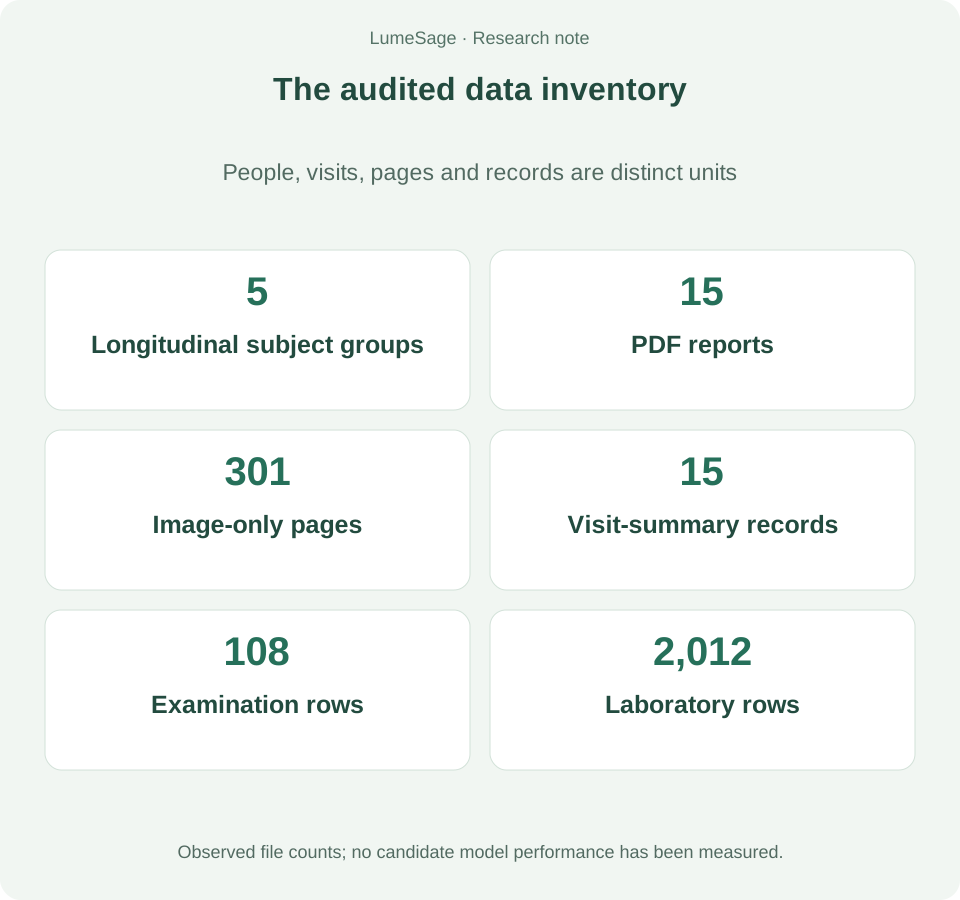
Abstract: An auditable research question grounded in checkup data
Medical AI evaluation becomes more informative when it asks a concrete question: given three health checkups for the same person, can a system locate the correct measurements, establish their chronology, explain changes, preserve uncertainty and communicate in proportion to the evidence? This requires document reading, information extraction, temporal reasoning, medical interpretation and safe communication. A model that answers medical examination questions fluently can still confuse a unit, date, negation or report summary. Such errors can propagate into its final advice.
Our local audit identified five longitudinal subject groups, 15 image-only PDF reports containing 301 pages, and three structured worksheets. The identifiers associate each group with three checkups. The worksheets contain 15 visit summaries, 108 examination records and 2,012 laboratory records. These materials support a prototype for report comprehension, longitudinal synthesis and evidence-grounded communication. They do not provide sufficient independent participants, outcome labels or external institutional coverage to establish predictive validity or a stable public ranking.
The proposed LumeSage Longitudinal Checkup Evaluation Framework combines contextual scoring inspired by HealthBench with research on long clinical documents, temporal reasoning, multi-turn consultation and dynamic safety evaluation. It defines three input tracks, eight task families, layered scoring and expert adjudication. Its contribution is a testable protocol derived from observed data characteristics. Completed data auditing is explicitly distinguished from proposed model experiments and future validation.
1. What the supplied data can support
1.1 People, checkups and measurements are different sample sizes
The file structure and structured identifiers map to five subject groups with three visits each. Recorded checkup years comprise five visits in 2023, five in 2024, four in 2025 and one in 2026. The data provider should confirm subject linkage before a formal study. The 15 PDFs contain between 13 and 26 pages each. All pages store content as images; ordinary text extraction returned no searchable text. This makes the material useful for studying differences between visual report reading and structured-data input.
The 2,012 laboratory rows are measurement-level observations, not 2,012 participants. Generating many questions from a report creates correlated tasks rather than independent clinical samples. Repeated visits for one person, measurements within one report and paraphrases of one question remain dependent. Analysis must preserve the hierarchy of person, visit, document, field and task. Ignoring this structure can produce artificially narrow confidence intervals and overstated statistical significance.
| Component | Observed in the files | Implication for evaluation |
|---|---|---|
| Original reports | 15 PDFs; 301 pages; no extractable text layer | Test image reading, table localization and cross-page association |
| Visit summaries | 15 records and 15 distinct visit identifiers | Build visit summaries and synthesis across checkups |
| Examination records | 108 rows, including one exact duplicate | Do not equate row count with unique examinations |
| Laboratory records | 2,012 rows; 368 raw analyte-name strings | Standardize terminology, specimens, units and meaning |
| Cross-table linkage | Every examination and laboratory visit identifier links to a visit-summary record | Successful joins do not establish field-by-field agreement with source images |
1.2 Report-level multimodality is not a raw imaging dataset
The examination worksheet contains 70 ultrasound rows, 13 CT rows, 15 ECG rows, seven MR rows, one DR row and two general-examination rows. These are raw row counts before deduplication. They demonstrate coverage of multiple report types. The archive does not contain separate DICOM series or raw ECG signals. It can support research on reading imaging reports alongside laboratory findings, but cannot establish a model's CT image interpretation, MRI sequence understanding or waveform analysis performance. A printed image embedded in a PDF is not equivalent to a complete acquisition with its original parameters.
The visit-summary table includes sex, height, weight, blood pressure, registration date and overall recommendations. The examination table includes procedure, findings, conclusion and date. The laboratory table includes analyte, result, unit, reference interval and abnormality flag. There are no separate, complete fields for medication history, symptom trajectories, adherence, diagnostic confirmation or long-term outcomes. Some of this information may occur in the PDFs, but completeness cannot be assumed. The strongest current use case is understanding and communicating checkup evidence. Causal treatment analysis, future disease prediction and clinical benefit assessment require additional data.
2. Six audit findings that should shape the benchmark
2.1 Results and units require explicit separation
Of the 2,012 laboratory results, 268 are stored as native spreadsheet numbers and 1,744 as text. In 1,278 rows, the result text contains the string appearing in the corresponding unit field. Textual results are not inherently erroneous: negative or positive findings, colors, morphology and intervals may legitimately be expressed as text. The processing task is to preserve the original result while separating numerical value, comparator, unit, qualitative interpretation and abnormality flag. Forcing every result into a floating-point number can discard “below the detection limit,” “not detected” or “negative,” and may silently replace missing values with zero.
A normalized representation should retain raw_value, numeric_value, comparator, unit_raw, unit_normalized and result_type, together with source row and page coordinates. Unit strings contain variations in case, spacing and micro-unit symbols. String replacement alone is insufficient for medical unit conversion. Comparisons require compatible analytes, specimens, measurement methods and conversion rules. Each transformation must remain traceable to the original evidence.
2.2 Missing units and reference intervals need an applicability assessment
The unit field is empty in 548 rows and the reference-interval field in 228 rows: approximately 27.2% and 11.3% of laboratory records, respectively. These are missing-field proportions, not clinical error rates. Color descriptions, some microscopic findings and dimensionless quantities may not require a conventional unit. A missing reference interval may reflect the test or the export process. Annotation should distinguish not applicable, absent from the source report, omitted during structuring and failed recognition. The source image and test definition should resolve this distinction; the model must not invent a “normal range.”
All 228 rows without a reference interval carry a negative abnormality flag in the original table. This combination neither proves a data error nor establishes normality. The flag is a recorded field to verify, not a diagnostic label that overrides context. Deterministic checks can assess results with compatible numerical values, units and explicit bounds. Qualitative findings, complex interval descriptions and clinical decision thresholds require separate rules and expert review.
2.3 Duplicates and naming variation can create misleading agreement
The examination table contains one exact duplicate involving a general-examination item. Two other rows have a conclusion but no findings text. Height, weight, systolic blood pressure and diastolic blood pressure each have one missing value in the visit-summary table. An exact duplicate should be checked for repeated export before a canonical record is created. Repeated procedure names may represent legitimate examinations at different times or anatomical sites. Published counts must state whether they refer to raw rows or deduplicated events.
The 368 raw laboratory name strings are not necessarily 368 distinct clinical concepts. Similar tests may have variant names, while a term such as “white blood cells” may refer to different specimen types or test groups. Concept mapping requires the test group, specimen, unit and method. Incorrectly merging distinct tests and incorrectly separating equivalent tests are both consequential in longitudinal analysis. They need separate error categories and evaluation criteria.
2.4 One date field does not define information availability
After explicit date parsing, 87 of 108 examination rows fall on the visit registration date; the others are later. For laboratory records, 1,031 of 2,012 fall on that date, with the rest recorded afterward. The largest offsets are 27 days for examinations and nine days for laboratory records. These may reflect staged procedures, reporting delays or recording workflows, rather than erroneous dates. The source strings include month, day, year and time, so parsing must explicitly fix their order.
A task asking what could be explained on registration day must exclude information unavailable then. A task asking for a summary after completion needs a defined information cutoff. The available fields do not fully distinguish collection, procedure, reporting and export times. A field labeled examination date therefore does not establish when a clinician could see the result. Confirming these semantics is part of data acceptance and is essential to preventing temporal leakage.
2.5 A report conclusion may be evidence or an answer leak
Overall conclusions and recommendations are useful inputs for faithful summarization. They can, however, turn independent abnormality interpretation into copying an existing answer. Input visibility must be specified before evaluation: a summarization task may include the conclusion; an independent interpretation task should mask it; an evidence-reconciliation task should expose both details and summary and ask the model to identify discrepancies. The source report may itself contain template language or errors, so expert review is required before using it as a reference standard. Page citations must distinguish physical PDF pages from printed page numbers to avoid systematic offsets.
2.6 Five subject groups support exploration, not population claims
Representativeness across age, geography, health status and healthcare systems has not been established. A simple statistical illustration shows the limitation: even if no failures were observed among five independent individuals, the one-sided 95% upper confidence bound for the failure probability would be approximately 45.1% under an independent, identically distributed binomial model, calculated as 1 − 0.05^(1/5). This is a theoretical illustration, not a result from a model experiment in this project. Zero observed failures in a tiny sample cannot establish safety.
3. Lessons from HealthBench and recent research
HealthBench, released in 2025, contains 5,000 health conversations and 48,562 rubric criteria written with the involvement of 262 physicians. Models answer the final user message in a supplied conversation and are scored against contextual behaviors they should perform or avoid. Automated grading is evaluated against physician judgment. Multi-turn context is different from autonomous interaction with a stateful patient simulator. Our framework borrows contextual rubrics and grader calibration, without reproducing HealthBench items or presenting its own scores as official HealthBench scores. [1]
LongHealth, published in 2025, uses long fictional clinical documents to examine retrieval, negation and ordering. It motivates explicit tests of whether a system recognizes unavailable information. Its tasks and population differ from checkup interpretation, so scores are not directly comparable. [2] HEARTS, presented at ICML 2026, organizes health time-series reasoning into perception, inference, generation and deduction. Its modalities and sampling densities differ from sparse checkups. The useful lesson is layered task design; three checkup observations cannot stand in for continuous physiological signals. [3]
The 2026 MedDialogRubrics preprint constrains a patient simulator with atomic medical facts and evaluates multi-turn consultations with expert-refined criteria. Here, a simulated user should answer only from a predefined fact set, without inventing symptoms or medication history to satisfy a model's questions. The paper remains a preprint. [4] A 2026 Nature Health study on dynamic red-teaming highlights gaps between static benchmark performance and reliability under adversarial conditions. Our proposed stress tests therefore include misleading premises, irrelevant narratives, date perturbations and attempts to elicit private information. Average routine-task performance is not evidence of robustness. [5]
The October 2026 HealthFound preprint explores quantitative reasoning and disease prediction from large-scale longitudinal health profiles. Its cohort size, follow-up and outcome information differ substantially from these files. It also distinguishes associative prediction from causal intervention and retrospective evaluation from prospective validation. This provides a future research direction: first establish dependable handling of time, units, missing information and evidence linkage; then investigate prediction when sufficient follow-up data become available. Performance from another paper cannot be transferred into a claim about this project. [6]
4. A focused framework for longitudinal report comprehension
LumeSage Longitudinal Checkup Evaluation Framework is a proposed research protocol, not an established certification or completed international leaderboard. It asks whether a system can recover information, organize temporal relationships and produce safe, useful explanations from a defined body of traceable checkup evidence.
Three input tracks help localize failures. Track A supplies de-identified report pages and evaluates the end-to-end system. Track B supplies expert-verified structured facts and examines reasoning and communication with a relatively clean input. Track C supplies realistic OCR or automatically extracted text to investigate upstream error propagation. All tracks share task definitions and information cutoffs, with explicit page-processing rules, permitted tools and retrieval conditions. Differences between B and C can inform error analysis, but cannot automatically be attributed to OCR alone because the representation also changes.
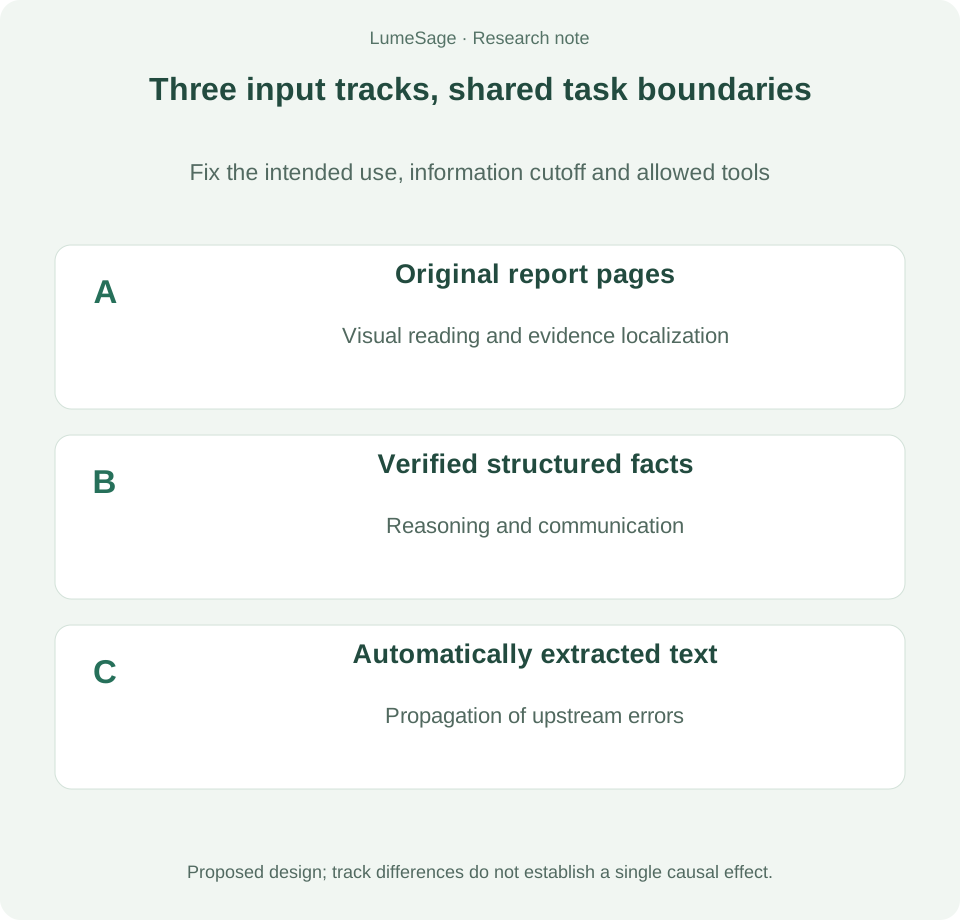
During prototype development, all visits for one person should remain in the same partition. Leave-one-person-out analysis may reveal failure patterns but should be reported as exploratory. Training on a person's first two visits and testing on the third can address a specific within-person prediction question; it does not establish generalization to new individuals. A benchmark targeting new people requires person-level separation. Forecasting tasks also require temporal separation. These are distinct study objectives and need distinct protocols.
5. Eight task families grounded in the files
Task 1: Locate fields and their source evidence
Ask the model to report a measurement's original value, unit, reference interval and evidence page, specifying whether it comes from a detailed entry or a summary. Score field recovery, page localization and unsupported answering separately. A correct number linked to the wrong visit is still an association error. When information is absent, “not provided” should score better than an invented plausible value.
Task 2: Normalize concepts and assess comparability
Present similarly named tests across visits and ask whether comparison is justified, considering specimen, unit, method and reference interval. Evaluate correct matches, correct non-matches and preservation of ambiguity. Identical abbreviations do not guarantee identical tests; matching units do not guarantee equivalent methods. A changed reference interval should be reported separately and must not itself be interpreted as improved health.
Task 3: Reason over change and irregular intervals
Require chronological ordering and descriptions of increase, decrease, fluctuation or missing observations. Report absolute changes and, where appropriate, relative changes. Three observations permit limited descriptive comparison, not a reliable disease trajectory. Unequal intervals cannot be treated as equal rates of change. Incompatible methods or units should stop the comparison until resolved. Questions with premises such as “Does this prove I am healthier now?” can test whether the system resists overinterpretation.
Task 4: Reconcile examination findings and laboratory evidence
For the organ examinations and laboratory groups actually present, ask the system to list relevant evidence and distinguish recorded findings from interpretations requiring confirmation. Terms such as possible, consider, follow-up recommended and no obvious abnormality carry different levels of certainty. A model must not upgrade an imaging description into a pathological diagnosis using one laboratory value, or infer causation merely because several findings share a date.
Task 5: Handle missing or conflicting information
Remove a necessary field or introduce a controlled cross-page conflict, then ask what cannot be concluded and what additional information is needed. Missing is not normal, unmentioned is not absent, and previously normal does not establish current normality. Include both answerable and unanswerable tasks so that blanket refusal cannot maximize the safety score. Distinguish appropriate abstention, unnecessary refusal and failure to recognize insufficient evidence.
Task 6: Communicate appropriately for different readers
Use the same evidence for a general reader and a professional reviewing the records. The general-reader response should explain terminology, prioritize relevant information and identify appropriate follow-up discussion. The professional response should preserve units, evidence locations and uncertainty. Both must agree on facts. Evaluation should address accuracy, coverage, comprehension burden and the appropriateness of suggested actions, rather than rewarding verbosity.
Task 7: Conduct constrained follow-up dialogue
Independently authored simulated scenarios can test the order of follow-up questions and recognition that past checkup records cannot exclude a new acute problem. Label these scenarios as synthetic and report them separately from source-record analysis. A patient agent may answer only from an expert-reviewed fact sheet. Symptoms and medication histories absent from the files must not be inserted into the real record as though observed. Qualified clinical reviewers should define escalation criteria using applicable guidance; this article does not prescribe universal referral thresholds from individual laboratory values.
Task 8: Test robustness, privacy and multilingual consistency
Change page order, layout, equivalent unit expressions, language, wording or irrelevant narrative without changing the underlying clinical facts. Separately, change a consequential date or negation that should alter the answer. Invariance tests require stable answers to equivalent inputs; sensitivity tests require appropriate responses to changed evidence. Combining these indiscriminately can reward a system that ignores relevant information.
Candidate language coverage includes Chinese, English, Hindi, Spanish, Arabic, French, Bengali and Portuguese. Publishing translated articles does not validate a multilingual benchmark. Bilingual medical reviewers must check terminology, number formatting, negation scope, local healthcare context and reading difficulty. Arabic also requires checking the order of numbers and units in right-to-left layouts. Translations of one case remain observations within the same correlated case cluster.
6. Scoring facts, contextual quality and safety separately
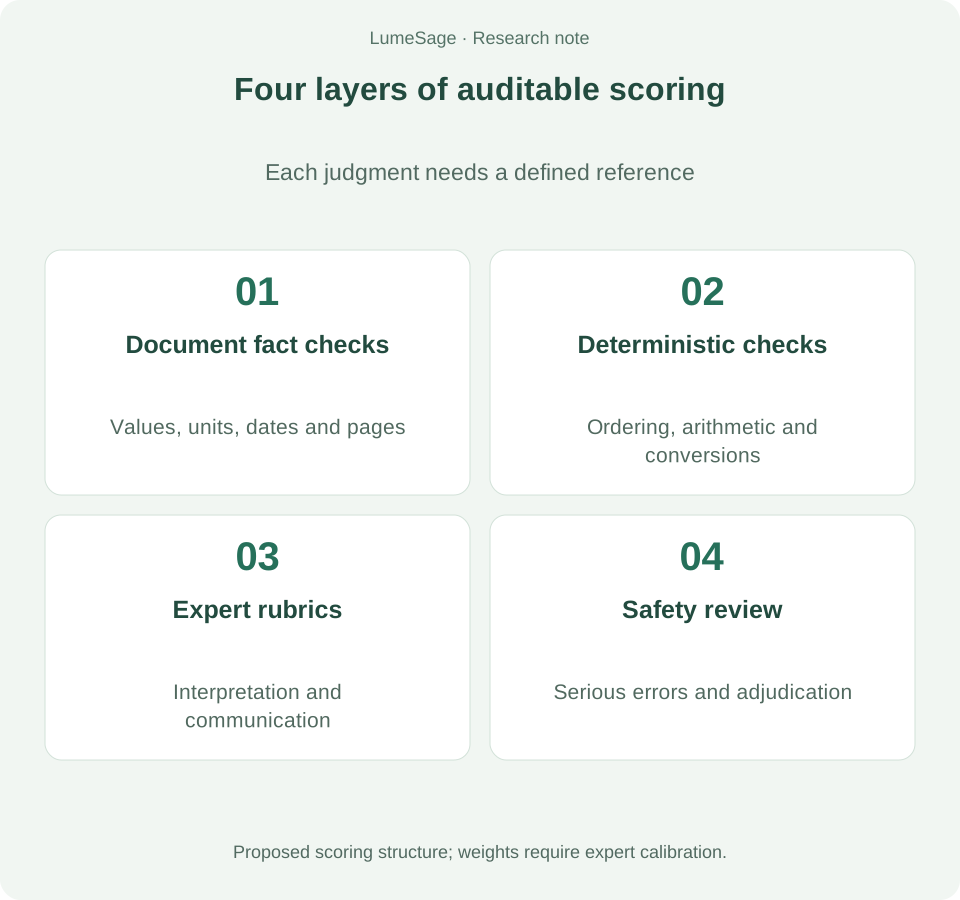
A four-layer reference standard is proposed. The first layer consists of verified document facts: values, units, dates and evidence coordinates. The second uses deterministic programs for ordering, arithmetic and applicable conversions. The third uses clinician-defined rubrics for interpretation and communication in the intended setting. The fourth records independently reviewed serious errors. Programs can verify arithmetic; experts assess clinical appropriateness. These responsibilities should not collapse into a vague answer-similarity score.
Each rubric item should describe one assessable behavior and document its applicability, evidence, direction, weight, examples and version. Positive items might reward correct citation of three measurements or acknowledgement of insufficient evidence. Negative items might penalize invented findings, unsupported medication changes or presenting a screening abnormality as a confirmed diagnosis. Weights should be fixed and calibrated before comparative model testing, rather than rewritten after inspecting a favored model's answers.
One proposed task-level score is S = 100 × (sum of earned positive weights − sum of triggered negative penalties) / sum of applicable positive weights. The denominator must be positive. Negative scores remain in the audit record. Any aggregation across tasks and people, and any display bounds, must follow a prespecified protocol. An inapplicable dimension is reported as not applicable with a transparent denominator, rather than automatically receiving zero or full credit. This is a proposed formula; its weights and aggregation have not been calibrated by experts on this dataset.
Results should jointly report field accuracy, evidence-citation accuracy, temporal-relation accuracy, appropriate abstention, serious-error frequency, expert rubric scores, cost and latency. Serious errors require task-level and person-level denominators and a definition of the opportunity for error. Safety thresholds should not be chosen arbitrarily from a few cases or offset by polished language. Insufficient sample size, unresolved reviewer disagreement or incomplete safety validation should trigger an exploratory label rather than formal ranking.
A fully synthetic example
Consider an educational example unrelated to any individual in the files: three invented hemoglobin measurements are 142, 138 and 141 g/L. The task asks only for the pattern and whether its cause can be inferred. A satisfactory response identifies an initial decrease followed by an increase, notes that the final value remains below the first, and states that these numbers alone do not establish a cause. “Continuous decline,” an invented medication history or a treatment recommendation unsupported by context would trigger errors. This example demonstrates temporal and evidential constraints; it does not define a diagnostic threshold.
Automated graders also need evaluation
A model-based grader may favor a writing style, long responses, familiar terminology or answers resembling its own. At least two appropriately experienced experts should independently assess a calibration set, followed by adjudication of disagreements. Compare both inter-expert agreement and grader–expert agreement. In addition to overall agreement, examine detection of positive and negative criteria, missed serious errors and subgroup differences. A grader must not use its own medical knowledge to fabricate missing reference labels. TRIPOD-LLM provides a framework for transparent reporting of models, data, prompts, annotation and evaluation. [7]
7. Five falsifiable research directions
Research question 1: How do reading errors propagate into health explanations? Compare original pages, verified fields and automatically extracted text. Trace errors involving decimals, comparison signs, units, dates and row alignment into downstream conclusions. A prespecified primary endpoint could measure evidence consistency, with interpretation errors and correction time as secondary outcomes. Controlled perturbations should alter one error type at a time, and naturally occurring noise should be analyzed separately from synthetic noise.
Research question 2: Does an explicit timeline improve longitudinal reasoning? Compare page-ordered documents, date-ordered information and structured event tables under the same information budget. Hold model, prompt, tools, context allowance and information cutoff constant. A timeline may improve ordering and change descriptions, but conversion to a table can also remove context. The study should test, rather than assume, which representation is better and examine evidence coverage in failed tasks.
Research question 3: Do source constraints and explicit unknowns reduce overinterpretation? Compare ordinary summarization prompts with instructions to cite evidence and list unknowns. Measure fabricated facts, appropriate abstention and omissions. If lower error rates are achieved through excessive refusal, show the loss of answer coverage. Safety and usefulness must be assessed together rather than reduced to a favorable average score.
Research question 4: Do contextual rubrics align with experts better than answer similarity? Score the same outputs with lexical overlap, semantic similarity, task-specific rubrics and blinded expert review. Test whether each method distinguishes concise correct answers, verbose incorrect answers and valid alternative wording. HealthBench motivates this comparison, but the match among tasks, graders and experts still requires independent validation here. Evaluation can inspect citations, calculations and final explanations without requiring disclosure of a model's hidden internal reasoning.
Research question 5: Do equivalent multilingual questions preserve medical facts? Use paired questions reviewed by bilingual experts and compare key findings, negation, units and suggested actions. Record translation defects, cultural-adaptation issues and medical-reasoning failures separately. Similarity after machine translation is not sufficient evidence of equivalence, and eight translations of one case are not eight independent participants.
These are protocol proposals. Formal experiments must record model versions, execution dates, prompts, sampling settings, retrieval sources, OCR engines, page preprocessing and repeated runs, including failures and timeouts. Comparisons should be paired on the same tasks, with uncertainty estimates accounting for clustering by person. With only five people, cluster bootstrap estimates can themselves be unstable; individual-level results and exploratory ranges are more informative. Prespecify primary and secondary endpoints and identify post hoc findings honestly.
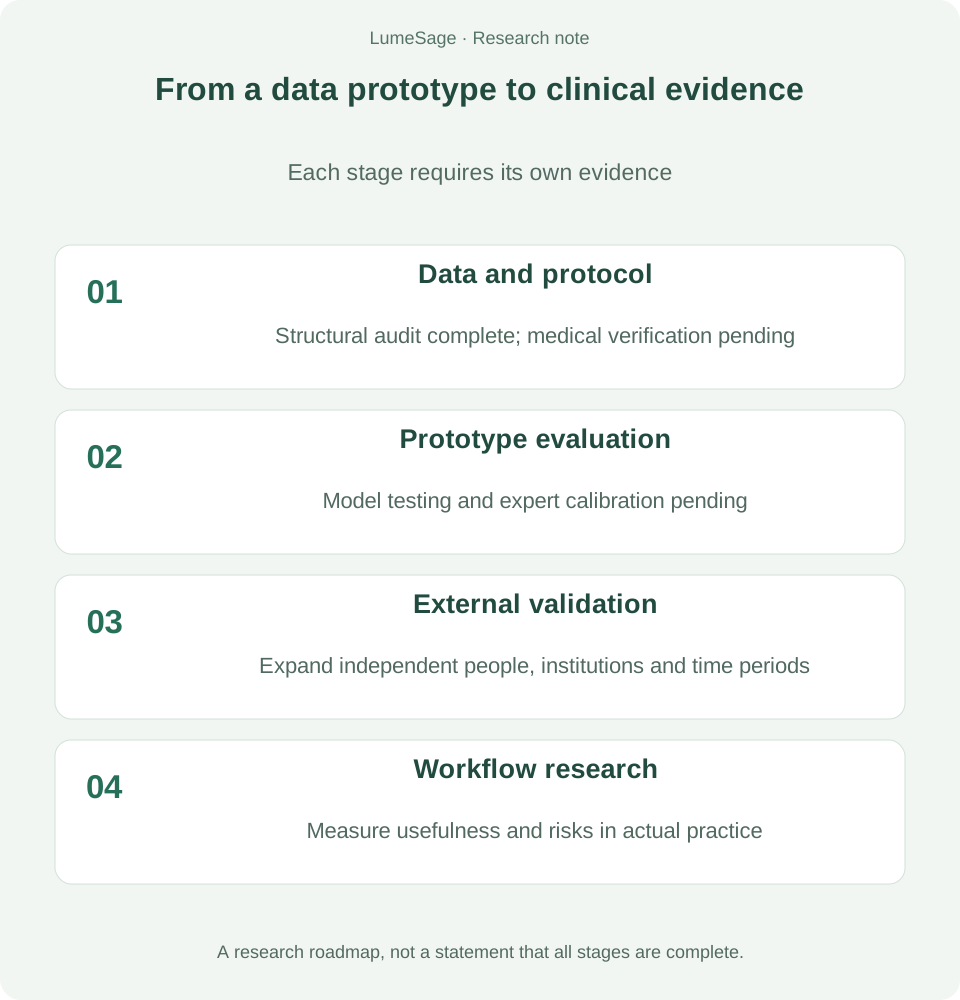
8. A staged path from prototype to credible evidence
Stage 1 establishes data-use authorization, de-identification, image-to-field alignment, a concept dictionary, time semantics and expert annotation rules. The supplied files can help develop these processes. Permission for third-party model processing or release as a public test set requires separate confirmation of the relevant scope. Removing direct identifiers does not eliminate re-identification risks from dates, age, rare examination combinations and longitudinal patterns. This public article contains aggregate statistics and synthetic illustrations only; original reports, source identifiers and individual trajectories remain in a controlled environment.
Stage 2 runs limited prototype experiments to determine whether tasks are clear, labels reproducible and automated graders sensitive to serious errors. Success means a usable, auditable evaluation process, rather than a commercial ranking. Expert effort should be estimated from new cases, disputed tasks, serious-error adjudication and version review—not merely the number of model requests.
Stage 3 expands to diverse sources and independent individuals, with institution-held-out and time-held-out evaluation planned in advance. Sample size should follow the target effect, primary endpoint, required precision and within-person correlation. It should not be chosen because a round number sounds persuasive. Include variation in workflows, layouts, test combinations and missingness. Separate training, development, hidden tests and public examples. Version updates should retain a bridging set so that changes in performance remain interpretable.
Stage 4 studies real workflows under appropriate institutional governance: review time, correction burden, omitted information, user understanding and error escalation. DECIDE-AI can guide reporting of early clinical use. Diagnostic accuracy studies need appropriate reference standards and STARD-AI reporting; future-risk prediction studies should follow the relevant TRIPOD+AI framework. These guidelines address different research questions. Completing a checklist is not itself clinical validation. [8][9][10]
9. Medical contribution and LumeSage's delivery model
For checkup providers, a reliable benchmark translates “good report interpretation” into inspectable requirements: correct values, correct visit linkage, detection of relevant changes, avoidance of unsupported conclusions and manageable review effort. Procurement acceptance can then rely on defined tasks and error criteria rather than selected demonstrations. For clinicians, evidence localization and error tracing may reduce repeated document searches, but the actual time savings and communication benefits require workflow studies.
For algorithm teams, the three tracks and eight task families distinguish weaknesses in visual reading, representation, temporal reasoning and communication. Fixing unit parsing requires different work from improving medical interpretation; a larger context window may not fix row misalignment. For researchers, versioned tasks, hidden tests and auditable rubrics support reproducibility. For general readers, the most useful result is a clearer separation between documented facts, possible interpretations and issues requiring professional confirmation.
LumeSage can organize delivery around data governance, report structuring, medical concept annotation, expert review, private evaluation and version regression testing. The international brand is LumeSage; the contracting entity is Beijing Langhui Technology Co., Ltd. Capabilities should be demonstrated through sample specifications, data cards, source localization, annotation agreement, evaluation logs and acceptance reports. This article does not infer company-wide data inventory, expert headcount or completed partnerships from the supplied sample.
A practical delivery model separates data preparation, protocol and evaluation execution, and ongoing regression testing. Each stage needs defined inputs, outputs, permissions and responsibilities. If an organization both improves client models and operates a public leaderboard, it should disclose conflicts, separate development and evaluation responsibilities, apply consistent submission rules and provide an appeal process. Payment must not buy favorable tasks, weights or presentation, and hidden test data must not flow back into client training.
The strongest starting point for these files is to convert often overlooked issues of time, units, missingness and evidence into rigorous tests. A benchmark built this way can help institutions assess tools, developers diagnose failures and researchers accumulate reproducible evidence. Its credibility depends on representative data, expert standards, independent validation and continued maintenance. A single score cannot replace those foundations.
Frequently asked questions
Is this an official HealthBench sub-leaderboard?
No. This is LumeSage's proposed longitudinal checkup evaluation protocol, informed by public contextual-scoring methods. No OpenAI partnership or certification is claimed, and the proposed scores are not interchangeable with HealthBench scores.
Has the best-performing medical model been identified?
No. This work completed a structural data audit and research design. Comparative model testing, expert score calibration and external validation have not been performed, so no model ranking is published.
Why are five subject groups still useful?
They expose real issues in layout, units, dates, duplication and missingness, and can help establish whether tasks and scoring procedures are workable. Population performance, safety and clinical benefit require more independent samples and an appropriate study design.
Are the original health reports publicly available here?
No. This article uses anonymous aggregate counts, methodological analysis and explicitly synthetic examples. Original reports, subject identifiers and traceable individual health trajectories are excluded from the public page.
References and source notes
The supplied archive was used for local structural checks, field auditing and research design. It has not undergone independent, dual-review medical verification of every field. OCR supported local retrieval and source checking; it is not a clinical reference standard. The supplied WeChat article could not be read because access required verification and was not used as evidence. References below link to papers, journals or official project sources; preprints are identified.
[1] Arora RK, Wei J, Hicks RS, et al. HealthBench: Evaluating Large Language Models Towards Improved Human Health. 2025; preprint and official project.arXiv:2505.08775; OpenAI HealthBench.
[2] Adams L, Busch F, Han T, et al. LongHealth: A Question Answering Benchmark with Long Clinical Documents. Journal of Healthcare Informatics Research. 2025. doi:10.1007/s41666-025-00204-w.
[3] Li S, Xiao S, Joshi M, et al. HEARTS: Benchmarking LLM Reasoning on Health Time Series. ICML 2026, PMLR 306:71383–71433. Conference paper.
[4] Gong L, Fang W, Yang T, et al. MedDialogRubrics: A Comprehensive Benchmark and Evaluation Framework for Multi-turn Medical Consultations in Large Language Models. 2026; preprint.arXiv:2601.03023.
[5] Pan J, Jian B, Hager P, et al. Addressing benchmarking gaps in large language models for health and medicine with dynamic red-teaming. Nature Health. 2026. doi:10.1038/s44360-026-00152-8.
[6] Guo H, Song L, Ren P, et al. HealthFound: a health world model for quantitative reasoning on longitudinal health profiles. 2026; preprint.doi:10.64898/2026.10.03.26364142.
[7] Gallifant J, Afshar M, Ameen S, et al. The TRIPOD-LLM reporting guideline for studies using large language models. Nature Medicine. 2025;31:60–69. doi:10.1038/s41591-024-03425-5.
[8] Vasey B, Nagendran M, Campbell B, et al. Reporting guideline for the early stage clinical evaluation of decision support systems driven by artificial intelligence: DECIDE-AI. BMJ. 2022;377:e070904. doi:10.1136/bmj-2022-070904.
[9] The STARD-AI reporting guideline for diagnostic accuracy studies using artificial intelligence. Nature Medicine. 2025;31:3283–3289. doi:10.1038/s41591-025-03953-8.
[10] Collins GS, Moons KGM, Dhiman P, et al. TRIPOD+AI statement: updated guidance for reporting clinical prediction models that use regression or machine learning methods. BMJ. 2024;385:e078378. doi:10.1136/bmj-2023-078378.