Abstract: Medical AI leaderboards should support evidence-based decisions
Medical AI leaderboards are often compressed into a table sorted by total score. However, in a medical scenario, just because a model is ahead in exam questions does not mean that it can stably collect medical history, identify missing information, reasonably select examinations, follow guidelines, and express uncertainty in real diagnosis and treatment, nor does it mean that it is suitable for being put into patient services or doctor workflows. The real value of a leaderboard is not to create a single champion, but to make model capabilities, task boundaries, risks, costs, and evidence levels observable, comparable, and reviewable.
Medical Q&A benchmarks remain relevant. MedQA converts American Medical Practitioner Examination questions into medical question and answer tasks. PubMedQA requires the model to combine the abstract of the paper to determine whether the research conclusion supports the problem; they provide a repeatable starting point for medical knowledge coverage and research reading ability [1–2]. But clinical practice does not jump directly from the question to the answer. Patients do not present information in textbook order, not all tests are known, multiple diagnoses may be reasonable simultaneously, and decisions are influenced by time, resources, patient preferences, and risk tolerance.
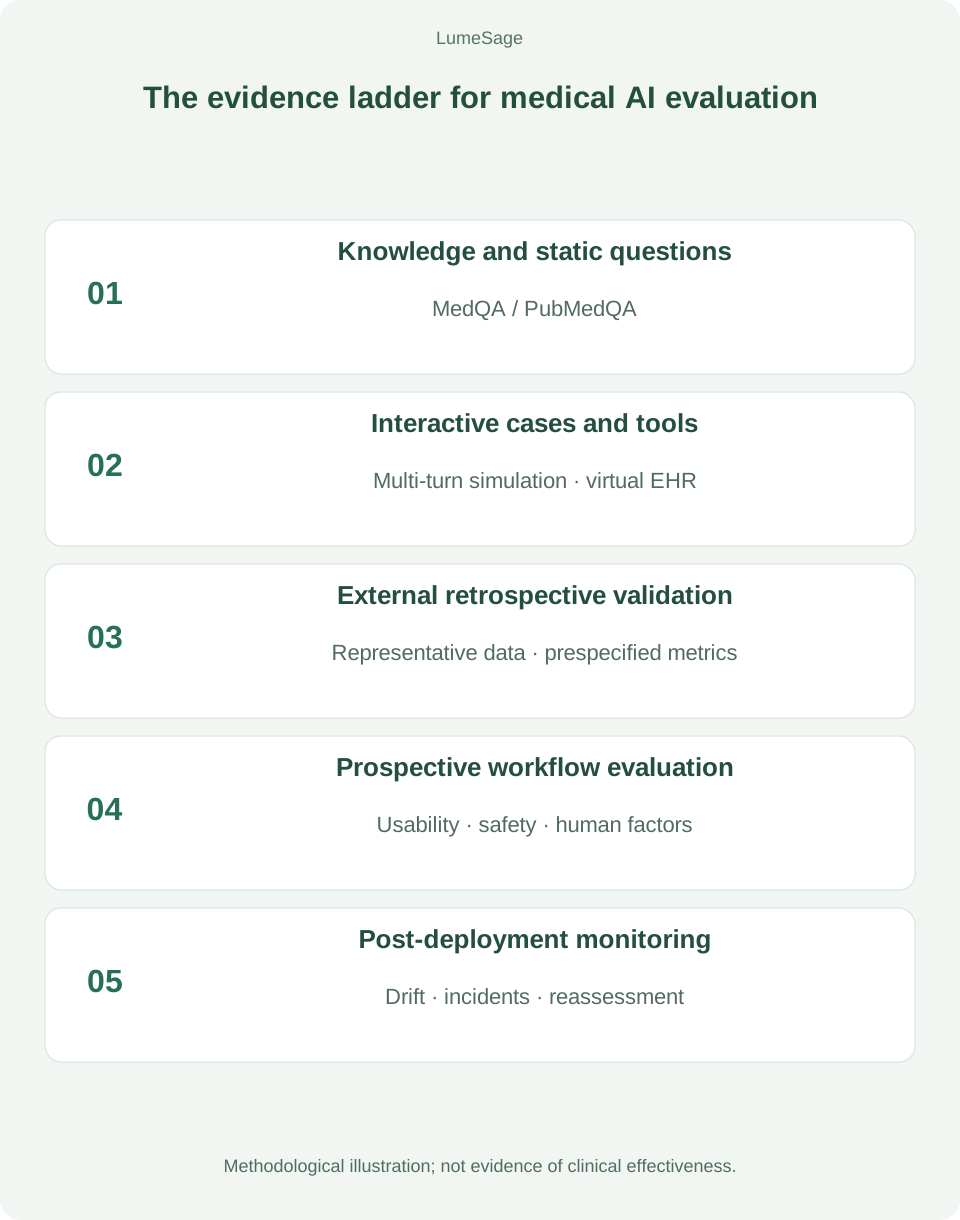
Evaluation work in recent years is expanding medical benchmarks to tasks closer to real work: HealthBench uses rubrics written by doctors to evaluate open-ended, multi-round health conversations; AgentClinic puts consultations, tool usage, and incomplete information into simulated clinical environments; MedAgentBench allows agents to complete tasks through a virtual electronic medical record environment that complies with FHIR; MedHELM organizes multiple medical benchmarks based on a task classification system [3–6]. The 2026 clinical AI review further pointed out that standard questions, simulated cases, retrospective validation and prospective clinical evaluation are at different levels of evidence and cannot replace each other [7].
This article is based on a medical AI leaderboard construction plan, focusing on analyzing the multiple rounds of consultation, examination feedback simulation, ICD coding, guideline basis, cost accounting, double-blind expert evaluation and human–AI collaboration. The solution has clear engineering value, but there are also scientific issues that must be corrected first: internal model scores cannot be directly used as public rankings when the sample size, version, prompts, scoring rules and confidence intervals are incomplete; missing examination results cannot be quietly filled in as "negative" by the simulator; the list of tests recorded in a medical record should not be used as the gold standard for diagnosis and treatment by default.
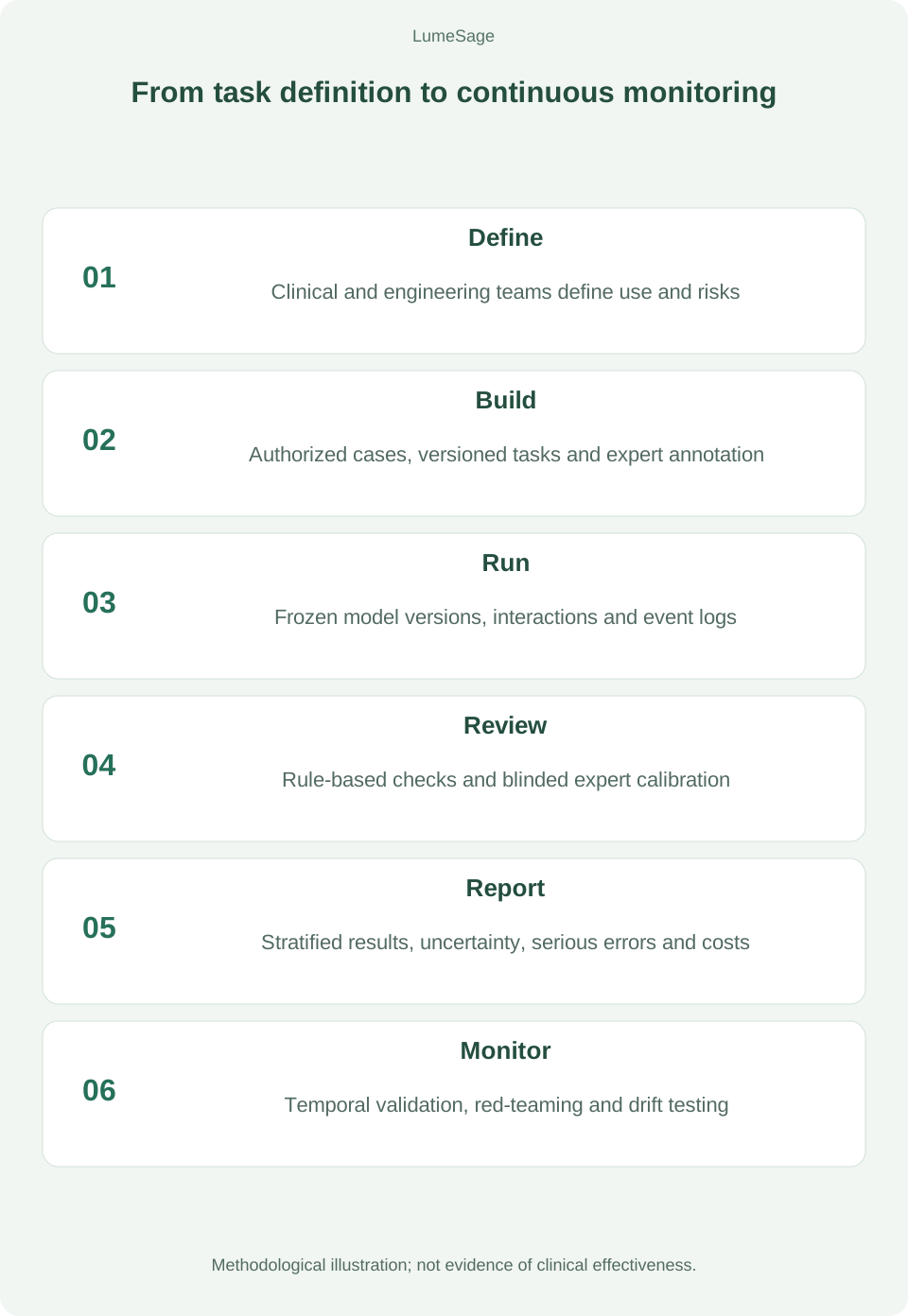
This article proposes a more robust construction path: first define uses and risks, and then organize sourced, authorized, and representative cases; establish an evidence ladder between static questions, interactive simulations, retrospective external verification, and prospective pilots; report at the same time on correctness, safety, calibration, resource utilization, usability, and human-machine collaboration performance; and finally maintain the benchmark with versioned data, auditable scoring, and continuous red team testing. For LumeSage, this direction can connect data engineering, medical annotation, expert review, quality management and private evaluation into a verifiable service process, rather than packaging "having data" or "being on the list" as clinical results.
1. Why examination scores cannot establish clinical capability
1. Medical knowledge questions measure specific capabilities The
medical multiple-choice question benchmark is suitable for testing knowledge extraction, concept analysis and limited reasoning processes under clear questions. Their advantage is that the question and answer formats are relatively stable, easy to reproduce, easy to establish baselines, and suitable for observing model changes with version updates. The problem is that the structure of the test questions condenses the clinical task into “given information—choose an answer.”The model does not have to ask questions, decide whether to test, or indicate what information is insufficient to support a conclusion.
Research-based Q&A also has its own task boundaries. PubMedQA organizes questions, abstract context, and conclusions into yes/no/maybe judgments, which is suitable for testing evidence reading and induction, but it cannot be inferred that the model is capable of handling conflicting information in medical records or actual doctor-patient communication. To refer to test scores directly as "clinical competency" is to extrapolate the results of one narrow task to another complex systems task.
2. Clinical decision-making is a sequential process
Real diagnosis and treatment involves a series of interacting choices: what to ask first, when to follow up, whether to test, how to interpret new results, whether to revise the differential diagnosis, when to stop testing, and when to ask for review. AgentClinic's research turned static MedQA questions into multiple rounds of interactions and found that the difficulty of sequential decision-making would increase significantly; MedAgentBench put a set of tasks into a virtual electronic medical record environment, requiring the model to read or operate structured medical records through tool calls [4–5]. These works remind that the ability of a model to answer questions and the ability of a model to complete a process are two different types of abilities.
3. The cost of medical errors is asymmetrical
Missing a critical sign, fabricating an inspection result that has not been done, and proposing unnecessary high-risk measures cannot be deducted according to the same standards as poor wording. Overall accuracy can mask low-frequency but high-consequence safety lapses. Safety benchmarks such as NOHARM take "frequency and severity of potential harm" as a special evaluation object; its research should still be interpreted according to the cases and annotation range of the paper itself, but it clearly illustrates that safety is not synonymous with medical knowledge scores [8].
4. Medical standards will age and may become “cooked”
When the public question bank is used many times for training, prompt word optimization and model selection, the leaderboard score may reflect more of the model's familiarity with the question distribution rather than its generalization ability when facing new cases. Static test sets can also quickly lose distinction due to model iteration too quickly. Dynamic Red Teaming Research 2025 and its 2026 journal work demonstrate the value of continuous mutation prompts, adversarial scenarios, and security stress testing in addition to static testing [9]. Dynamic testing is not a universal solution: if the attack rules for each round are not transparent or reproducible, scores will be difficult to compare. Therefore, it is prudent to use fixed public sets for reproducible baselines, controlled hidden sets, out-of-time validation, and dynamic red teaming for novelty and robustness checks, and to clearly disclose the questions answered by each score.
2. From static benchmarks to clinical workflow evaluation
1. From single-question answers to real conversations The original project information of
HealthBench shows that the benchmark includes 5,000 health dialogues, which were constructed by 262 doctors who have practiced in 60 countries, and an item-by-item scoring rubric is designed for model responses; the official information clearly states that the dialogue can be multi-turn, multi-lingual, and also covers scenarios between ordinary users and medical professionals [3]. Therefore, the description of HealthBench as “all single-turn conversations” in the program materials needs to be corrected. The key here is not whether a certain benchmark is "the most advanced", but that the benchmark introduction must go back to the original paper and verify the official data description, and cannot rely on second-hand tables.
Physicians write item-by-item rubrics to help avoid evaluating open-ended medical responses with keyword matching alone. But rubric coverage, weights, decision boundaries, and automatic graders still need to be verified. The original work on HealthBench also used model scorers and had doctors review them for consistency with human judgments; such methods are suitable for scaling up, but should not be interpreted as "LLM judges are naturally objective".
2. From static cases to interactive environment
AgentClinic research sets up roles such as doctors, patients, and measurement tools in a simulated environment to support incomplete information, multiple rounds of interaction, and tool usage [4]. MedAgentBench further provides 300 clinical tasks, 100 patient files, and a FHIR-compliant virtual EHR environment [5]. They expand the evaluation object from a text answer to "whether the model can complete the specified action in a certain environment."
The value of the simulation environment lies in its controllability, repeatability, and recordability; its limitation is the gap between the patient simulator, examination simulator, medical record data structure, and the real medical system. The MedAgentBench paper also clearly mentioned that the virtual environment cannot be directly used as a production system, and pointed out that there are boundaries in data sources and task coverage. For self-built benchmarks, the agent environment must not only ask "whether the task is completed", but also record tool calls, status changes, unauthorized operations, invalid requests, repeated checks and termination points.
3. From “one big list” to task pedigree
MedHELM organizes large medical model evaluations into 5 major categories, 22 subcategories and 121 tasks, and brings together multiple existing and new benchmarks [6]. This structure better illustrates what the model is and isn't suitable for than crushing diagnosis, medical record generation, patient communication, medical research, and administrative processes into a single score. The inspiration is: the first level of the list should be classification of uses, and the second level should be model comparison.
For example, clinical record summaries and patient education belong to different risk scenarios; test report extraction, diagnostic recommendations and medical resource scheduling should not share the same set of evaluation weights. For a list oriented to a specific purpose, the target users, input information, allowed tools, system output, manual review responsibilities and failure costs should be fixed first, and then the scoring dimensions should be determined.
4. From one-time ranking to continuous monitoring
Clinical AI systems may rely on model APIs, prompts, search libraries, tool chains, and human-computer interaction strategies. Merely reporting "model name + score" is not sufficient to reproduce a system. TRIPOD-LLM in 2025 reminds researchers to report information such as usage scenarios, models and versions, prompt engineering, data processing, human review qualifications, and quality control; TRIPOD+AI, DECIDE-AI, and CONSORT-AI provide corresponding reporting frameworks for predictive model reporting, early real-life scenario evaluation, and AI intervention clinical trials respectively [10–13]. These guidelines are not clinical approval or quality certification, but they illustrate that transparent reporting is the basis for academic comparability and reproducibility.
3. Assessing the proposal: feasibility, limitations and revisions
1. Real medical records and complex information: the direction is correct, and the source and representativeness of the sample need to be clear The
scheme recommends that structured real medical records, tests and examination information be used to improve the abundance of clinical information, which is a necessary direction. Clinical texts contain abbreviations, omissions, typos, time spans, and cross-document contradictions, making it difficult for synthetic cases to cover the full true complexity. The use of real data must also explain: data sources and authorization scope, patient-level deduplication, privacy protection, inclusion and exclusion criteria, institution and population distribution, disease and severity ratios, missing mechanisms, and whether there are problems with the same patient across training/test sets.
"Real" does not mean "representative". Data from large hospitals or single departments cannot be naturally extrapolated to communities, different regions and different language groups. Measurements should report performance by clinical setting, institution, age group, gender, disease subtype, and key risk group; when insufficient samples are available, uncertainty should be made explicit rather than treating scores for low sample groups as reliable rankings.
2. Inspection result simulation: research can be done, but unknowns cannot be disguised as negative The
plan proposes that when the original case does not provide the examination requested by the model, the "examination agent" will predict the result. This can help construct interactive scenes, but it is also the riskiest link in the entire technical design. In real-world data, "no inspection" means that the result is unknown, which does not mean that the result is normal; if the simulator generates a seemingly reasonable result and directly returns it to the model under test, the test will change from "decision-making under incomplete information" to "decision-making under manually written information", which may induce erroneous conclusions and make the test results depend on the deviation of the simulator itself.
recommends that the information status be strictly distinguished into: observed results, clearly not done, unavailable, and simulated generation. Simulation results are returned only within a separate simulator study task, and their generation source, confidence level, applicability, and true distribution verification are preserved in the background. The main list can be set up with two tracks: one only scores on deterministic case information; the other uses an environmental simulator externally verified with real data to evaluate the model's handling of uncertain results. Simulators must not be used as invisible clinical fact generators.
3. ICD-10 and standardized scoring: conducive to standardizing records, but not equivalent to establishing a diagnostic gold standard
Mapping diagnoses to codes such as ICD-10 is helpful for hierarchical statistics, category aggregation, and cross-team review, but code matching can only answer "where does the system code the conclusion?" and cannot independently answer "whether the clinical judgment is correct."Coding levels may be too coarse, multiple conclusions may be justified, and diagnoses may change over time and with new tests. The correct approach is to use the coding as a computable auxiliary field, while retaining records of clinical concepts, evidence, acceptable alternative diagnoses, diagnostic hierarchy, and expert judgment.
The reference standard should be established by doctors with corresponding specialist experience based on case data and applicable guidelines; if necessary, two people should independently mark it, arbitrate it by a third party, and record differences. For cases in which multiple clinically reasonable pathways exist, scoring should recognize a predefined set of acceptable answers rather than treating a single discharge code as the only correct answer.
4. Guideline consistency: evaluation path, but lock the version and applicable group
Incorporates guidelines, clinical pathways, and expert consensus to provide a rationale for why this test or treatment was chosen. The evaluation protocol must fix the guideline name, version, release date, applicable population, and recommendation strength; otherwise, the model may be scored with a recommendation that is outdated or inappropriate for the patient. Nor can guidelines exhaust each patient's preferences, contraindications, resource availability, and clinical uncertainties.
recommends splitting guideline consistency into three checkable questions: whether necessary key steps have been omitted; whether the performed steps have corresponding indications; whether the model expresses uncertainty and proposes a reasonable upgrade path when the evidence is insufficient or not covered by the guideline."Mentioning key words in the guideline" cannot be regarded as "following the guideline", nor should the fluency of the reasoning process be directly equated with clinical correctness.
5. Cost evaluation: Including economics in the list is progress, but a single price cannot replace clinical value. The
plan proposes to calculate resource consumption based on inspection prices, and can identify the unreasonable strategy of "opening unlimited inspections in order to increase information."This is consistent with the direction of the Sequential Diagnosis Benchmark to place sequential diagnosis and examination costs in the same evaluation environment [14]. However, the price of medical services depends on the region, hospital, payment system, patient insurance and specific examination combinations; the price list can only be an approximation at a certain time and scenario, not a universal true cost value.
A more robust reporting approach would be to simultaneously present diagnostic performance, risk of missed diagnosis, over-examination, number of examinations, cost range, waiting time, additional medical burden, and uncertainty. Draw the "risk-effect-cost" frontier for different models to explain under what uses, thresholds and payment environments a certain solution is more suitable, rather than directly declaring that a model is "the most cost-effective". If there is no basis for clinical utility weighting or decision analysis, multiple indicators should not be forcibly converted into a single ROI.
6. Stability and pass@k: must be accurately defined, without repeated sampling to replace single reliability
Medical systems usually face a real request when deployed, so pass@1 reflects whether a single run can complete the task; pass@k usually emphasizes the probability of at least one success among multiple attempts, and the probability of "k all successes" or the variance of scores across runs is another stability indicator. Pass@k and pass^k in the scheme need to be clearly defined one by one in the paper protocol, and the number of repetitions, random seeds, temperature, sampling strategy and summary algorithm of each case must be noted.
If the model can be retried in real scenarios, the system may display the best answer to the user, but this approach will change the delay, cost and risk and must be evaluated separately. Post-training quality or clinical stability cannot be directly inferred from the difference between pass@k and pass@1 alone; statistical differences also take into account sample size, confidence intervals, case clustering, and predetermined analysis plans. All rankings should give uncertainty intervals, and avoid interpreting ranking exchanges in small samples as generational differences in ability.
7. LLM-as-a-Judge: Expand annotation capabilities, retain expert calibration and auditing
The LLM referee is suitable for format checking, partial fact checking, preliminary screening of rubrics, and auxiliary scoring of large samples, but it may prefer answers that are longer, more confident, and worded more like its own output, or it may share the same knowledge blind spots with the model being tested. Studies such as HealthBench and MedHELM have demonstrated the practice of rubric and model scorers, and also illustrated the need to compare the consistency between scorers and clinical expert judgments [3,6].
recommends the use of hierarchical scoring: deterministic rules are used for programmable verifiable items; medical facts and key safety points are reviewed using cited sources, rules and clinical experts; communication experience and program suitability are reviewed using trained blind clinical reviews. A certain proportion of each batch of samples is selected for independent scoring by two people, and the consistency index, disagreement rate and arbitration status are reported. The name and version of the referee model, prompts, scoring temperature, rubric version and calibration samples are also frozen and archived.
8. Double-blind expert platform: need to prevent blinding, order effects and scoring fatigue The case comparison, dual-model question and answer and random blind testing platforms designed in the
plan are operable. To make the results trustworthy, blinding cannot rely solely on hiding model names: the output format needs to be unified, vendor and model style tags removed, and the order of answers randomized; reviewers should not know the source of the answers or their position on the list; two model responses for the same case should not reveal paired clues in the interface. Review training, fatigue control, duplicate question detection, scoring time limit, blind guessing questionnaire and objection review should be set up.
clinical expert ratings are not “naturally unbiased” either. Judgments of acceptable risks may differ across specialties, years of experience and practice settings. Studies should report reviewer qualifications, specialty distribution, case task matching methods, inter-reviewer consistency and arbitration processes, and set up participation mechanisms for patient and public concerns. DECIDE-AI emphasizes clinical practicality, safety, human factors and preparation for further trials in early clinical evaluation; it reminds us that real clinical evaluation should focus on users, workflow and system iteration, not just model answer scores [12].
4. A methodology for trustworthy medical AI benchmarking
1. Make the “Purpose Card” first, and then write the questions
For each sub-item of the list, first fill in the purpose card: who is the target user; what type of patients and clinical problems are served; what role the model plays; what data is allowed to be included in the input; whether the output affects actual medical decisions; whether retrieval, tools or electronic medical records are allowed to be called; who will conduct the final review; what harm will be caused by failure. Purpose cards determine tasks, risk levels, measurement metrics, and disclosure wording. In the absence of a purpose definition, the list cannot explain what the score means for procurement or clinical deployment.
2. Establish case pedigree and data card
Each case records at least anonymized patient/visit identification, task type, disease and severity, information source, time point, structured fields, association between documents and examinations, labeling basis, applicable guideline version, missing status, case inclusion/exclusion rules and set of acceptable answers. Case-level splitting should avoid the same patient, same visit, or near-duplicate documents spanning training, parameter adjustment, and test sets. The test set must retain version and data lineage; regular pollution audits must be conducted on the public set, and access control and audit logs must be implemented on the hidden set.
3. Design task card and environment status
describes each task as: initial information, questions that the model can ask, available tools, environment return rules, termination conditions, allowed operations, prohibited operations, and preset risks. Sequential tasks must preserve complete dialog and tool traces, distinguishing between models with no queries, environments with no data, checks not performed, and results unknown. If simulated patients or inspection agents participate in the test, their verification process and failure mode need to be disclosed; the simulation environment cannot leak labels to the model under test, nor can new facts that do not comply with the state transition rules be generated just because the model under test is asked a few more rounds.
4. Use indicator dashboard instead of single total score
It is recommended to divide the indicators into at least six groups
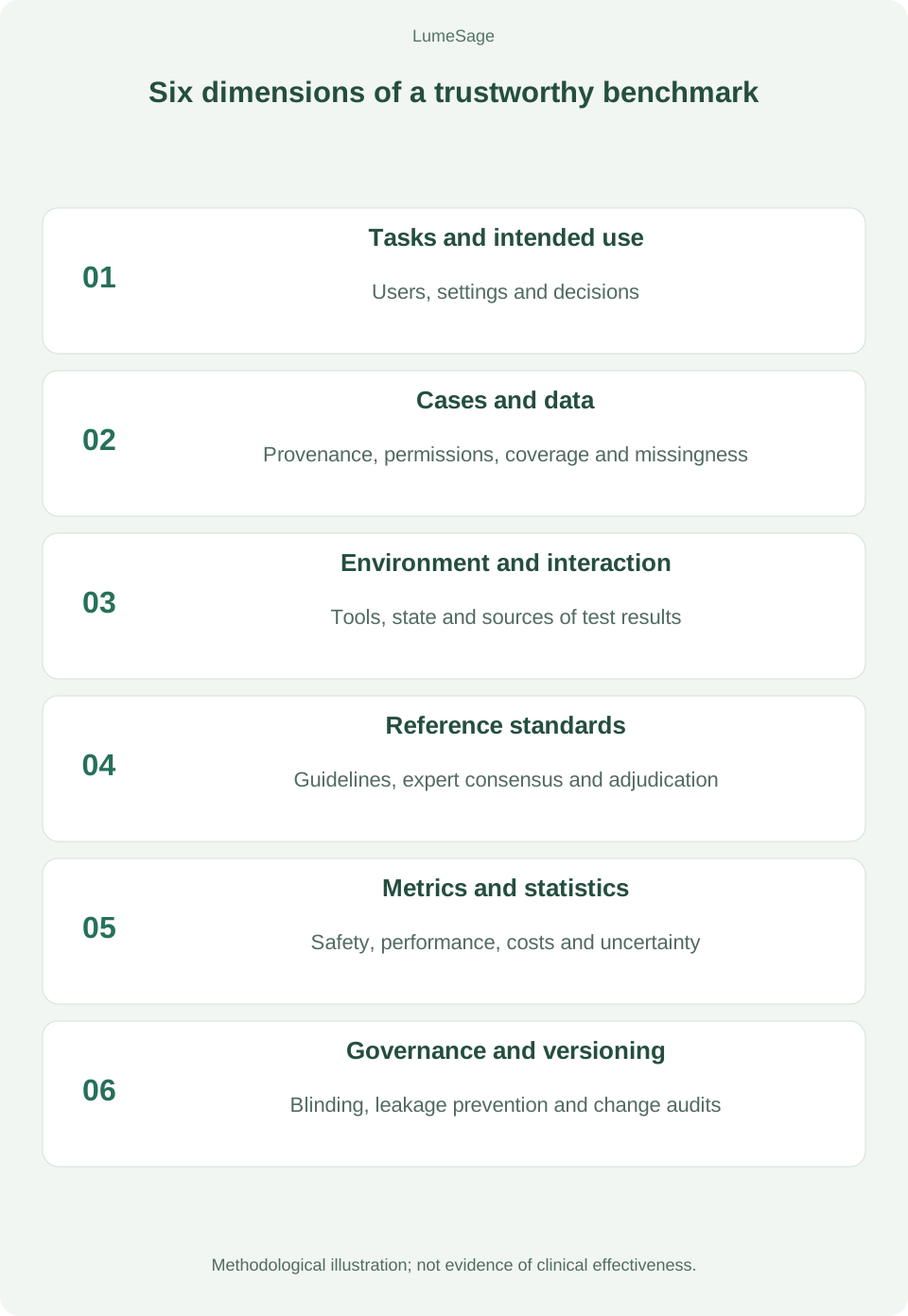
1. task performance Diagnosis or decision accuracy, key step coverage, structured extraction completeness, task completion rate.2. Patient Safety Serious error, dangerous omission, overhandling, false comfort, taboo neglect, fictitious examination or quotation.3. Process quality Information collection efficiency, inspection selection, repeated operations, correctness of tool calling, and whether to stop at the appropriate time.4. Uncertainty Calibration error, risk stratification, appropriateness of rejection/upgrade labor, relationship between selective prediction and coverage.5. Resource Utilization Clinical benefits under cost, delay, number of examinations, manual review time and resource constraints.6. Generalizability Performance under time, outside institution, subgroups, different input qualities, language variants and adversarial perturbations.
There should be a minimum threshold for safety performance; models with serious safety flaws should not be "offset" by the overall overall score due to high scores on low-risk tasks. The list can provide a weighted view relevant to the purpose, but the weights, thresholds and sensitivity analysis must be disclosed, and each original indicator must be retained for readers to review.
5. Pre-registration statistical plan and version report
Before running the model, first write down the primary endpoint, secondary endpoint, sample size basis, comparison object, confidence interval, missing data processing, stratified analysis, multiple comparison processing and stopping rules. Task results can be clustered according to cases, patients and institutions to calculate intervals; multi-model comparisons for the same case should use appropriate paired analysis to avoid treating the testing of each model as independent of each other. Model and prompt word versions, temperature, tool permissions, search sources, API dates, software and hardware configurations, and price sources should be kept on file. After the model supplier is updated, do not directly use the old ranking. You should mark the snapshot and re-evaluate.
6. The public benchmark adopts the parallel structure of "development set-validation set-hidden set-dynamic set" The
development set is used for community debugging, the verification set supports parameter and scoring rule calibration, the hidden set reduces overfitting to the test target, and the dynamic red team set tests new attacks and distribution changes. The four types of data each have their own uses and should not be combined into a mysterious "total test set". If case samples are made public, the risk of them being included in search engines and subsequent training corpus should be assessed; key labels, complete rubrics, or hidden cases do not have to be made public, but evaluation protocols, statistical summaries, codes, or auditable interfaces should be made public, and researcher access procedures should be established.
5. Four stages from an offline prototype to clinical evidence
Phase 0: Defining Boundaries and Governance, ~4–6 weeks
First choose a specific, verifiable, low-risk entry task, such as "clinical document information integrity check" or "specific imaging report field extraction", rather than starting from "evaluate all medical AI". Establish a team with clinical, algorithm, statistics, data protection and product participation; form a purpose card, risk analysis, data authorization list, case labeling specifications, scoring manual and pre-registration statistical plan. The stage thresholds are: the source of the case is clear, the permitted uses are clear, and the evaluation standards can be actually used by two independent experts.
Phase 1: Static baseline and blind annotation, approximately 6–10 weeks
Build a set of development sets and independent verification sets for iteration; select public model snapshots and private model interfaces, and freeze prompts and configurations. We first evaluate task performance, error types, hierarchical performance and consistency between automatic referees and expert scores, and do not pursue the one-time release of a "national ranking". The stage thresholds are: main indicators can be repeated, there is an arbitration process for scoring disputes, and serious safety errors can be traced back to cases and evidence.
Phase 2: Interactive environment and external validation, ~8–14 weeks
Put consultation, examination decision-making or medical record operation tasks into an isolated simulation environment. Patient status, examination results, tool interfaces, timelines, and resource costs are all saved; simulated data is strictly separated from real observation data. At a minimum, the validation is repeated on set-aside cases from different sources or time periods, and the setting and labeling are reviewed by an independent clinical team. The stage thresholds are: the simulator has validation reports, cross-source performance gaps are quantified, and no unlabeled synthetic information is mixed into clinical facts.
Phase 3: Small-scale real-life workflow pilot and continuous monitoring
If the task will affect actual medical decision-making, it should enter into a forward-looking small-scale evaluation supported by ethics, privacy and institutional governance, and first be positioned as "assisted" rather than "automated execution". Record whether physicians viewed and acted upon recommendations, duration of use, modification behavior, frequency of manual escalation, potential adverse events, workload, and performance in different subgroups. Report transparently in accordance with applicable guidance such as DECIDE-AI, and select appropriate specifications based on the specific study type. Larger-scale clinical studies or productization pathways are discussed only after preset safety and efficacy thresholds are met. The draft AI medical device software life cycle released by the FDA in 2025 provides suggestions for risk management and filing materials for related products, but the document is marked as a draft and non-binding, and should not be described as completed approval or a generally applicable regulatory conclusion [15].
The time period for Phases 0–3 is only a project planning interval and is not a guaranteed delivery commitment; the actual period depends on institutional cooperation, ethical review, data authorization, case volume, review resources, and specific uses. The budget should be broken down into data governance, clinical experts, engineering, statistics, platform, security audits, and ongoing maintenance, rather than just estimating by model call volume.
6. How benchmarking can contribute to healthcare
1. Allow medical institutions to choose models more based on
Healthcare organizations can view a model's safety margins, costs and error types by specific tasks rather than betting on an overall ranking. For procurement, the list can turn "model demonstration performance is good" into verifiable acceptance terms: sample and task scope, serious error threshold, response time limit, audit records, regression testing after version update, and upgrade mechanism when it cannot be processed.
2. Help the model team locate the real direction of improvement
Insufficient accuracy may result from knowledge, information collection, image reading, tool invocation, contextual integration, calibration, or presentation. Error classification and process traces can connect data enrichment, post-training, retrieval enhancement, tool design and security policies. For data services, this helps shift from “how many samples to deliver” to “which samples can fill which observable capability gap”.
3. Reduce invisible risks borne by patients and clinical teams If the
list records omissions, misleading, over-checking, ultra-authorized operations, and uncertain behaviors, it can help organizations set manual review points before deployment. It does not guarantee zero risk, but it can make known risks easier to identify, communicate and manage.
4. Establish a reproducible comparison basis for research
Standard tasks, frozen configurations, public reports and version audits can reduce the incomparability caused by "each testing his own" among different organizations. Researchers can also observe the performance drift of the model in different tasks, languages, institutions and versions, providing a traceable starting point for external validation and prospective research.
5. Let data services and clinical evaluation form a closed loop
When data specification and model evaluation are mapped, the team can track “case attributes—labeled evidence—model failure—supplementary samples—retest results.”This closed loop helps distinguish between data quality, annotation quality, and model capabilities: model failure is not necessarily a lack of data, and data abundance does not automatically produce clinical value. The evaluation conclusion should go back to specific tasks and data cards, rather than just forming a publicity list.
7. LumeSage: delivering verifiable evaluation processes
The construction of the medical AI leaderboard requires more than just the engineering ability to call the model. It also needs to translate clinical goals into task specifications, embed case sources, authorization, desensitization and version management into data processes; establish traceable associations for images, documents, tests and multi-modal samples; precipitate specialty annotation, review, disagreement arbitration and rubric scoring into auditable records; and then use the engineering platform to complete automated execution, log playback, cost accounting and report generation.
LumeSage can organize services around these links: requirements and usage sorting, test set design, sample specifications and data cards, medical annotation and quality inspection, expert blind evaluation, private evaluation environment, benchmark report and version regression. The value of private evaluation services such as Medical Gate should be explained by its actual task boundaries, data authorization, expert participation, scoring protocols and replication evidence; statements involving patient safety or clinical effectivenesss must be supported by corresponding research and applicable scenario evidence.
The multi-agent simulation, cost analysis, expert platform and diagnostic-oriented scoring presented in this solution are suitable for use as a research and development route and internal verification of hypotheses. Before publicly releasing the model results, the number and source of cases, data splitting, model snapshots, prompts, temperature, tools, number of repetitions per case, scoring rubric, expert composition, referee consistency, confidence interval, cost area and calculation method, as well as pre-registration or code recurrence information should be completed. In the absence of these materials, it is not appropriate to call the internal chart an independently verified public ranking; this white paper does not disclose the specific model rankings and single case costs in the plan.
As for "Can the medical list prove that the model can independently diagnose and treat", the answer should be clear: no. Benchmarking provides offline evidence for specific tasks; true clinical usability also depends on external validation, clinical workflow, human factors, regulatory boundaries, and prospective safety and efficacy studies. The brand credibility of medical AI should be established by clear boundaries, reviewable methods, and the ability to question results.
Conclusion: An evidence map beyond a single ranking
The Future of Healthcare AI Benchmark should not be a lifetime medal, but a map expanded by purpose, patient population, data type, risk, cost, and evidence level. It not only allows models to demonstrate progress in clear tasks, but also presents unsolved problems; it not only encourages algorithm iteration, but also retains room for judgment by clinical experts, patients, and institutions.
For medical institutions, the list should serve bounded choices; for algorithm teams, it should serve locable improvements; for data service providers, it should serve a closed loop of tasks, evidence, and quality; for patients, it should reduce the risk of mistaking fluent answers for safe conclusions. The competition in medical AI should not only be about who scores higher in the question bank, but about who can provide stable, transparent, and accountable help for a clear purpose, and know when to stop when there is insufficient evidence.
*This article is a discussion of medical AI evaluation and research methods. It does not constitute clinical diagnosis and treatment recommendations, medical device registration conclusions, or certification of the clinical effectivenessiveness of any model.*
Frequently asked questions
References
[1] Jin D, Pan E, Oufattole N, et al. What disease does this patient have? A large-scale open domain question answering dataset from medical exams. *Applied Sciences*. 2021;11(14):6421. DOI: 10.3390/app11146421
[2] Jin Q, Dhingra B, Liu Z, Cohen WW, Lu X. PubMedQA: A Dataset for Biomedical Research Question Answering. *EMNLP-IJCNLP*. 2019:2567–2577. ACL Anthology
[3] Arora RK, Wei J, Hicks RS, et al. HealthBench: Evaluating Large Language Models Towards Improved Human Health. 2025. Paper · Project Description and Data
[4] Schmidgall S, Ziaei R, Harris C, et al. AgentClinic: A Multimodal Agent Benchmark to Evaluate AI in Simulated Clinical Environments. 2024. arXiv:2405.07960
[5] Jiang Y, Black KC, Geng G, et al. MedAgentBench: A Virtual EHR Environment to Benchmark Medical LLM Agents. *NEJM AI*. 2025;2(9). DOI: 10.1056/AIdbp2500144
[6] Bedi S, Liu Y, Orr-Ewing L, et al. MedHELM: Holistic Evaluation of Large Language Models for Medical Tasks. 2025. arXiv:2505.23802 · Stanford HELM leaderboard
[7] Worth JE, Perez A, Wu DJH, et al. State of Clinical AI in 2026. *BMJ Digital Health & AI*. 2026;2(1):e000113. Journal full text
[8] Wu D, Nateghi Haredasht F, Kumar Maharaj S, et al. First, do NOHARM: Towards Clinically Safe Large Language Models. 2025. arXiv:2512.01241, preprint
[9] Pan J, Jian B, Hager P, et al. Addressing Benchmarking Gaps in Large Language Models for Health and Medicine with Dynamic Red-Teaming. *Nature Health*. 2026. DOI: 10.1038/s44360-026-00152-8
[10] Gallifant J, Afshar M, Ameen S, et al. The TRIPOD-LLM Reporting Guideline for Studies Using Large Language Models. *Nature Medicine*. 2025;31:60–69. DOI: 10.1038/s41591-024-03425-5
[11] Collins GS, Moons KGM, Dhiman P, et al. TRIPOD+AI Statement: Updated Guidance for Reporting Clinical Prediction Models that Use Regression or Machine Learning Methods. *BMJ*. 2024;385:e078378. DOI: 10.1136/bmj-2023-078378
[12] Vasey B, Nagendran M, Campbell B, et al. Reporting Guideline for the Early Stage Clinical Evaluation of Decision Support Systems Driven by Artificial Intelligence: DECIDE-AI. *BMJ*. 2022;377:e070904. DOI: 10.1136/bmj-2022-070904
[13] Liu X, Cruz Rivera S, Moher D, et al. Reporting Guidelines for Clinical Trial Reports for Interventions Involving Artificial Intelligence: CONSORT-AI Extension. *BMJ*. 2020;370:m3164. DOI: 10.1136/bmj.m3164
[14] Nori H, Daswani M, Kelly C, et al. Sequential Diagnosis with Language Models. 2025. arXiv:2506.22405, preprint
[15] U.S. Food and Drug Administration. Artificial Intelligence-Enabled Device Software Functions: Lifecycle Management and Marketing Submission Recommendations. Draft Guidance, January 2025. FDA official page