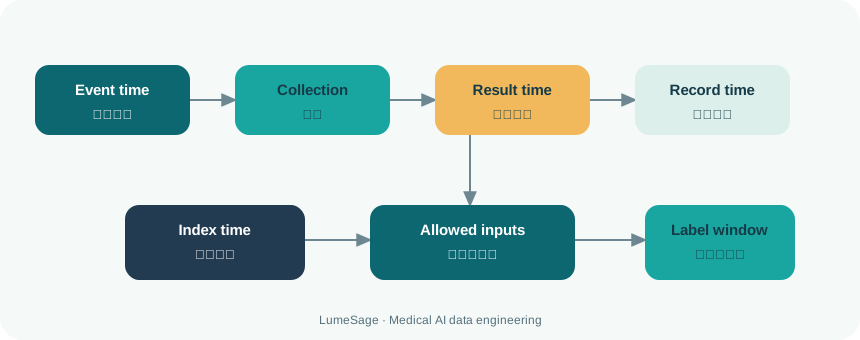
There are at least five kinds of "time" in clinical records
Hospitalization information appears to have a unified date, but is actually a mixture of many clocks. Test items include sampling time, laboratory reception time, analysis completion time and report review time; images include appointment, scanning, reconstruction, and report issuance time; disease process documents include event occurrence time, doctor entry time, review time, and supplementary entry time; diagnosis includes initial proposal, correction, confirmation, and discharge summary time. If you only keep a timestamp, you will confuse "when it happened" and "when the model can see it" into the same thing.
The prediction task needs to first define the index time point, such as emergency triage, hospitalization, return of a certain test result, or preoperative evaluation. The model can only use data that is actually available before that point in time. If the inspection samples are taken in the morning and the results are released in the afternoon, and the task is to predict at noon, the result values correspond to the morning samples but are not yet available. If the model uses this result, the evaluation introduces future information. Conversely, when studying physiological processes in disease, sampling time may be more appropriate than reporting time to describe the biological state. Both types of time are important, but serve different purposes.
The data dictionary should name the time fields as event_time, collection_time, result_time, authored_time, signed_time, ingestion_time, etc., and clarify the time zone, accuracy, source system, whether it is estimated and the reason for missing. The original time should be retained; the standardized time should be saved and the conversion rules should be recorded. The accuracy should not be falsified when there are only dates without time and minutes, document replacement, cross-day hospitalization, or daylight saving time conversion. For events that cannot be sorted, it is more scientific to save time intervals or uncertain order flags than to forcibly arrange them.
Use event graphs to connect time, evidence and clinical objects
The flat table is convenient for statistics, but it is difficult to express "who did what when and based on what". The longitudinal event graph can build patients, visits, events, documents, examinations, indicators, diagnoses and treatments into nodes respectively, and connect them with relationships such as "occurred in", "recorded in", "results from", "referenced from", "revised from", and "belongs to the same examination". Each edge can not only represent a clinical relationship, but also record the source system, matching rules, time difference and review status. This allows the algorithm team to query: In which document before discharge did a certain discharge diagnosis first appear? When is a test value visible to clinical personnel? Which DICOM Study does the report describe?
For example, a laboratory indicator should not just be a patient ID plus a value. A more complete record would include test items, collection time, reporting time, values, units, reference ranges, abnormal flags, specimen type, result status, laboratory source, and original reporting location. Repeated testing of this indicator on the same patient will form multiple ordered events instead of covering each other. The images also need to be connected to the examination date, scan site, modality, contrast agent information, series and report; when the disease course record cites an examination, the reference basis and time interval should be retained as much as possible.
Event graph does not mean training a graph neural network for every task. It is first and foremost a representation of the data engineering layer that enables different research tasks to generate inputs from stable event fact tables and relational tables. Classification tasks can intercept the nearest window based on index points; risk prediction can construct event sequences; retrieval enhancement systems can only fetch relevant documents before a certain point in time; multi-modal models can group texts, structured values, and images that are close in time and semantically corresponding. Only when the underlying relationships and time rules are consistent can horizontal comparison of models be facilitated.
Time alignment is not a simple nearest neighbor pairing
Pairing tests, disease processes, and images by most recent timestamp is a common but dangerous simplification. Course notes may summarize data from the previous few hours; examination reports are released late; one clinical event may be referenced by multiple documents; some time fields are automatically generated by the system. If you use a fixed time window to find the "most recent report", you must first determine whether the target is the same clinical episode, the same examination, the same problem, or just the same time period. Temporal proximity does not mean semantic consistency, and semantic similarity does not mean causality.
A more robust alignment requires a combination of multiple pieces of evidence: patient and visit keys, test or order identifiers, modality and site, document references, time windows, and human review. The system should save multiple candidate matches and their confidence levels, rather than giving a seemingly certain unique result for each field. For multiple images of the same patient, pre- and post-operative examinations or pathological specimens, dates and body parts can eliminate some errors, but technical correlations such as Study UID and clinical context are also required. Cross-source contradictions should form an exception queue and be handled by someone familiar with the semantics of the data.
Absence also has temporal implications. If a certain test has not been performed, it may be due to clinical judgment that it is not needed; if the test has been performed but the report has not been returned, it indicates right censoring; if the data interface is not collected, it is a technical deficiency; if the records cannot be associated, it is a link failure. Combining these conditions into the same null value would cause the model to mistake hospital processes or data interface patterns for disease signals. It is recommended to add state enumeration, observation window and missing reason, and test whether the model is stable after the missing mode is changed during training.
How models use longitudinal multimodal information
Common longitudinal modeling methods start from three aspects: time interval, event sequence and modal joint representation. Structured sequence models can represent tests and vital signs as events at irregular time points and explicitly encode the time difference from the index time point; text encoders can handle course and radiology reports; image encoders can handle slices, volumes, or key views. The fusion strategy can be spliced at the input layer, aligned representation at the intermediate layer, or different modalities can be modeled separately and then fused at the decision-making layer. Which one to choose depends on the quality of the data pairing, the proportion of missingness, the target task, and the modalities available at the time of deployment.
The PULSE framework study published in Nature Computational Science in 2026 organized structured laboratory data with clinical text into four-hour windows to compare multimodal time series with unimodal protocols in two retrospective ICU cohorts. The value of this type of study is to demonstrate how temporal alignment and cross-modal complementarity can be systematically modeled; its AUROC and cohort results are in a paper setting and cannot be directly extrapolated to other hospitals, diseases, or real workflows. When reading model results, also check index definitions, sample exclusions, patient segmentation, age of data collection, external validation, and calibration.
The conversational multi-modal model needs to further distinguish between "the time mentioned in the conversation" and "the collection time of the attachment itself". The patient's statement that "they had a CT scan last week" does not mean that the current session is actually associated with that examination; the model should not treat the imaging report as the image itself. Each modal should have identifiable source tags, time, permissions, and missing descriptions. If the model infers image content from text, the evaluation must make it clear that it is doing text inference, not visual diagnosis. Medical algorithm engineering must report representation capabilities separately from actual sources of evidence.
Preventing time leakage: from data extraction to evaluation division
Time leakage can occur in any link of SQL, data warehouse, feature engineering, label construction and segmentation. Typical scenarios include using discharge diagnoses to predict outcomes on admission; using information in the final summary of the disease course to predict earlier risks; treating reported audit values as if they were immediately visible as samples; grouping multiple visits for the same patient into different sets before segmenting the patients; and applying standardized statistics calculated over future time periods to past data. High performance does not prove the task is correct, and be especially wary of shortcut learning caused by process fields or label surrogate variables.
A practical and executable line of defense is to save index_time and prediction_horizon for each sample, and enforce available time constraints when constructing features: input events must not be available later than the index point, and label events must be within a pre-specified observation window. Feature extraction and label generation are versioned, and a leak diagnostic report is produced listing input fields that overlap with label time, events outside the prediction window, and features from discharge summaries. Developers should do "truncated stress testing": gradually shorten the visible time window to observe whether the model can still use reasonable precursor signals instead of relying on terminal information.
The segmentation strategy should at least be based on patient units, and longitudinal prediction should also consider time extrapolation and institutional extrapolation. A time-segmented internal test set can be established, and then an independent institution can be selected for external verification; cases with multiple visits, continuous imaging, and slices must be kept in the same patient group. If data comes from multiple sites, report leave-one-site-out or results stratified by site, but make sure label definitions and device differences are transparent. External validation looks not only at discrimination, but also at calibration, sensitivity at clinical thresholds, subgroup differences, and failure modes.
Turn procurement requirements into measurable temporal-quality checks
attachment clearly requires the supplementary inspection collection and reporting time, the supplementary inspection time, and the inspection report, disease course reference and DICOM catalog date should be compared during acceptance. To implement such requirements, each type of time relationship can be defined as a checkable invariant: the reporting time should not be unexplainably earlier than the acquisition time; the examination cited in the document should be found within the same patient visit; the DICOM examination date should be within an acceptable range with the imaging report; the order of admission, discharge, and hospitalization documents should be reasonable. Exceptions should not be rejected uniformly, but can be classified according to data source, exception scenarios and allowable errors.
It is recommended to select different departments, different time spans, pre- and post-operative sequences, delayed reports and supplementary documents in the acceptance sample. In addition to statistical pass rates, misalignment types, time difference distributions, proportions where the order cannot be determined, and manual review conclusions should also be listed. For "revised diagnosis/supplementary diagnosis", check whether the recording time, revision time and diagnosis status of the original text are retained; the final diagnosis cannot cover the early diagnosis. For severe and long-hospital cases, especially check whether the interdisciplinary consultation and ICU time periods are complete, because complex trajectories are most likely to expose interface alignment errors. Indicators such as the number of hospitalization days, number of consultations, and number of historical visits
In the requirements document are suitable for defining population screening and acceptance fields; they themselves are not equivalent to perfect labels for clinical complexity. The length of stay may be affected by bed availability, transfer and social factors, and the number of consultations is affected by hospital procedures. The project should retain the indicator calculation caliber, data source and statistical time range, and avoid claiming that "meeting multiple thresholds" is a standardized disease severity. In model studies, these indicators can be used for stratification or sampling, but their relationship with the target outcome should be verified separately.
Deliverables for reproducible research
In addition to the data itself, a time-reliable delivery package also requires a time field dictionary, time zone and precision rules, index event definitions, available time rules, label windows, event correlation logic, missing status encoding, quality statistics, and version records. Just handing in a table of "time column" fields doesn't allow another team to reproduce what the model saw when. When necessary, synthetic examples or test examples without patient information should be provided to illustrate how different sources map to a unified time model.
For the modeling side, it is recommended to use a small but difficult POC to verify the time semantics: randomly select the complete longitudinal trajectories of several patients, and verify the original text and time event by event; replay the model index time points according to the task definition; test late results, supplementary documentation, multiple inspections and missing situations; check whether the patient-level segmentation is truly isolated. Expanding the scale after the POC is passed can expose the structural problem of "fields exist but time is not available" in advance.
Langhui can participate in clinical data field sorting, patient and visit association, event time design, medical annotation and evaluation plan construction within the scope of authorization and project agreement. Specific data scale, institutional sources, indicators and deliverable scope must be confirmed by the contract and data card. For medical AI, a reliable timeline is not an add-on feature, but the infrastructure upon which task definition, data governance, and model evaluation all depend.
The management of timestamps also needs to consider the common "delay" and "backfilling" in clinical data. A record may enter the system hours after the event occurs, or a provisional conclusion may be entered and a formal report may be issued later. The data pipeline should differentiate between clinical time and system time, and determine the available time based on specific tasks: real-time alerts are usually defined by the point in time that is accessible to clinical personnel, and retrospective natural history studies may be defined by the point in time when an event occurs. The research protocol should be stated in advance to avoid incomparable conclusions drawn from the same data set due to different processing rules.
longitudinal samples also need to deal with the problem of different observation window lengths. Historical data before patients are admitted may be missing due to different starting points of institutional coverage, and follow-up after discharge may be truncated; these situations may cause inconsistencies in the number of events and observable time for different patients. It can record the time the patient entered the system, continuous insurance or medical treatment coverage, last observation time and censoring status, and then decide whether to set the shortest lookback window. For risk prediction, patients who are lost to follow-up before the end of the labeling window cannot simply be regarded as negative, and censoring needs to be handled according to the study design, and sensitivity analysis must be performed.
Verify time alignment using manual "timeline replay". For sampled patients, the reviewer will restore the data that can be seen at the time according to the original records, and then compare it with the model input generated by the program. The test covers asynchronous reports, supplementary registration documents, cross-day inspections, multiple similar inspections, transfers to departments and hospitals. Automated testing uses synthetic events to construct edge cases to ensure that late results do not enter early predictions, future diagnoses are not used as a priori features, and time zone transitions do not reverse the order. These tests should be rerun every time the rules are updated and the differences should be retained.
The timelines of different forecast tasks cannot be borrowed from each other. Warnings for hospitalization deterioration may use each hour after admission as multiple dynamic index points to predict the next 6 hours or 24 hours; readmission risk may use discharge time as an index and observe the follow-up window; interpretation of test results begins after the report is returned. Index events, prediction windows, observation windows and label determinations need to be specified independently for each task. If multiple tasks share a "patient timeline", event facts can be reused, but the feature view and label view must be versioned separately to prevent future events in one task from leaking to another task.
For time series models, the sampling frequency and resampling strategy must also be clarified. Clinical records were irregular, with some testing every hour and others only testing when their condition changed. Simple forward filling may mistake old values for the current state, and linear interpolation may introduce future values at the prediction time. The imputation should document the maximum allowed interval, whether future information is used, the missingness mask, and the original measurement time. The model should compare different imputation strategies with the original irregular event representation, reporting the sensitivity of the performance to changes in the strategy. For clinical data, the deletion itself may contain process information, but verification is required that it is not a shortcut caused by site or recording habits.
method boundaries and data sources
This article summarizes the key points of data engineering and cohort design based on the medical data fields and repurchase requirement documents provided by users, and discusses it in conjunction with public peer-reviewed research, technical standards, and regulatory/reporting guidelines. The fields, filter thresholds, and quantities in the attachment are examples of requirement specifications and do not prove that the data has been procured, delivered, or has passed model validation. The algorithms and processes in this article are used for scientific research and engineering design discussions and do not constitute medical diagnosis or treatment recommendations. Specific projects are subject to authorizations, data cards, contracts, and ethics/compliance reviews.
References and Technical Standards
- Longitudinal alignments and syntheses of multimodal clinical data for personalized medicine with the PULSE framework, Nature Computational Science (2026)
- EHR extraction and dynamic prediction data preparation: temporal leakage from improper time filtering and table joins, Journal of Medical Internet Research (2025)
- TRIPOD+AI statement: updated guidance for reporting clinical prediction models that use regression or machine learning methods, BMJ (2024)
- External validation of clinical prediction models: principles and methods, BMJ (2024)